TL;DR: Apæron, a new Swedish synth company, is crashing the gates of Superbooth 2026 with AFOUR — a desktop polyphonic synthesizer packing 44 knobs, 27 velocity-sensitive keys, and a generous LED display. Details on whether it’s analog or digital are still under wraps, but the sheer knob count and multitimbral promise have us reaching for our coffee mugs.
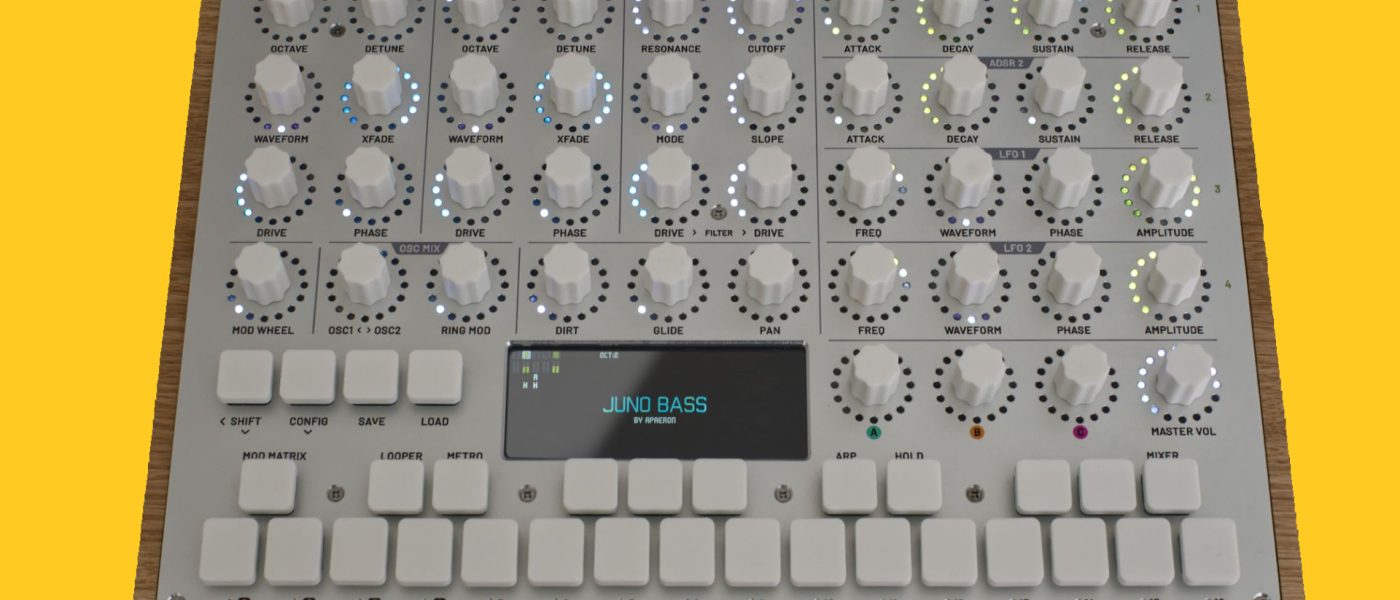
- AFOUR is an A4-sized desktop polysynth with 44 knobs, each sporting an LED ring, plus a large LED display for visual feedback.
- It features 4 channels (likely multitimbral), multi-wave oscillators with crossfade and drive, a multimode filter, two ADSR envelopes, and two LFOs.
- Built-in arpeggiator and looper add performance flexibility; synthesis method (analog vs. digital) remains unconfirmed.
- Apæron will debut at Superbooth 2026 in Malmö, Sweden, at booth B059; price and availability are TBA.
Reading time: 4 min
Want more synth news before your next coffee break? Join the Noxal newsletter — no spam, just gear worth knowing about.

Meet the Apæron AFOUR

Every year, Superbooth gives birth to a handful of synths that make us drop our espressos. This year, the AFOUR from Apæron — a brand-new company based in Malmö, Sweden — is that synth. It’s an A4-sized desktop polyphonic synthesizer with a staggering 44 knobs and 27 velocity-sensitive keys. That’s a lot of knob per square centimetre, and we at Noxal approve.
The AFOUR is clearly designed for hands-on immediacy. Each knob has its own LED ring, and a large central LED display gives you visual feedback for parameters. The interface suggests a dual-oscillator architecture with multi-wave oscillators featuring crossfade and drive controls. There’s also a multimode filter with cutoff, resonance, and pre/post-filter drive — because who doesn’t love driving a filter until it screams?
Knobs, LEDs, and the Interface Arms Race
The AFOUR’s claim to fame is its control density. With 44 knobs, it rivals the likes of the Moog Subsequent 37 or the Dreadbox Nymphes in terms of immediate parameter access. I’ve spent too many hours menu-diving on synths that promise depth but deliver a headache. The AFOUR looks like it was designed by someone who actually wants to twist knobs, not scroll through submenus.
But let’s address the elephant in the room: the enclosure. The source mentions a wooden enclosure, and I’ll be blunt — that’s a misstep. Wood looks retro in the worst way, like a synth that escaped from a 1970s living room. We at Noxal prefer our gear all metal, with the kind of industrial heft that says “I mean business.” If Apæron wants to win over the discerning synth crowd, they’d do well to offer an optional metal panel. Or at least a brushed aluminium faceplate. Please.
Synthesis Secrets and Market Musings
The biggest question mark is whether the AFOUR uses analog or digital synthesis. The website is coy, mentioning only “4 channels” (suggesting 4-voice multitimbrality) and a modulation matrix. The oscillator section has multi-wave options with crossfade and drive, but that could be either analog VCOs or digital wavetables. I’m leaning toward digital — the LED display and knob rings hint at a digital brain — but time will tell.
From a market perspective, the AFOUR enters a crowded field of desktop polysynths. The Dreadbox Nymphes (analog, 6-voice) and the Modal Cobalt 8 (digital, 8-voice) are strong competitors at similar price points. If Apæron can nail the user experience and price it competitively — say, under €1000 — they might have a winner. The reality is that most synths sound similar these days; it’s the interface that makes or breaks the experience.
Who Is This For?
The AFOUR is for the knob-twiddler, the performer who wants to sculpt sounds without looking at a computer screen. It’s for the studio rat who has a soft spot for LED rings and big displays. It’s also for the Superbooth attendee who wants to be the first on their block to own a synth from a mysterious Swedish startup.
That said, if you’re a purist who insists on analog-only signal paths, you might want to wait for confirmation. If you’re someone who hates wooden enclosures (hello, me), you might want to petition Apæron for a metal option. But if you’re open to a hybrid or digital synth with a killer interface, the AFOUR is worth keeping on your radar.
Frequently Asked Questions
What is the Apæron AFOUR?
The AFOUR is a desktop polyphonic synthesizer from Swedish startup Apæron, featuring 44 knobs, 27 velocity-sensitive keys, a large LED display, and multitimbral capabilities. It will debut at Superbooth 2026.
Is the AFOUR analog or digital?
Apæron has not confirmed the synthesis method. The interface suggests digital control (LED rings, display), but the signal path could be analog or digital. We’ll know more after the Superbooth reveal.
When will the AFOUR be available and how much will it cost?
Price and availability are TBA. Apæron will showcase the AFOUR at Superbooth 2026 (booth B059) from May 7-9, 2026, so expect announcements then.
We at Noxal will be watching Superbooth 2026 like hawks, coffee in hand, ready to decide if the AFOUR is worth the hype — or just another pretty face with a wooden case.