
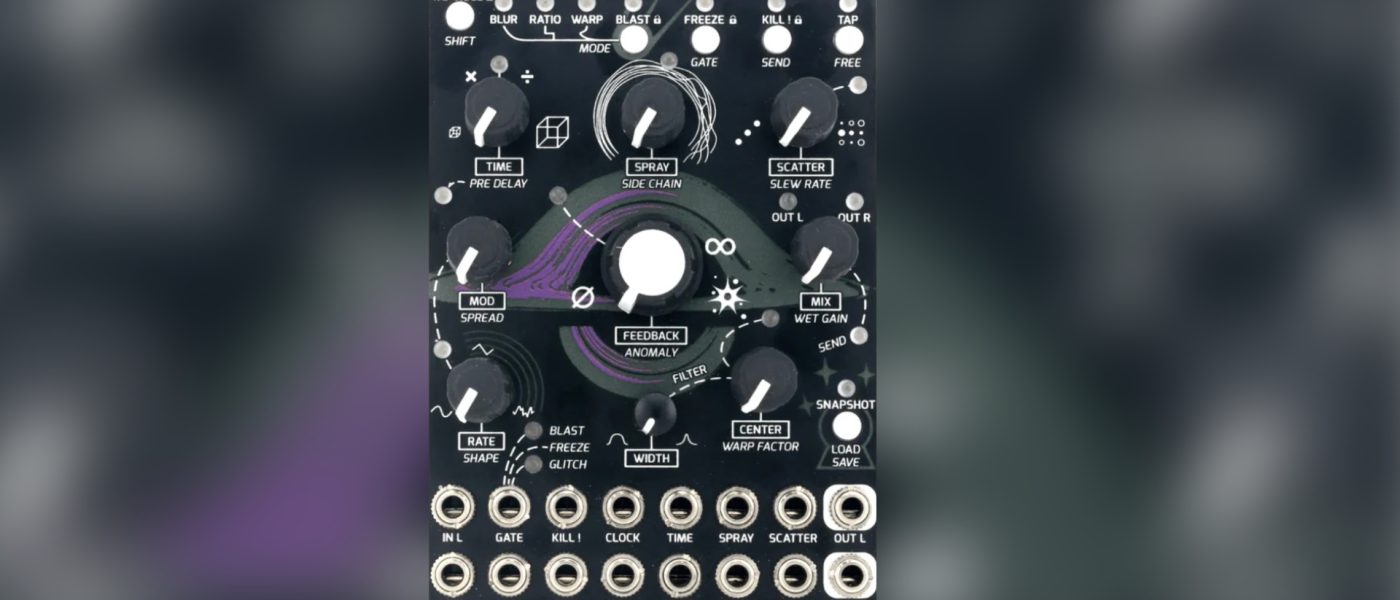
TL;DR: WMD, in collaboration with Infrasonic Audio, has officially opened pre-orders for the Cosmic Debris, a performance-oriented delay and reverb powerhouse module first announced at Knobcon 2025. At its core is a new engine with 16 interactive delay lines that can be morphed into lush reverbs and chaotic textures. Priced at $549, it’s now in production and heading to racks soon.
- Cosmic Debris is a collaborative Eurorack module from WMD and Infrasonic Audio, born from Denver’s modular community.
- Its engine features 16 interactive delay lines with parameters like Spray (for reverb) and Scatter (for feedback chaos).
- Key performance features include a Freeze function, a CV-modulatable band-pass filter, and a multi-mode gate input for Blast, Freeze, and Glitch triggers.
- It offers stereo I/O, extensive CV control, and a send/return mode for flexible signal routing.
- Pre-orders are live at $549, with the module now in production after a year of development.
Reading time: 5 min
Want more synth news before your next coffee break? Join the Noxal newsletter — no spam, just gear worth knowing about.

A Community Collaboration Comes to Life

In an industry often romanticized for its solitary tinkerers, the best stories frequently emerge from the community. The WMD Cosmic Debris is a textbook example. This isn’t a corporate R&D project; it’s a module forged in the crucible of Denver’s monthly Freq Boutique gatherings. Nick Donaldson of Infrasonic Audio (the mind behind the Warp Core module) had a design. He took it to WMD, ostensibly for manufacturing advice. But as soon as the WMD team heard what he was cooking up, the conversation shifted from consultancy to collaboration. What started as a friendly tip evolved into a joint mission to refine, expand, and solidify a unique sonic vision.
We at Noxal have a soft spot for these narratives. They remind us that the Eurorack ecosystem, for all its wires and voltages, is fundamentally powered by human connections. The official line says the process was “as rewarding as the results,” and having seen a few of these journeys up close, I believe it. The Cosmic Debris is the tangible output of that shared enthusiasm—a delay-reverb processor that carries the fingerprints of both a passionate designer and a seasoned manufacturer known for robust, performative gear. It’s a proper collaboration, not just a licensing deal.
Beyond Delay: Sixteen Lines to Texture
Let’s talk tech, because the specs are where the “powerhouse” label earns its keep. At the heart of the Cosmic Debris is a newly developed engine built around 16 interactive delay lines. You get the expected controls: time, rate, feedback, pre-delay. You can sync it to a clock, tap in a tempo, or let it run free. This is the foundation. Then, Cosmic Debris starts showing its true colors.
The magic begins with two key parameters: Spray and Scatter. The Spray knob is your gateway to ambience, transforming the discrete delay taps into a lush, continuous reverb tail. It’s not a separate algorithm tacked on; it’s an emergent property of the delay network. Right next to it, Scatter does something more mischievous, reshaping the feedback paths and interactions between the 16 lines. This is where ordered echoes break down into evolving, chaotic textures—a twist of the knob away from clarity into beautiful mayhem. Further modulation is injected via a dedicated Time Modulation control, offering everything from subtle analog-style wow and flutter to radical, randomized pitch fluctuations.
Performance at the Forefront
WMD has always designed with the player in mind, and Cosmic Debris is packed with features that beg for real-time manipulation. A dedicated Freeze function captures audio into a timeless loop, letting you hold a texture indefinitely—a staple for ambient builders. The built-in band-pass filter isn’t just for tone-shaping; it’s CV-addressable, allowing you to sweep space into the mix dynamically.
The connectivity is thoughtfully comprehensive: stereo I/O on 3.5mm jacks and CV control over most parameters. But the star of the interface might be the multi-mode gate input. It offers three distinct triggers: Blast (for a momentary input boost and 100% send level), Freeze, and the intriguingly named Glitch (details on which are still tantalizingly sparse). Furthermore, a send mode re-tasks the mix control into a CV-controllable send/return level, making this module a fantastic candidate for processing other voices on your bus. This isn’t a set-and-forget effect; it’s an instrument in its own right.
Who Is This For, and What’s Next?
So, who is the Cosmic Debris for? It’s for the modular explorer who looks at a standard digital delay and thinks, “That’s not nearly enough.” It’s for the performer who wants to travel from crisp rhythmic echoes to smeared, pitch-shifted soundscapes without patching half their rack. It’s for the sound designer seeking a single, deep source of modulation-rich spatial effects. With a pre-order price of $549, it sits in the upper-mid range, asking for a serious commitment from those who value texture and hands-on control over simplicity.
The module is now officially in production, and pre-orders are open. While we’ve seen a promising sound snippet, the full depth—particularly of the Blur, Ratio, Warp modes, and that Glitch function—awaits deeper demos. In a market dense with delays, Cosmic Debris distinguishes itself through its collaborative origin, its textural ambition, and its clear design for live manipulation. It feels less like an effect module and more like a chaotic, beautiful ecosystem in a 26HP package.
Frequently Asked Questions
What is the core technology inside the WMD Cosmic Debris?
The Cosmic Debris is built around a newly developed engine that utilizes 16 interactive delay lines. This network forms the basis for both its delay and reverb effects, with parameters like Spray and Scatter morphing the behavior of these lines to create everything from clear echoes to dense, evolving textures.
How does the “Spray” parameter create reverb?
The Spray knob doesn’t switch to a separate reverb algorithm. Instead, it manipulates the 16 delay lines to increase their density and interaction, effectively blurring the discrete echoes into a continuous, lush reverberant tail. It’s a reverb that emerges organically from the delay structure.
What are the practical uses for the multi-mode gate input?
The gate input offers three performance-focused triggers. “Blast” injects a momentary audio burst and maxes out the send level for explosive effects. “Freeze” captures and holds the current audio buffer. “Glitch” is the mystery function—its exact behavior is yet to be detailed, but it promises instant, performative disruption.
Now, if you’ll excuse me, I need to re-caffeinate and ponder whether my current delay module feels suddenly inadequate. The coffee, at least, is a constant.