
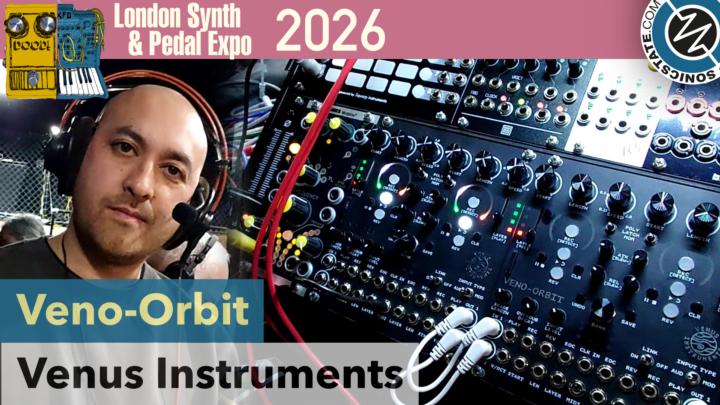
TL;DR: Venus Instruments has unveiled a significant firmware update for its Veno-Orbit dual-channel sampler at LSPXPO 2026. The update introduces smooth overdubbing, an undo/redo function, and an output limiter, refining an already versatile hardware sampler that handles audio, CV, and granular textures. Priced at £529, the unit remains a compelling option for hands-on sample manipulation.
- New firmware adds smooth overdubbing, undo/redo, and an output limiter to the Veno-Orbit.
- It’s a dual-channel polyphonic sampler capable of audio/CV sampling with four layers per channel.
- Functions range from loop creation and granular processing to acting as a polyphonic oscillator.
- Storage is handled via SD card with support for up to 64 sample bank slots.
- The hardware is currently in production and available for £529.
Reading time: 4 min
Want more synth news before your next coffee break? Join the Noxal newsletter — no spam, just gear worth knowing about.
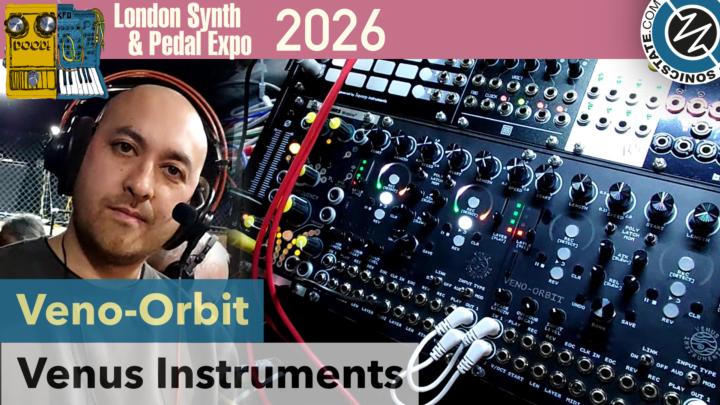
What Is the Veno-Orbit?

Let’s cut through the trade show haze. The Venus Instruments Veno-Orbit, which landed last October, is not just another sampler in a crowded field. It’s a deliberately designed, dual-channel polyphonic sampler built for tactile exploration. We at Noxal have a soft spot for gear that chooses a specific lane and drives it with purpose, and the Veno-Orbit’s lane is flexible, layer-based sample manipulation. It sidesteps the menu-diving of a modern workstation or the austerity of a classic drum machine, instead offering a playground for audio and CV.
The core concept is powerful in its simplicity: two independent channels, each capable of hosting up to four sample layers. This architecture immediately opens doors to stereo field experimentation, dual mono processing, or complex, evolving textures built from stacked sounds. It can be your loop station, your ambient bed generator, your granular mangler, or—interestingly—a polyphonic oscillator source for your modular or synth rig. This isn’t a device that does one thing perfectly; it’s a device that does several things very well, provided you enjoy getting your hands dirty with sound.
The Firmware Facelift
The news from LSPXPO 2026 isn’t a new hardware revision, but something often more valuable: a thoughtful firmware update that addresses real workflow pain points. The three headline features—smooth overdubbing, undo/redo, and an output limiter—are the kind of additions that transform a promising instrument into a reliable studio workhorse. Smooth overdubbing is a gift for live performers and improvisational composers, allowing for seamless sound-on-sound building without jarring cuts. It turns the sampler into a canvas, not just a recorder.
Meanwhile, the undo/redo function is a simple luxury we shouldn’t have to celebrate, but in the hardware world, it’s a rare and beautiful thing. It encourages experimentation. Got a bit too aggressive with the granular stretch? Undo. That last overdub ruined the vibe? Redo. It removes the fear of “breaking” a good sequence. Finally, the output limiter is a small but crucial guardian of your speakers and downstream gear. In the heat of a session, when you’re layering four textures per channel, clipping is a real risk. This update shows Venus Instruments is listening to users, polishing the experience post-launch.
Specs, Storage, and Signal Flow
Beneath the new firmware beats a capable hardware heart. The dual-channel design supports both stereo and dual mono operation, offering flexibility in integration. MIDI compatibility ensures it can sit neatly in a DAW-driven setup or be sequenced from a hardware brain. The polyphonic playback is key here—this isn’t a monotimbral device. You can build chords and pads from your samples, or trigger multiple layers simultaneously for rich, composite sounds.
Storage is handled practically via SD card, a welcome sight for anyone tired of proprietary solutions or internal memory limits. Support for up to 64 sample bank slots means you can organize projects, kits, or sound libraries with ease. The four-layer depth per channel is the secret sauce, though. It allows for velocity switching, key zoning (within the sampler’s architecture), or simply stacking variations of a sound to create something entirely new. It’s a spec that promotes depth over breadth, which is a philosophy we can get behind.
Who Is This For?
So, who should be looking at the Veno-Orbit, especially with these updates? Firstly, the hardware-inclined sound designer. If you love sourcing unique field recordings, vinyl crackle, or synth bleeps and then warping them into playable instruments or atmospheric loops, this provides a dedicated, hands-on box for that very purpose. It’s a sketchpad for sound. Secondly, the live electronic performer. The smooth overdubbing and immediate control over two channels make it ideal for building and mutating soundscapes in real-time.
Finally, it’s for the modular or hardware synth enthusiast looking to integrate complex sample-based elements without going “in the box.” The ability to sample CV (control voltage) is a niche but powerful feature for modular users, allowing them to capture and re-trigger modulation sequences. At £529, it sits in a competitive space, but its unique blend of dual-channel flexibility, layering, and now-refined workflow makes a strong case for itself. It’s not trying to be an MPC or an Octatrack; it’s carving out its own Veno-Orbit-al path.
Frequently Asked Questions
Can the Veno-Orbit act as an audio interface or connect via USB audio?
Based on the available specifications, the Veno-Orbit does not appear to function as an audio interface. It uses an SD card for sample storage and transfer and features standard audio outputs (and likely inputs for sampling). Connectivity focuses on MIDI and direct audio/CV I/O for integration with other hardware.
What does “sampling CV” actually mean on this device?
Sampling CV means the Veno-Orbit can record a control voltage signal—like an LFO, envelope, or sequencer pattern from a modular synth—as an audio file. You can then play back this “CV sample,” effectively using the Veno-Orbit as a complex modulation source or sequencer for your modular system, which is a brilliantly creative feature.
Is the sample editing (trimming, normalizing, etc.) done on the device or on a computer?
The core manipulation—like granular processing, layering, and looping—happens on the device. However, for fundamental sample editing like trimming start/end points or normalizing levels, you will likely need to prepare your samples on a computer before loading them onto the SD card. The Veno-Orbit is designed for performance and texture manipulation rather than detailed sample surgery.
Now, if you’ll excuse me, the promise of smooth overdubbing has inspired me to finally sample my espresso machine’s gurgle and layer it into something resembling a pad. The limiter will hopefully save my monitors from the inevitable steam-vent climax.