
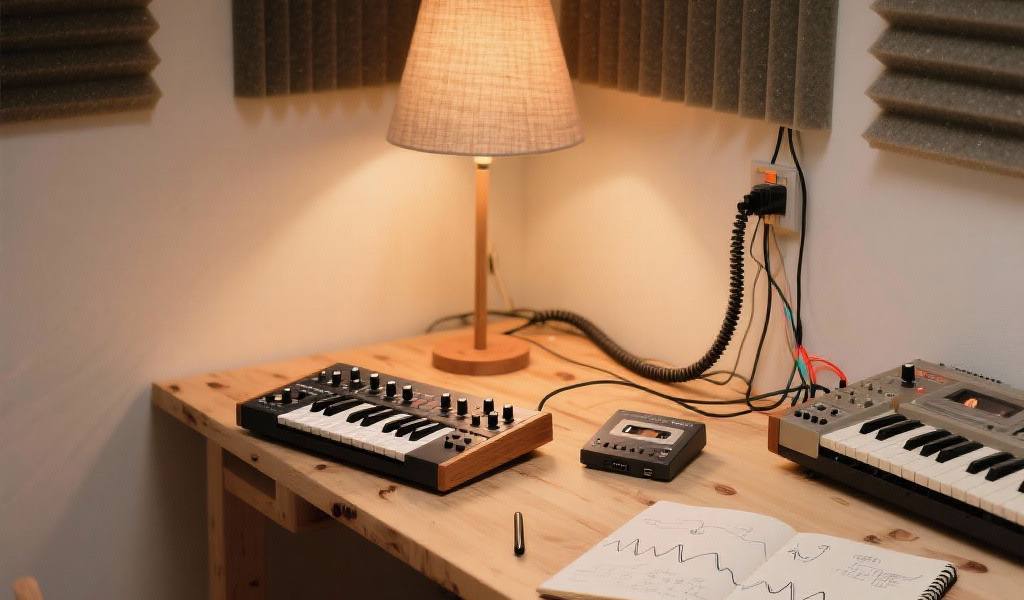
Summary: The pursuit of unique sounds in electronic music production drives innovation beyond traditional methods. This article explores unusual techniques such as field recordings, circuit bending, modular synthesis, and creative sampling, encouraging artists to embrace experimentation and find their own sonic identity while pushing the boundaries of sound.
Key Takeaways:
- Unconventional Sources: Field recordings and found sounds can transform everyday noises into impactful musical components.
- Circuit Bending: Rewiring toys and inexpensive electronics can yield exciting and unpredictable sonic results.
- Modular Synthesis: Break free from traditional signal paths to explore new sound textures and controls.
- Creative Sampling: Transcend simple looping by transforming samples into entirely new soundscapes.
- Software Sorcery: Use digital tools to manipulate sound in ways not possible with hardware alone.
Estimated Reading Time: 8 minutes
Call to Action: Join our newsletter to stay updated on the latest in electronic music production and sound exploration!
Table of Contents:
The Lure of the Unconventional: Unusual Ways to Make Electronic Sound in Music Production
In the vast landscape of sound design, the “unusual” isn’t merely a gimmick; it’s a philosophy, a commitment to pushing boundaries. From early pioneers of musique concrète to today’s avant-garde modular artists, compelling electronic music often emerges from methods that defy norms. Let’s explore some of these fascinating avenues.
Accidental Alchemy: The Power of Field Recordings & Found Sounds
Imagine a symphony crafted from the mundane – the creak of an old door, the distant hum of a city, the subtle rustle of leaves. Field recording transforms the world into an instrument, capturing transient sonic events and giving them new life in a musical context.
The genesis of this approach can be traced back to figures like Pierre Schaeffer, who pioneered *musique concrète* in the late 1940s, manipulating recorded sounds rather than traditional instruments. His groundbreaking work demonstrated that any sound could become musical material, radically embracing concrete sounds over abstract notation.
Today, this spirit thrives. Captivated by the rhythmic clanking of machinery and the resonance of empty warehouses one afternoon, I recorded these gritty sounds. Back in the studio, they evolved into a unique track, revealing their industrial character while becoming unrecognizable in a musical context.
Practical Takeaways:
- Start Simple: A smartphone can capture useful textures – focus on interesting acoustics.
- Process, Process, Process: Experiment with EQ, reverb, granular synthesis, and more.
- Layer and Blend: Combine field recordings with traditional synth sounds.
- Think Sonically, Not Literally: Capture the *character* of sounds, enhancing their essence.
The Thrill of the Hack: Circuit Bending & DIY Instruments
For many, the allure of synthesizers lies in their intricate circuitry. But what happens when you intentionally short-circuit connections or build instruments from scratch? This is the unpredictable world of circuit bending and DIY instruments, a truly unusual way to make electronic sound.
Reed Ghazala, the godfather of circuit bending, defined it as the creative short-circuiting of battery-powered devices to create new instruments. This rebellious art involves taking everyday objects and unlocking their sonic potential.
Some incredible circuit-bent creations abound, with legends of producers transforming old game consoles into unique sound palettes. The unpredictable nature of this art fosters sonic exploration and unique instrument textures, representing a spirit of creativity and experimentation.
Practical Takeaways:
- Start with Research & Safety: Begin with low-voltage toys, following safety practices while bending.
- Embrace the Unexpected: The “mistakes” in circuit bending often yield magic.
- Salvage & Experiment: Old electronics can be components or resonators for building instruments.
- Learn Basic Electronics: Understanding circuits allows for intentional design in sound creation.
Modular Madness: Unconventional Signal Paths & Control Voltage (CV)
When discussing synthesizers, modular synthesis stands as a playground for experimental sound design. Modular systems consist of individual modules connected with patch cables, offering immense freedom and complexity alongside the ability to abandon traditional signal paths.
My first modular experience felt overwhelming, but soon transformed into exhilaration. The idea of creating unique sounds rather than just playing them opens up endless possibilities.
Pioneers like Don Buchla explored complex timbres and self-modulating systems, while Suzanne Ciani showcased the Buchla system’s potential for organic soundscapes. Unusual CV usage, from LFOs to biometrics, unleashes creativity and unpredictability in sound design, encouraging exploration beyond standard methods.
Practical Takeaways:
- Beyond the Basics: Explore cross-modulation and audio-rate modulation techniques.
- Feedback Loops: Create chaotic patterns and drones by patching outputs back into inputs.
- Unusual CV Sources: Use random voltage generators and unconventional sensors to inject unpredictability.
- Embrace the “Happy Accident”: Exploration leads to unexpected, compelling sounds.
Creative Sampling & Audio Mutilation
Sampling transcends basic looping when extreme transformation occurs. Early hip-hop producers reshaped snippets into new grooves, yet it’s the *mutilative* approaches that intrigue. Artists like Aphex Twin treated samples as raw clay, pushing boundaries to create sonic deconstruction.
One transformative technique involves utilizing **granular synthesis**. Breaking sounds into tiny grains allows for unique manipulation, resulting in evolving textures and stuttering rhythms. A vocal syllable can become a 30-second pad while a drum hit may morph into metallic shards.
Practical Takeaways:
- Beyond the Loop: Reverse, pitch-shift, and time-stretch samples creatively.
- Resampling is Key: Process a sample repeatedly to create complex new textures.
- Spectral Processing: Manipulate frequencies for unique sound shapes.
- Creative Destructive Editing: Push samples to their limits for interesting impacts.
- Use Samples as Modulators: Create rhythmic effects by manipulating parameters with samples.
Software Sorcery: Algorithms, Generative Sound & Digital Synthesis
In the digital realm, sound creation boundaries dissolve. Software offers unprecedented control, facilitating methods impossible with hardware. Algorithmic composition and generative soundscapes enable deep personal creation.
Early pioneers used computers for complex score generation, while later artists leveraged environments like Max/MSP and Pure Data for customization. Encountering generative patches fosters a living soundscape, evolving melodies based on defined rules rather than loops.
Beyond coding, digital software opens avenues for sonic exploration. **Physical modeling synthesis** creates realistic sounds, while less common methods like wavetable and vector synthesis produce dynamic, animated tones.
Practical Takeaways:
- Explore Experimental VSTs: Look for unique plugins that stretch sound boundaries.
- Learn a Visual Programming Language: Engaging with Max/MSP or Pure Data enhances sound fundamentals.
- Dive into Less Common Synth Types: Experiment with FM, additive, and resynthesis tools.
- Automate Everything: Use LFOs and randomizers for evolving sound dynamics.
Noxal’s Perspective: Why Unconventional Sound Matters to Us
At Noxal, we believe that the pursuit of unusual sound in music production fuels creativity—it’s how genres evolve and how artists find their voice. We champion the curious innovators who challenge norms.
Through stories of sound exploration, from Schaeffer to Aphex Twin, we see that innovation often demands courage and a willingness to embrace unpredictability. These techniques illuminate sonic listening and enrich artistic expression.
The connection between musician and instrument is personal, forging a unique sonic signature. This pursuit of individuality defines Noxal’s editorial vision—to empower our community to explore their voice in the captivating realm of electronic sound.
Your Journey Beyond the Preset
We’ve traversed the realms of found sounds, circuit-bent wonders, modular synth chaos, extreme sampling, and digital techniques. These unusual paths unlock new sonic dimensions and infuse music with distinct character.
So, what are you waiting for? Grab a recorder, dust off that old toy, dive into a new plugin, or simply look at your existing gear with fresh eyes. Turn off the internet for an hour, ignore the manual, and just *experiment*. Let curiosity guide you, and don’t shy away from sounds that are weird or broken—often, that’s where the magic lies.
**Now, it’s your turn!** We at Noxal eagerly seek your sound adventures. Have you discovered an obscure technique? Do you have a favorite experimental artist? Or perhaps an accidental breakthrough in your studio? Share your stories in the comments below! Together, let’s build a vibrant community of sonic explorers.
**Stay curious, stay creative.** And remember to follow Noxal for more explorations into synthesizers, production, and electronic music culture. Find us on [Social Media Links] and explore more articles on our blog. Let’s make some noise!
And remember, in the world of synths: if your machine starts talking back, don’t panic – it’s just expressing its *synth-anxiety*.