
TL;DR: The legendary Buchla MARF, the Model 248t Multiple Arbitrary Function Generator, is finally shipping from Tiptop Audio in Eurorack format. Announced nearly a year ago, this “holy grail” module is now a reality, offering two channels of 16-stage programmable voltage and time control. It arrives alongside the newly available Model 230t Triple Envelope Follower, marking a significant expansion of the accessible Buchla 200 series.
- The Tiptop Audio Buchla Model 248t MARF is now shipping and available for purchase.
- It’s a 2×16-stage programmable function generator capable of complex sequencing, envelope generation, and voltage manipulation.
- Development was challenging, based on a 1977 manual and expert consultation due to a lack of a working original unit.
- The Model 230t Triple Envelope Follower, also announced last year, is now available, converting audio amplitude to CV and gates.
- These releases continue Tiptop’s mission to bring rare, historically significant Buchla 200-series designs to the Eurorack mainstream.
Reading time: 5 min
Want more synth news before your next coffee break? Join the Noxal newsletter — no spam, just gear worth knowing about.
The MARF Arrives

We at Noxal have a soft spot for announcements that graduate from “impressive prototype” to “actual product you can buy.” It’s a rarer transition than one might hope. So, it’s with genuine pleasure—and a slight sigh of relief—that we confirm the Tiptop Audio Buchla Model 248t, the Multiple Arbitrary Function Generator (MARF), is now shipping. The news broke alongside the availability of the Model 230t Triple Envelope Follower, another module teased at last year’s Superbooth. This isn’t just another utility module hitting the market; this is the culmination of a years-long project to resurrect one of the most conceptually profound instruments in synthesis history for the Eurorack format. The wait, it seems, is finally over.
The journey to this point has been public. The MARF prototype was the star of Tiptop’s Buchla booth at Superbooth 2024, a tantalizing glimpse of West Coast esoterica made tangible. The projected price range was $650-950; the final figure has settled near the top of that estimate, landing at $963 / €989. For a module of this complexity and historical weight, that price point feels almost reasonable. It’s a significant investment, but you’re not buying a simple LFO or VCA. You’re buying a piece of a philosophy, a system of thinking about control voltage that diverges radically from the East Coast norms that dominate our racks.
With the MARF now in the wild, Tiptop Audio’s Buchla 200 series reissue project feels like it’s reached a pivotal peak. They’ve brought back the foundational sound-shapers—the 258t oscillator, the 292t Lopass Gate—and now they’re delivering the brainiac control modules that define the system’s unique workflow. The 242t Programmable Pulser and the 264t Quad Sample & Hold/Polyphonic Adapter paved the way. The MARF is the main event.
What Is This Thing, Anyway?
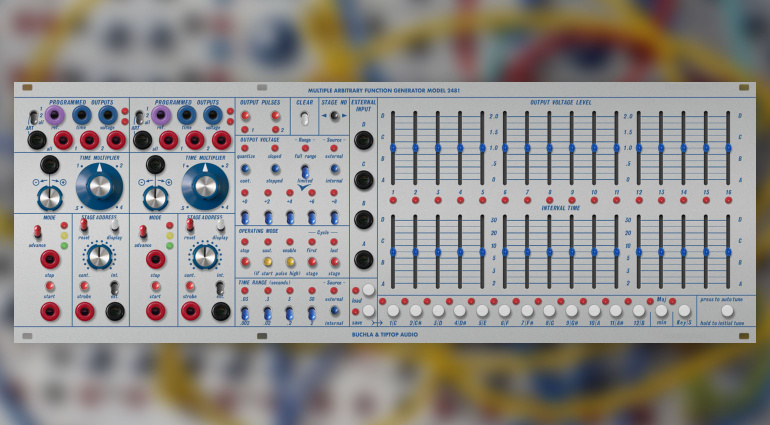
Let’s cut to the chase: what does a MARF actually do? Calling it a “complex envelope generator” is like calling a cathedral “a large room.” Technically true, but it misses the point entirely. The Model 248t is a dual-channel, 16-stage arbitrary function generator. Each channel has 16 steps. For each step, you independently set a voltage level and a time interval. This means you can draw incredibly detailed, non-linear voltage contours over time. It can be a bizarrely specific multi-stage envelope, a complex LFO with uneven waveshapes, or a 16-step sequencer where each step can have its own unique clock division.
This architecture unlocks a paradigm of control that is fundamentally different from a standard step sequencer. A typical sequencer advances one step per clock pulse, with each step holding a static voltage. The MARF treats time as a continuous, sculptable canvas within each step. The voltage moves from one step’s level to the next over the duration you set for that step. The result is voltage curves that can be glacial sweeps, sudden spikes, or rhythmic stutters—all within a single “sequence.” It blurs the line between sequencing and modulation, making it a source of organic, evolving control that feels more like conducting voltages than programming them.
In practice, this means patching a MARF is an exercise in exploratory thinking. You could use one channel to modulate the pitch of an oscillator in a non-linear, melodic-but-unpredictable way, while the other channel modulates the cutoff of a filter with a completely independent, non-synchronized contour. Or cross-modulate the two channels. Or use it as the master clock and complex rhythm generator for an entire patch via its trigger outputs. Its “arbitrary” nature is its superpower; it is, as the original manual suggested, “pretty much anything you want it to be.”
The Archaeological Dig

One of the most fascinating aspects of this release is how it was made. Tiptop Audio has been admirably transparent about the challenge. They couldn’t find a functioning original Model 248 to reverse-engineer. These modules are museum pieces, ghosts of a rare and expensive system. So, they had to become synthesis archaeologists. Their primary source material was Don Buchla’s original 22-page manual from 1977—a document presumably full of circuit diagrams, philosophical musings, and the kind of technical prose that requires several cups of coffee to decipher.
They didn’t work in a vacuum. To fill in the gaps and understand the musical intent, they consulted with authorities like synthesist and Buchla expert Todd Barton and engineer Kyle Swisher. This process is as much about cultural translation as it is about electrical engineering. It’s about understanding why Buchla designed it this way, what problems he was trying to solve, and what musical behaviors he valued. The result isn’t just a clone; it’s a thoughtful reconstruction for a new generation and format, maintaining the original’s spirit while ensuring it can be reliably manufactured and sit happily in a modern Eurorack case.
This context makes the module more compelling. You’re not just buying a cool sequencer; you’re buying a piece of meticulously researched history, a direct link to the mind of Don Buchla. The MARF represents a pinnacle of his alternative approach to instrument design, where control structures were as innovative and complex as the sound generators themselves. Tiptop’s achievement is in making this obscure masterpiece accessible, without (one assumes) needing a second mortgage to afford an original 200-series cabinet.
Who Is This For?
Let’s be practical. The Tiptop Audio Buchla 248t is not a beginner’s module. If you’re still figuring out the difference between a gate and a trigger, this will likely overwhelm you. It’s a deep, conceptual tool for synthesists who feel constrained by traditional ADSR envelopes and 16-step grids. It’s for the patcher who looks at a complex modulation source and sees not confusion, but possibility. It’s for the composer interested in generative, evolving structures, and for the sound designer needing hyper-specific, drawn voltage contours that standard tools can’t produce.
It’s also, undoubtedly, for the Buchla curious. The Eurorack format has democratized access to West Coast synthesis concepts, and the MARF is perhaps the ultimate expression of that philosophy in a single module. For anyone who has built a “Buchla-influenced” rack with function generators and low-pass gates, the 248t is the authentic, historic centerpiece they’ve been waiting for. It completes the system conceptually, providing the kind of sophisticated control that the 258t and 292t voices crave.
Finally, it’s for the collector of unique musical ideas. In a market saturated with variations on a theme, the MARF stands apart. It doesn’t sound like anything. It makes other things sound like nothing else. Its value is in the unique pathways it opens in your patching and thinking. If your studio ritual involves seeking out instruments that force you to work differently, that challenge your assumptions about sequencing and modulation, then the MARF, now finally a real product on a dealer’s shelf, is calling your name. Just be prepared to spend some serious time with its 16 stages. And maybe brew a strong pot of coffee first.
Frequently Asked Questions
Is the Tiptop Audio 248t a true replica of the original Buchla MARF?
It is a faithful functional reproduction based on the original 1977 schematics and manual, developed with input from Buchla experts. Since a working original was unavailable for direct cloning, Tiptop focused on capturing the musical functionality and behavior of the MARF for the Eurorack format, making necessary adaptations for modern manufacturing and reliability.
What is the main difference between the MARF and a regular sequencer?
A standard sequencer typically outputs a static voltage per step for a fixed, clock-divided duration. The MARF allows you to set both a target voltage and a specific time interval for each of its 16 steps per channel. This lets you create continuous, sculpted voltage curves within the sequence, blurring the lines between step sequencing, complex envelope generation, and arbitrary waveform creation.
Can the MARF be used as a standard clocked sequencer?
Yes, absolutely. While its power lies in arbitrary timing, it can easily function as a phenomenal standard 16-step sequencer. You can set equal time intervals for each step and use the voltage controls to create a melodic sequence. Its dual channels mean you can run two independent sequences, or use one for pitch and the other for modulation, with a level of stage-by-stage timing control no typical sequencer can match.
Now, if you’ll excuse me, I need to clear an 84HP space in my case and explain to my bank account that it’s for a historical research project. The coffee pot is on standby for the first deep-dive manual reading session.