I’ve always been captivated by the idea that a piece of circuitry, a collection of oscillators and filters, could single-handedly redraw the map of music. It’s not just about adding a new sound; it’s about creating an entirely new sonic language, giving birth to cultures and communities around specific frequencies and textures. Today, we’re embarking on a journey through music history, exploring how synths shaped entire genres in music production. From the mechanical heartbeats of early electronica to the hypnotic grooves of techno, the synthesizer hasn’t just been a tool; it’s been the very architect of sound.
So grab your favorite coffee, maybe put on a classic album with a fresh pair of ears, and let’s delve into the incredible impact of these electronic marvels.
Brief Summary
Key Takeaways
- The synthesizer is not just an instrument; it’s an integral part of genre creation and cultural movements.
- Embraces limitations in sound design can lead to innovation and unique musical identities.
- Understanding historical contexts of synthesizer use helps modern producers create compelling electronic music.
- Hybrid approaches in music production can blend vintage and modern sonic qualities.
- Every synthesizer has a story that adds depth to the creative process.
Estimated Reading Time
Table of Contents
- The Sonic Alchemists: How Synths Shaped Entire Genres in Music Production
- The Krautrock & Early Electronica Genesis: Forging New Realities (1970s)
- The Synth-Pop & New Wave Explosion: Melodies of the Future (Late 70s – 80s)
- The House & Techno Revolution: Rhythms of the Underground (Mid-80s – 90s)
- The Digital Frontier & IDM/Ambient Explorations: Precision and Texture (90s – 2000s)
- The Modern Revival & Hybrid Approaches: Blending the Best (2000s – Present)
- A Producer’s Perspective: More Than Just Instruments
- The Enduring Legacy of the Sonic Shifters
- FAQ Section
The Sonic Alchemists: How Synths Shaped Entire Genres in Music Production
1. The Krautrock & Early Electronica Genesis: Forging New Realities (1970s)
I remember the first time I truly listened to Kraftwerk’s Autobahn. It wasn’t just music; it was a journey, a mechanical ballet of sound. The long, evolving sequences, the precise, almost robotic rhythms – this was a radical departure from the rock and pop of the era. They utilized early modular synths like the Moog Modular and ARP 2500/2600, alongside custom-built vocoders and sequencers, to create sounds that felt both futuristic and deeply reflective of a post-industrial society.
How Synths Defined It:
- Repetitive, Motorik Rhythms: Synths and drum machines allowed for perfectly quantized, driving, repetitive beats that human drummers struggled to maintain with such relentless precision. This “motorik” beat became a cornerstone of Krautrock.
- Evolving Textures & Soundscapes: Unlike traditional instruments with fixed timbres, synthesizers offered endless possibilities for sound design. Long, sustained pads and filters slowly sweeping open or closed created immersive, atmospheric soundscapes that pulled listeners into a new world.
- Dehumanization & Modernity: The cold, often detached sound of early electronic instruments perfectly encapsulated themes of technology, urbanisation, and the future, which were central to the genre’s ethos.
For producers today, this era teaches us the power of embracing a limited palette to create a distinct identity. The early pioneers didn’t have infinite options; they squeezed every drop of sonic potential out of their machines, demonstrating that innovation often thrives within constraints.
2. The Synth-Pop & New Wave Explosion: Melodies of the Future (Late 70s – 80s)
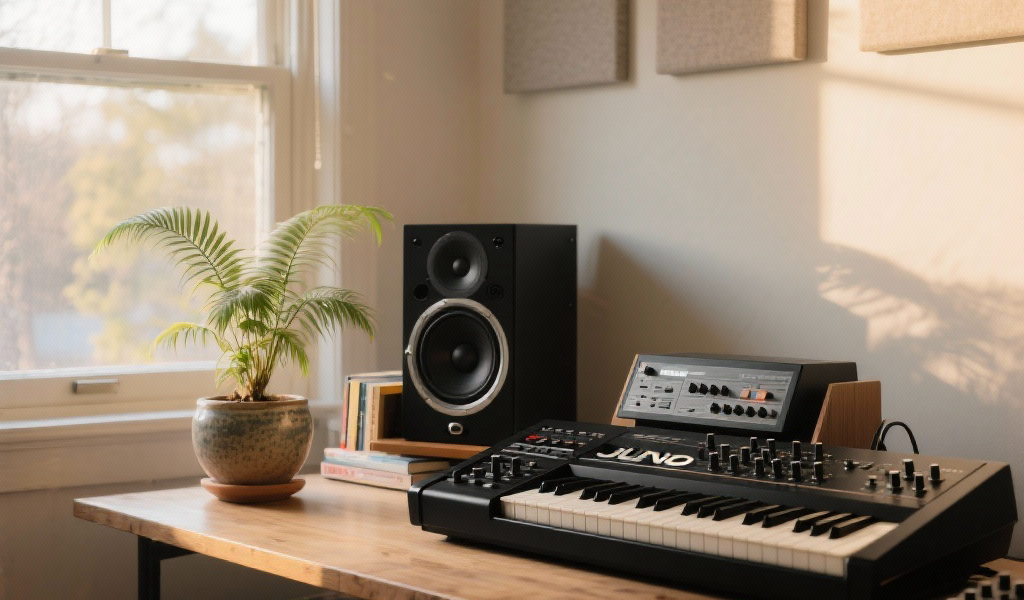
I vividly recall the first time I heard the distinct, glassy sheen of a Yamaha DX7 bassline or the warm, enveloping pads of a Roland Juno-60. These weren’t just background elements; they were lead melodies, rhythmic hooks, and the emotional core of the songs. The DX7, with its revolutionary FM synthesis, brought a whole new palette of sharp, metallic, and often bell-like sounds that contrasted sharply with the analog warmth of earlier synths.
How Synths Defined It:
- Accessibility & Affordability: Synths like the Roland Juno series and later the DX7 made electronic music production more accessible to a wider range of artists. No longer did you need a sprawling, expensive modular system; a polyphonic synth could provide a full band’s worth of sounds.
- Iconic Timbre Palettes: Specific synth presets and sounds became synonymous with the era. The “Lately Bass” on the DX7, the shimmering “Choir” on the Junos, or the piercing leads of the Sequential Circuits Prophet-5 were instantly recognizable and became the backbone of countless tracks.
- Melodic & Harmonic Innovation: Synths encouraged different approaches to melody and harmony. Arpeggiators opened up new rhythmic possibilities, while rich polyphonic pads allowed for lush chord voicings previously difficult to achieve with traditional instruments in a pop context.
- Aesthetic Shift: New Wave embraced an aesthetic that was polished, modern, and often slightly detached, mirroring the clean, precise sounds of the synthesizers.
For anyone diving into electronic music production today, studying the 80s is crucial. It teaches us how specific iconic synthesizers can become character-defining elements in music, and how to craft memorable hooks using unique sonic landscapes.
3. The House & Techno Revolution: Rhythms of the Underground (Mid-80s – 90s)
I sometimes wonder what music would even sound like without the 808’s booming sub-bass kick or the 909’s crisp, driving snare and hi-hats. These weren’t just drum machines; they were rhythmic engines that propelled entire cultures. Frankie Knuckles in Chicago, Juan Atkins and Derrick May in Detroit – these pioneers harnessed the raw, hypnotic power of these Roland instruments to create dance music that transcended its origins.
And then there’s the TB-303. Its squelching, acidic basslines, initially intended to accompany guitarists with automated bass patterns, became the signature sound of Acid House. The unpredictable resonance and filter sweeps, often pushed to extreme settings, created a psychedelic, otherworldly groove that defined a subgenre and fueled countless raves.
How Synths (and Drum Machines) Defined It:
- Foundation of the Groove: The distinctive sounds of the 808 and 909 became the rhythmic bedrock. The 808’s long decay kick, the 909’s punchy snare and open/closed hi-hats created a sonic palette that was instantly recognizable and uniquely suited for continuous dance.
- Hypnotic Basslines: The TB-303’s unique wave generator and filter created a totally new type of bassline – melodic, often repetitive, and capable of extreme sonic manipulation via its famous “accent” and “slide” functions. It taught producers that bass could be an expressive, dynamic lead instrument.
- Loop-Based Production: These machines facilitated a new approach to music production: looping short, evolving patterns to build long, immersive tracks. This was crucial for the continuous flow of DJ sets and club nights.
- DIY Ethos: The relative affordability and standalone nature of these machines empowered a generation of bedroom producers to create professional-sounding tracks, fostering a vibrant, independent music scene.
For any producer looking to craft compelling dance music, understanding the nuances of these vintage synths (or their modern emulations) is non-negotiable. They are the language of the club.
4. The Digital Frontier & IDM/Ambient Explorations: Precision and Texture (90s – 2000s)
I remember being blown away by the sheer detail in tracks by Autechre, where every transient seemed meticulously placed, every texture sculpted with surgical precision. This wasn’t just about catchy melodies or driving beats; it was about the art of sound itself. While analog warmth remained prized, digital synths and software plugins opened doors to entirely new forms of synthesis – wavetable, granular, physical modeling – allowing for sounds that were previously impossible.
How Synths Defined It:
- Granular Control: Digital environments offered unprecedented control over every aspect of sound, from micro-timing to complex filter envelopes and modulation matrices. This allowed for hyper-detailed textures and evolving soundscapes.
- Expanded Sonic Palettes: Wavetable synthesis, for example, allowed for morphing between different waveforms, creating sounds with incredible movement and complexity. Software samplers opened up the world of intricate sound manipulation and collage.
- Experimental Structures: With the freedom to manipulate sound almost endlessly, producers began experimenting with non-linear structures, broken beats, and atmospheric pieces that prioritised texture and mood over traditional song forms.
- Home Studio Revolution: The increasing power of personal computers and DAWs meant that sophisticated electronic music production could be done entirely in a home studio, democratizing the process for a new generation of sonic explorers.
This era highlights the shift from hardware-centric production to a more integrated, software-driven approach, demonstrating that the ‘instrument’ could be the entire computer itself. Understanding these techniques is vital for any modern synthesist exploring experimental or highly sculpted electronic music.
5. The Modern Revival & Hybrid Approaches: Blending the Best (2000s – Present)
I often find myself using a hardware analog synth for a gritty bassline, feeding it into a software modular environment for complex effects, and then layering that with pristine digital pads. The boundaries are blurred, and the possibilities are truly infinite. This approach has allowed artists across genres – from pop and R&B to film scoring and avant-garde electronic – to craft unique, deeply personal sounds.
How Synths Define It Now:
- The Best of Both Worlds: Modern production often combines the raw power and hands-on immediacy of analog synths with the flexibility, recall, and processing power of digital tools.
- Democratization of Modular: The growth of Eurorack has made modular synthesis more accessible, allowing producers to build highly customized, unique sound-generating systems tailored to their specific creative needs. This emphasizes individual sound design expression.
- Genre Fluidity: The vast array of available synthesis methods and tools means artists can easily pull sounds from different eras and styles, fostering genres that defy easy categorization and constantly evolve.
- Emphasis on Creativity: With so many tools, the focus shifts even more acutely to the creative vision of the producer. What unique sound can you craft? How can your studio setup enable unprecedented sonic exploration?
This current landscape is a testament to the synthesizer’s enduring power and adaptability. It encourages us to be brave, to combine unexpected elements, and to always prioritize the search for new sonic experiences.
A Producer’s Perspective: More Than Just Instruments
When I dive into a classic album now, whether it’s Tangerine Dream’s Phaedra or Daft Punk’s Discovery, I don’t just hear the music; I hear the machines behind it. I listen for the unique envelopes of the ARP Odyssey, the gritty resonance of a Korg MS-20, or the iconic vocoder from Around The World. This approach encourages revisiting albums with a new ear, uncovering layers of intention and sonic craft that might have gone unnoticed. It’s an invitation to appreciate the role of the synthesist not just as a player, but as a sonic sculptor.
Practical Takeaways for Musicians and Producers:
- Don’t Just Play, Design: Understand that a synthesizer isn’t just about playing pre-programmed sounds. Dive into the oscillators, filters, envelopes, and LFOs. Learn to sculpt your own sounds. This is where true originality in electronic music production lies.
- Study the Classics: Understanding the foundational sounds of different genres isn’t about copying; it’s about building a vocabulary. Deconstruct classic tracks to identify the synth sounds and techniques used. How did that artist achieve that bassline or that pad?
- Experiment Beyond Presets: While presets are a great starting point, challenge yourself to tweak, modify, and completely transform them. Many iconic sounds were discovered through happy accidents or by pushing a synth to its limits.
- Embrace the Hybrid: Don’t limit yourself to purely analog or purely digital. The most interesting music often comes from blending different synthesis methods and leveraging both hardware and software.
- Connect with the Culture: Every synth has a story, and every genre built around synths has a rich cultural history. Understanding this context enriches your own creative process and appreciation for the music.
The Enduring Legacy of the Sonic Shifters
At Noxal, this is why we do what we do. We’re not just reporting on gear; we’re exploring the deep, often invisible, connections between technology, creativity, and culture. We believe that understanding how synths shaped entire genres in music production empowers us all – producers, musicians, and avid listeners – to engage with electronic music on a deeper, more meaningful level. It teaches us that every knob turn, every patch cable, every line of code holds the potential for the next sonic revolution.
So, what genre will you help shape next? The tools are more powerful and accessible than ever before. The legacy is calling.
FAQ Section
A: Synthesizers are pivotal in the creation of electronic music, as they offer unique sound design possibilities that shape genres, influence culture, and inspire innovation.
Q: How did synthesizers influence pop music in the 80s?
A: Synthesizers became the cornerstone of Synth-Pop and New Wave, transforming how melodies and sounds were created and recognized in mainstream pop music.
Q: What are some essential synths for modern music production?
A: Essential synths include the Yamaha DX7, Roland Juno series, and modern Eurorack modules, which offer a blend of both historical significance and contemporary versatility.
Q: How can I start using synthesizers in my music?
A: Start by experimenting with both hardware and software synths, understanding their parameters, and learning to design your own sounds or edit presets to fit your creative vision.
Q: Why is it essential to understand the history of synthesizers?
A: Understanding the history enriches your perspective on creative processes and helps in identifying influential techniques and sounds that can inform your own productions.