Summary: Discover how electronic scores transformed cinema and music production. From the haunting Theremin wails of early films to modern synth-drenched blockbusters, synthesizers have drastically shifted the emotional landscape of film soundtracks. This deep dive explores iconic soundtracks, the evolution of electronic music in film, and the profound impact of technology on composition.
Key Takeaways
- The transition from acoustic orchestras to synthesizers revolutionized film soundtracks, allowing for unmatched emotional depth.
- Early experiments with electronic sounds proved essential in paving the way for contemporary film scores.
- Understanding synthesis can enhance your music production and film scoring capabilities.
- Electronic scores effectively create atmosphere and psychological depth in cinematic storytelling.
- The blend of vintage and modern techniques can yield innovative compositions for film and beyond.
Estimated Reading Time: 8 minutes
Table of Contents
- The Dawn of Drones and Dreams: Early Electronic Experiments in Film Scoring
- How Electronic Scores Shaped Movie Soundtracks: Iconic Examples and Their Impact
- The Technical Evolution: From Analog Beasts to Digital Wonders
- Beyond the Notes: The Nuances of Electronic Sound Design in Film
- Practical Takeaways for Musicians and Producers
- Noxal’s Perspective: Our Ongoing Love Affair with Cinematic Synths
- The Future is Pulsating
- FAQ
The Dawn of Drones and Dreams: Early Electronic Experiments in Film Scoring
The journey of electronic scores in cinema began subtly, often as experimental flourishes rather than full-blown scores. Early electronic instruments, cumbersome and temperamental, found their way into niche projects, creating eerie soundscapes for sci-fi and horror films. Think of the Theremin’s haunting wail in Spellbound (1945) or Forbidden Planet (1956), which featured an entirely electronic score by Louis and Bebe Barron, a true landmark in electronic music for film. These early forays laid the groundwork, proving that electronic timbres could evoke unique psychological and atmospheric responses from an audience.
How Electronic Scores Shaped Movie Soundtracks: Iconic Examples and Their Impact
To truly understand how electronic scores changed cinema in music production, we need to look at some of the titans of the genre. These are the scores that didn’t just accompany films; they defined them, embedding themselves into our collective synth culture consciousness.
Blade Runner (1982) – Vangelis and the Cyber-Noir Soul
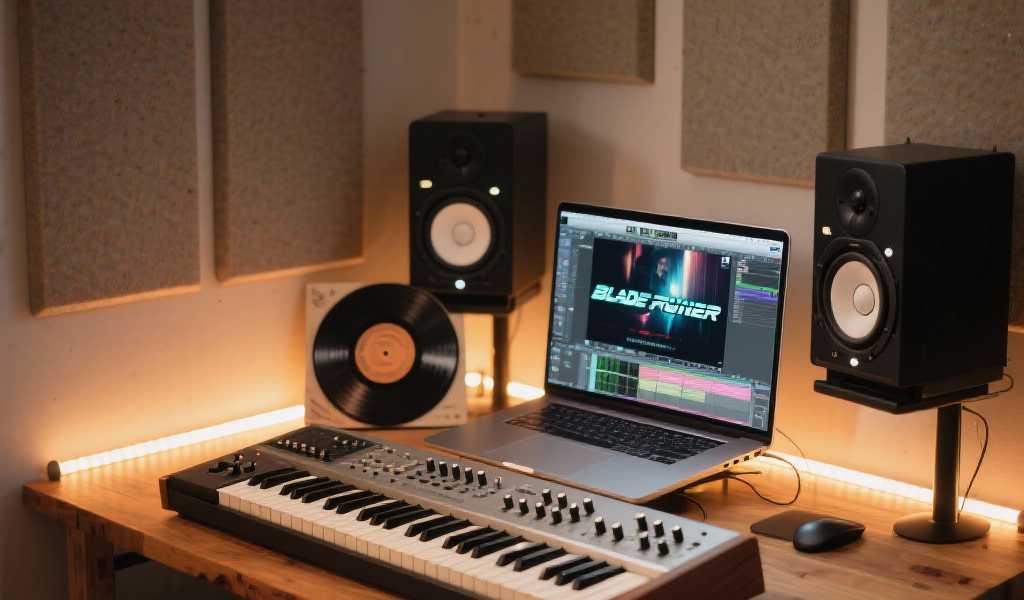
No discussion of electronic film scores is complete without Blade Runner. Vangelis‘s monumental score for Ridley Scott’s dystopian masterpiece is not just music; it’s the very air the film breathes. Using a blend of Yamaha CS-80, Roland VP-330 Vocoder Plus, and other analog synthesizers, Vangelis crafted a soundscape that is simultaneously futuristic and melancholic, epic and intimate.
We at Noxal are fascinated by the way Vangelis used synths to evoke not just technology, but profound human emotion. The layered pads, the mournful brass-like synths, the driving, yet ethereal, sequences – they don’t just tell you about the future; they make you feel the isolation, the longing, the beauty amidst the grime. It’s a masterclass in sound design that prioritizes atmosphere and psychological depth over traditional melodic arcs.
Actionable Insight: I often suggest aspiring music producers and film composers to take a deep dive into specific scenes. Let’s try one now: Rewatch the “Tears in Rain” monologue scene from Blade Runner (You can find clips on YouTube easily). Pay close attention to the synths. Notice how the sustained, evolving pads create a sense of vastness and finality. The subtle pitch bends and filter sweeps on those pads add a living, breathing quality, almost like a sigh. There’s a quiet, shimmering arpeggio underneath that suggests fragility and memory. The overall effect is one of profound, poignant beauty, entirely crafted from electronic textures. It’s not just an accompaniment; the synth score is the emotion of the scene, shaping our interpretation of Roy Batty’s final moments. This is where electronic scores changed cinema in music production forever, proving synths could carry the heaviest emotional weight.
Halloween (1978) – John Carpenter and the Minimalism of Terror
On the other end of the spectrum, we have John Carpenter. A true auteur, Carpenter not only directed but also composed the iconic scores for many of his films, often using primitive, monophonic synthesizers and drum machines. His approach was raw, minimalist, and incredibly effective.
For Halloween, Carpenter’s simple yet terrifying theme, built on a repeating piano-like synth motif and pulsing arpeggios, became synonymous with dread. He used the limited palette of his EMS Synthi AKS and a sequential circuits Prophet-5 to create a relentless, suffocating tension. This wasn’t about grand orchestration; it was about surgical precision in psychological torment. I’ve always believed that Carpenter’s genius lay in understanding that sometimes, less is terrifyingly more. He proved that vintage synths, even with their limitations, could be incredibly powerful storytelling tools. His work inspired countless horror composers and cemented the idea that electronic textures were perfect for generating suspense.
Tron: Legacy (2010) – Daft Punk’s Digital Symphony
Fast forward a few decades, and Daft Punk took the reins for Tron: Legacy. This wasn’t just a score; it was a cultural event. The French duo, already legendary in electronic music, brought their signature blend of electro, house, and cinematic scope to the big screen. Their score for Tron: Legacy (Listen to the full soundtrack here) showcased how far electronic music production had come. They masterfully blended orchestral elements with their distinct synth-heavy sound, creating a score that felt both grandly traditional and utterly futuristic.
The propulsive rhythms, the soaring synth melodies, the meticulous sound design – Daft Punk created a world that sounded exactly like it looked. They brought a contemporary electronic music sensibility to Hollywood, proving that mainstream blockbusters could not only embrace, but thrive on, electronic scores. Their influence pushed the boundaries of what was considered “film music,” bridging the gap between underground synth culture and global cinematic appeal.
Stranger Things (2016) – The Nostalgic Glow of Modern Electronic Scores
Perhaps one of the most culturally significant examples of recent years is the score for Stranger Things by Kyle Dixon and Michael Stein of S U R V I V E. This television series, heavily inspired by 80s cinema, uses its electronic score as a direct homage and a crucial atmospheric element.
The Stranger Things soundtrack, saturated with analog synth textures reminiscent of John Carpenter and Tangerine Dream, perfectly captures the nostalgic dread and wonder of the show. It’s a prime example of modern electronic scores leveraging the emotional resonance of vintage synths and their distinct character. The iconic main theme, with its shimmering arpeggios and dark, sustained bass lines, immediately transports you to Hawkins, Indiana, even before you see a single frame.
For us at Noxal, Stranger Things is a beautiful demonstration of how a well-crafted electronic score can define a show’s identity and connect deeply with an audience’s nostalgia and emotional landscape. It shows how modern music production can re-contextualize classic synth sounds to create something fresh yet familiar.
The Technical Evolution: From Analog Beasts to Digital Wonders
The evolution of electronic scores is inextricably linked to the technological advancements in synthesizers themselves.
- Analog Era (70s-early 80s): Early scores relied on large, often monophonic or limited polyphonic analog synthesizers like the Moog, ARP, and Sequential Circuits Prophet-5. Their warm, organic sound, often characterized by subtle inconsistencies and powerful filters, gave these scores their unique character. Composers had to be incredibly inventive with layering and recording techniques due to polyphony limitations. This era laid the foundation for modern sound design techniques.
- Digital Explosion (80s-90s): The Yamaha DX7, with its FM synthesis, brought a cleaner, sharper, and often more metallic sound, alongside greater polyphony. Samplers like the Fairlight CMI and E-mu SP-1200 opened up new worlds of manipulating recorded sounds. This allowed for more complex arrangements and intricate sonic textures, though sometimes at the cost of the raw analog warmth.
- Software Synthesis and Modular Synthesis Revival (2000s-Present): The rise of powerful Digital Audio Workstations (DAWs) and software synthesizers has democratized electronic music production for film. Composers now have access to an almost limitless palette of sounds, from emulations of classic vintage synths to utterly unique digital instruments. Parallel to this, there’s been a massive resurgence in modular synthesis, offering unparalleled depth in sound design and experimental textures, allowing composers to craft sounds that are truly bespoke for a film’s specific needs. Composers like Hans Zimmer have been instrumental in blending massive orchestral sounds with powerful, often aggressive, electronic textures, creating the “hybrid score” that defines much of contemporary blockbuster cinema (think Dune, Inception).
Beyond the Notes: The Nuances of Electronic Sound Design in Film
What makes electronic scores so uniquely effective? It’s often not about the melody, but the texture, the atmosphere, the visceral impact.
- Atmosphere and World-Building: Synths excel at creating sustained moods, ambient textures, and soundscapes that immerse the audience in the film’s world. They can evoke everything from the cold emptiness of space to the buzzing energy of a futuristic city.
- Psychological Depth: Electronic sounds can be unsettling, abstract, or deeply emotional. They can hint at internal turmoil, psychological states, or hidden dangers in ways traditional instruments might struggle with. The subtle manipulation of filters, envelopes, and LFOs can create sounds that are almost subliminal, working directly on the viewer’s subconscious.
- Flexibility and Innovation: Composers aren’t limited by acoustic physics. They can invent sounds that have never been heard before, pushing the boundaries of sonic expression. This freedom allows for true innovation in film scoring, continuously evolving the language of cinematic music.
- Sound Design as Score: Often, the line between sound design and score blurs in electronic compositions. A low, rumbling synth might function as both a musical bass note and a sound effect for an impending earthquake, adding incredible cohesion to the film’s auditory experience.
Practical Takeaways for Musicians and Producers
For those of you immersed in music production or aspiring to compose for film, the history of electronic scores offers valuable lessons:
- **Embrace Sound Design:** Don’t just think about notes and chords; think about textures, layers, and how sounds evolve over time. Electronic instruments are incredible tools for sculpting unique timbres.
- **Learn Your Synths:** Understand the basics of synthesis (subtractive, FM, wavetable, granular, etc.). Each type has its character and strengths. Experiment with filter cutoff, resonance, envelopes, and LFOs. Your chosen synthesizers are your orchestra.
- **Study Iconic Scores:** Actively listen to film scores that inspire you. Try to deconstruct them. What synths might have been used? How are pads layered? What kind of rhythmic elements are present? Use soundtrack analysis as a learning tool.
- **Less Can Be More:** As John Carpenter showed, powerful emotional impact can come from very simple, well-chosen sounds. Don’t feel the need to over-complicate.
- **Connect Emotion to Sound:** Before you start tweaking, consider the emotion you want to evoke. What does fear sound like? How about wonder, or isolation? Then, use your synthesizers to translate those feelings into sonic form.
- **Experiment with Hybrid Approaches:** Like Daft Punk or Hans Zimmer, don’t be afraid to blend electronic elements with acoustic instruments or orchestral samples. This often leads to the richest and most dynamic scores.
Noxal’s Perspective: Our Ongoing Love Affair with Cinematic Synths
Here at Noxal, we’re not just chroniclers of synth culture; we’re active participants. We’re constantly tinkering with vintage synths and exploring the latest modular synthesis innovations, always with an ear for how these sounds can tell stories. The journey of electronic scores in cinema is a microcosm of our broader passion: the belief that electronic instruments are not just tools, but collaborators in artistic expression.
We believe that by understanding this rich history – from the early experiments to the modern electronic scores dominating today’s cinema – we gain deeper insight into the power of electronic music itself. It helps us appreciate the craft, the innovation, and the sheer emotional punch that a well-placed pad or a perfectly timed arpeggio can deliver. This evolution in film scoring isn’t just about movies; it’s about the ever-expanding sonic vocabulary available to all music producers and musicians.
The Future is Pulsating
How electronic scores changed cinema in music production is a story of relentless innovation, creative courage, and an unshakeable belief in the power of sound. From the minimalist terror of Halloween to the expansive futures of Blade Runner and Tron Legacy, synthesizers have proven their indispensable role in shaping our cinematic experiences. They don’t just create sounds; they create worlds, feelings, and memories that resonate long after the credits roll.
So next time you settle in for a movie, take a moment to truly listen. You might just hear the oscillating heartbeat of a synth telling a story only it can tell.
FAQ
What are electronic scores?
Electronic scores are soundtracks created using electronic instruments, such as synthesizers, drum machines, and computer software, giving composers the ability to craft unique sonic textures and atmospheres.
Electronic scores are soundtracks created using electronic instruments, such as synthesizers, drum machines, and computer software, giving composers the ability to craft unique sonic textures and atmospheres.
How did synthesizers change film scoring?
Synthesizers provided composers with new tools to express emotions and create soundscapes that were previously unachievable with traditional acoustic instruments.
Synthesizers provided composers with new tools to express emotions and create soundscapes that were previously unachievable with traditional acoustic instruments.
What are some famous electronic film scores?
Iconic electronic film scores include those for Blade Runner by Vangelis, Halloween by John Carpenter, Tron: Legacy by Daft Punk, and the series Stranger Things by Kyle Dixon and Michael Stein.
Iconic electronic film scores include those for Blade Runner by Vangelis, Halloween by John Carpenter, Tron: Legacy by Daft Punk, and the series Stranger Things by Kyle Dixon and Michael Stein.
What role does sound design play in film?
Sound design enhances the storytelling experience by creating ambiance, conveying emotions, and providing a deeper connection between the audience and the film’s narrative.
Sound design enhances the storytelling experience by creating ambiance, conveying emotions, and providing a deeper connection between the audience and the film’s narrative.
As a final note, remember: if a synth isn’t part of your music production process, you’re just skipping the best parts of the ride. So, don’t forget to patch some cables and have a little oscillating fun! After all, nothing says “I’m serious about music” like an unexpected synth solo at a dinner party!