TL;DR: Squarp Instruments has released firmware version 3.0 for its Hapax sequencer, fundamentally redefining its role. The headline feature is a deep, performance-oriented MPE integration, transforming the Hapax from a pattern programmer into a dynamic performance instrument. This, alongside a more flexible routing system and numerous workflow refinements, cements its position as a central hub for modern hybrid setups.
- The core of Hapax 3.0 is a redesigned MPE system, allowing per-track MPE zones and turning its 128 pads into a real-time expressive controller in Live mode.
- USB connections are now handled as multiple independent MIDI ports, offering superior organization and stability for complex hardware/software rigs.
- A suite of workflow updates, including an earlier-accessible modulation matrix and color-coded patterns, makes the sequencer more intuitive and fluid to use.
- The update shifts the Hapax’s identity from a classic step sequencer to a performance-centric instrument where sequences react dynamically to playing style.
- This follows the recent 2.10 update, which added features like an SH-101 style step recorder and new MIDI effects, showing Squarp’s commitment to long-term development.
Reading time: 6 min
Want more synth news before your next coffee break? Join the Noxal newsletter — no spam, just gear worth knowing about.

From Sequencer to Instrument
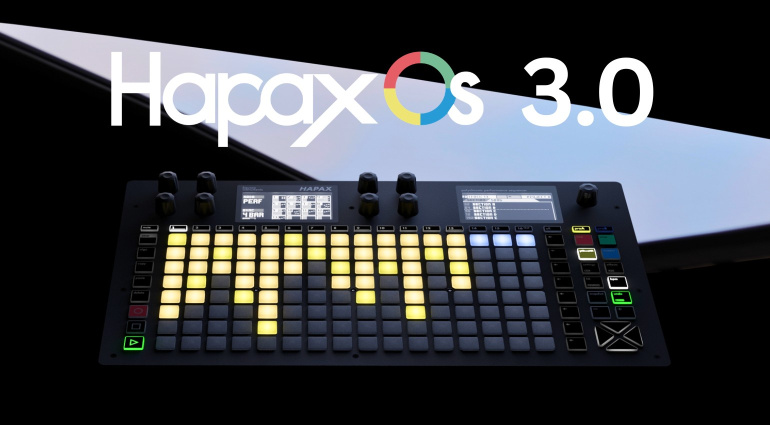
Let’s be honest: the word “firmware update” rarely quickens the pulse. It usually promises bug fixes and, if we’re lucky, a marginally more stable clock. Squarp Instruments, however, has a history of treating firmware like a product launch, and with Hapax 3.0, they’ve outdone themselves. This isn’t a patch; it’s a paradigm shift. For years, the Hapax has been lauded as a powerful, performer-friendly sequencer. With version 3.0, Squarp is making a bold declaration: the Hapax is no longer just a sequencer. It is now a performance instrument in its own right.
This philosophical shift is crucial. Most sequencers are tools for planning—they are architects of future events. You program, you tweak, you hit play. The Hapax 3.0, particularly through its new MPE soul, demands to be played. It invites interaction, expression, and imperfection in the moment. It blurs the line between programming a sequence and performing it, creating a workflow where the studio and the stage are no longer separate realms but a continuous creative space. For those of us who view our setups as instruments first and tech stacks second, this is a profoundly appealing evolution.
MPE: The Heart of the Update
The headline, the star, the reason you’re probably reading this, is the completely redesigned MPE (MIDI Polyphonic Expression) implementation. Previous support was, frankly, a checkbox feature. Now, it’s the central nervous system. The key is per-track MPE zones. This means you can assign a different expressive controller—say, a Roli Seaboard on track one, and an Expressive E Osmose on track two—to independently and precisely control separate synth voices, all from within a single Hapax project. The sequencer becomes a masterful conductor of expression.
This shines in two distinct modes. In Live Mode, the Hapax’s 8×16 grid of pads transforms into a multidimensional controller. Each pad transmits not just note and velocity, but also timbre (CC74) and pitch bend per note. You can play chords and apply vibrato to a single note within them, or sweep filter frequencies across a pad cluster. It turns static chord triggers into a dynamic, tactile performance surface. In Step Mode, you can now define these MPE expression values—slide, pressure, timbre—per note, right in the sequencer. The movement is baked into the sequence itself, meaning your pre-programmed patterns now have a lifelike, human feel before you ever touch a pad live. This is where sequencing truly comes to life.
Routing: The Nerve Center
Power is nothing without control, and a sequencer claiming hub status needs impeccable traffic management. Hapax 3.0 delivers with a significantly expanded routing system. The most impactful change is the treatment of the USB connection. It’s no longer a single monolithic MIDI port. Now, it can be configured as multiple independent virtual ports. In practice, this is a game-changer for hybrid setups.
Imagine this: you can send clock and transport commands to your hardware drum machine on DIN MIDI Out A, sequence a software synth in Ableton on USB Port 1, and control a modular rig via CV/Gate, all while using USB Port 3 exclusively for the sync signal from your DAW. This level of isolation prevents MIDI feedback loops, reduces clutter, and brings a studio-level of organization to a hardware unit. Furthermore, pattern transitions can be tied to specific tracks and ports, allowing for more musical, staggered changes rather than a jarring, global cut. For the live performer, this translates to a setup that is both incredibly flexible and rock-solid stable—a rare and precious combination.
The Devil in the Details
While MPE and routing are the showstoppers, Hapax 3.0 is packed with thoughtful refinements that collectively smooth out every rough edge. The modulation matrix, a powerhouse feature for adding movement, can now be accessed and configured much earlier in the track creation process. No more breaking your flow to set up an LFO; the tool is there when the inspiration strikes. Color-coded patterns provide instant visual navigation in complex projects. A broader selection of musical scales invites exploration beyond the usual suspects.
These updates follow hot on the heels of the substantial version 2.10, which itself was a major release. That update gifted users an SH-101-style step recorder (an instant classic for bassline programming), four new creative MIDI effects (like the polyphonic arpeggiator/loop designer “Arpoly”), and a more powerful shuffle algorithm. Squarp isn’t just adding features; they’re systematically addressing musician workflows. They observe how people actually use the box—in the studio trying to capture an idea, on stage trying to execute a transition—and then build tools to make those moments more fluid and more creative.
Context and Conclusion
In the crowded market of high-end sequencers, the Hapax has always stood out for its clear screen, thoughtful layout, and live performance focus. With the 3.0 update, Squarp has executed a brilliant flanking maneuver. While competitors chase track counts and polyphony, Squarp has doubled down on expressiveness and integration. They’ve recognized that the future of electronic music performance isn’t just about playing more notes, but about playing notes with more feeling and intention.
So, who is this for? It’s for the performer who views their setup as an instrument, not a playlist. It’s for the sound designer who wants morphing, living sequences. It’s for the hybrid artist tired of the mental context-switch between hardware jams and DAW arrangements. The Hapax 3.0 asks more of you as a player, but in return, it gives you a far more intimate and dynamic relationship with your music. It’s a compelling argument that in the age of limitless digital power, the most valuable currency is genuine expression.
Frequently Asked Questions
Do I need an MPE controller to benefit from Hapax 3.0?
While the full expressive potential is unlocked with a controller like a Roli, LinnStrument, or Osmose, you still benefit greatly. The per-note expression editing in Step Mode means you can draw in pitch bends, pressure, and timbre changes for any synth, MPE-capable or not, adding incredible movement to standard MIDI gear. The workflow and routing improvements are universal.
How does the Hapax 3.0 compare to a DAW for sequencing?
It’s a different philosophy entirely. A DAW is a limitless canvas for arrangement and editing. The Hapax is an instrument for generation and performance. Its strength lies in immediacy, tactile control, and stability. The new MPE and routing features allow it to manage a hybrid setup with a reliability and hands-on feel that a mouse-and-screen DAW workflow often lacks, especially in a live context.
Is the update free for existing Hapax owners?
Yes, absolutely. Like all of Squarp’s major firmware updates, Hapax version 3.0 is a free download for all existing owners. This commitment to long-term, value-adding development is a significant part of the brand’s appeal and makes the initial investment in their hardware far more compelling.
Now, if you’ll excuse me, I need to pour a fresh cup and spend the next hour trying to make a simple bassline, failing utterly because I can’t stop sliding every note. Thanks, Squarp.