
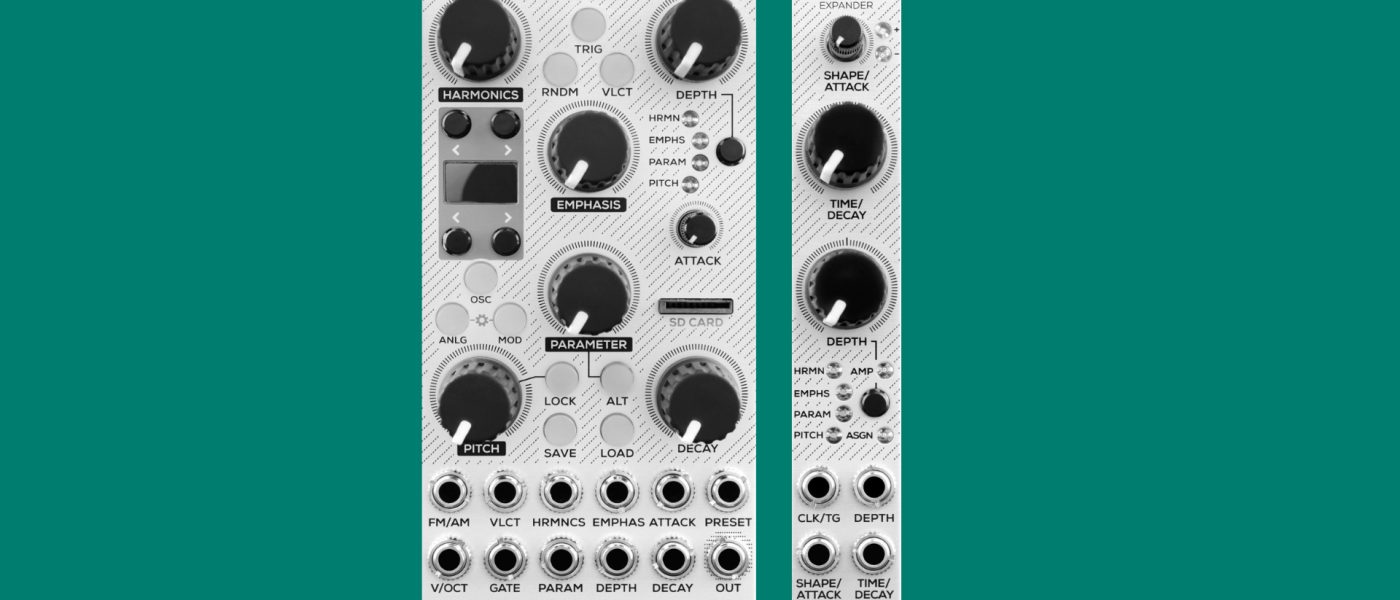
TL;DR: Shakmat Modular has finally launched the Ballista Blast, a 12HP hybrid synth voice for Eurorack. It packs a digital multi-engine oscillator, four analog filters, an analog distortion circuit, and 256 preset slots into a remarkably compact frame. At $419, it’s a potent, space-conscious engine for complex patches.
- A true hybrid: 16-bit digital multi-engine (VA, FM, Wavetable) paired with four types of analog filters and an analog distortion circuit.
- Extremely compact at 12HP, offering a complete voice (VCO, VCF, VCA, modulation) in a single module.
- Features 256 preset slots and a “virtual dice” randomizer for instant sound generation and recall.
- Includes a microSD slot for importing custom wavetables into the onboard engine.
- Optional $129 expander module adds a freely assignable, CV-controllable modulation source (envelope/LFO).
Reading time: 4 min
Want more synth news before your next coffee break? Join the Noxal newsletter — no spam, just gear worth knowing about.

The Compact Hybrid Proposition
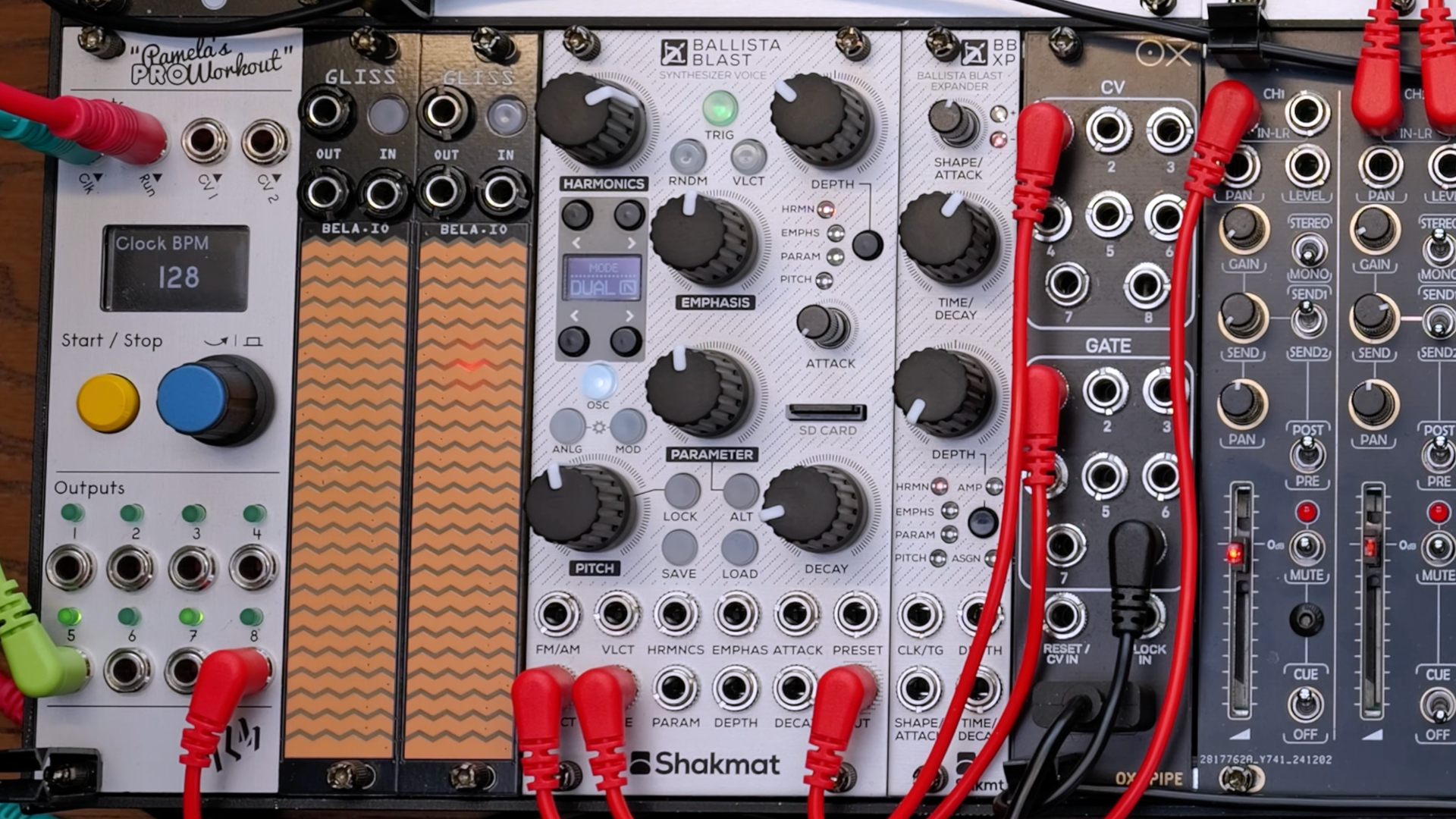
We at Noxal have a soft spot for modules that defy their own footprint. The Shakmat Ballista Blast, announced two years ago and now finally shipping, is a masterclass in this art. The premise is deceptively simple: a complete, hybrid synthesizer voice in a mere 12HP of Eurorack real estate. In a landscape where building a comparable voice from discrete modules could easily consume 40HP or more, the Ballista Blast’s density is its first and most compelling argument. It consolidates the entire signal chain—oscillator, filter, amplifier, and modulation—into a single, intelligently designed panel, promising the depth of a small system with the immediacy of a single instrument.
This isn’t just about saving space; it’s about streamlining creativity. For performers and patch builders working within a skiff or a tightly packed performance case, the Ballista Blast acts as a powerful, self-contained sound source that can be deployed instantly. You’re not patching a VCO to a VCF to a VCA and then hunting for an envelope generator. It’s all there, pre-normalled, ready to be shaped and modulated. This integrated approach reduces setup friction and lets you focus on sound design and performance, which is, after all, the entire point of this expensive hobby of ours.
The two-year development cycle, from its Superbooth 2024 debut to its current release, suggests Shakmat Modular was committed to getting this balance right. A rushed, cramped module is a nightmare to use, but from the demos, the Ballista Blast appears to have avoided that fate. The controls, while dense, seem logically grouped, and the inclusion of a clear screen for preset and engine management is a crucial touch. It’s a module that respects both the limitations of physical space and the boundless nature of sonic exploration.
Digital Heart, Analog Soul

Let’s dissect the “hybrid” claim, because it’s more than just marketing jargon here. At its core is a 16-bit, 48kHz digital oscillator offering three distinct synthesis engines: a virtual-analog subtractive model, an FM engine, and a wavetable mode. This is a formidable digital playground. The VA engine provides the bread-and-butter waveforms, sub-oscillators, and even chord generation. The FM section offers different algorithms for that classic, glassy complexity. The wavetable mode, however, is particularly enticing with its 32 factory tables and, crucially, a microSD slot for importing your own. This transforms the module from a closed system into a customizable sonic palette.
Where the Ballista Blast earns its “soul” is in its analog signal path. The digital oscillators feed into a selection of four analog filters: two-pole low-, mid-, and high-pass, plus a resonant four-pole low-pass. This is where the grit, squelch, and warmth—those intangible qualities we fetishize in hardware—are applied. Following this is an analog distortion circuit offering both symmetrical and asymmetrical soft clipping. This thoughtful pairing means you can generate pristine digital waveforms or harsh FM textures and then immediately run them through the forgiving, saturating character of analog circuitry. It’s a best-of-both-worlds scenario that purely digital or purely analog modules struggle to replicate on their own.
Of course, this being Eurorack, nothing is static. Every major parameter across both the digital and analog domains has a dedicated CV input. There’s even a velocity CV input, allowing for expressive, keyboard-style playing dynamics—a feature often overlooked in modular voices. And for those who need even more modulation, the optional $129 expander adds a fully assignable, CV-controllable modulation source that can act as an envelope or LFO, with up to two expanders supported per main module.
The Practical Performer
Beyond its synthesis capabilities, the Ballista Blast is packed with features that scream “designed for actual use.” The headline here is the 256 preset slots. In a modular environment often associated with ephemeral, un-saveable patches, this is a game-changer, especially for live performers. You can build a setlist of sounds, from delicate pads to screaming leads, and recall them instantly between songs or even mid-performance. This practicality cannot be overstated; it bridges the gap between the experimental playground of modular and the reliable toolkit needed for a gig.
Then there’s the “virtual dice”—a gate-triggered randomizer with per-parameter depth control. I have a profound appreciation for modules that include a thoughtful randomization function. It’s the ultimate creativity spark, a way to break out of your own sound design habits. You can use it to apply subtle variations to a sound, keeping it organic and evolving, or you can let it loose to generate entirely new, chaotic starting points from a known preset. It turns the module into both a precise instrument and a collaborative idea generator.
Combined, the preset system and the randomizer create a powerful workflow loop: craft and save your perfect sounds, then use the dice to generate inspiring mutations of them. It encourages both discipline and serendipity, which is a rare and valuable combination. For the studio composer, this means rapid iteration. For the live artist, it means reliability with the option for controlled improvisation.
Who Is This For?
So, who should be eyeing the Ballista Blast? Firstly, the space-conscious synthesist. If you’re building a portable case or simply want to maximize the power-per-HP of your rack, this module is a top-tier contender. It delivers a staggering amount of functionality in a footprint smaller than many single-function modules. Secondly, the live performer. The preset memory alone makes it a compelling choice for anyone who needs consistent, recallable sounds on stage without sacrificing the depth of modular synthesis.
It’s also an excellent “second voice” or primary engine for those new to Eurorack who want immediate access to a wide range of sounds without the complexity and cost of assembling a voice from scratch. The learning curve is contained within one module, making it a fantastic educational tool that covers subtractive, FM, and wavetable synthesis alongside analog filtering. Finally, it’s for the sound designer who craves hybrid textures. The ability to morph a digital wavetable through a squelchy analog filter and then into a warm, asymmetrical distortion is a specific sonic pathway that the Ballista Blast makes incredibly immediate.
Priced at $419, it sits in the mid-range for a complex voice module. When you consider the cost of a capable digital oscillator, a quality analog filter, a VCA, and a modulation source bought separately, the Ballista Blast represents significant value, both in terms of money and panel space. The optional expander, at $129, is a logical addition for those who crave deeper modulation, but the core module is impressively complete on its own. After a two-year wait, Shakmat Modular appears to have delivered a focused, powerful, and genuinely useful instrument that understands the modern modular musician’s needs.
Frequently Asked Questions
Can I use my own wavetables with the Ballista Blast?
Yes, absolutely. One of the standout features is the onboard microSD card slot, which allows you to import custom wavetables into the module’s wavetable engine. This significantly expands its sonic palette beyond the 32 factory wavetables.
How does the preset system work in a modular context?
The Ballista Blast stores all its internal parameter states—oscillator engine selection, filter settings, modulation routings, etc.—into one of 256 preset slots. It does not save external CV patching. This means you can recall complete internal sound setups instantly, which is ideal for live performance or studio workflow, but you’ll need to re-patch any external modulation sources you were using.
What exactly does the optional expander add?
The expander adds a dedicated, multi-function modulation source. It can be configured as an envelope generator or an LFO, with control over shape, time, and depth. This modulator can be freely assigned to nearly any parameter on the main Ballista Blast module via a menu, and it includes a CV input for triggering/clocking and modulating its own parameters. You can add up to two of these expanders for even more modulation complexity.
Now, if you’ll excuse me, I need to clear out 12HP of space and brew a fresh pot. Something tells me a module this dense will require my full, caffeinated attention.