TL;DR: Pylobolus has officially unveiled the Alkove, a fully-realized 12-voice desktop hybrid synthesizer, evolving from last year’s Alkohol prototype. Its core innovation is a binaural, multi-timbral stereo engine where spatialization is integral to synthesis, all managed through a unique interface with 17 screens and a deeply integrated software editor. Price and availability are still to be announced.
- Evolved from the 2025 Alkohol prototype into a sleek, modern desktop unit with a radical interface featuring 17 screens for direct visual feedback.
- 12-voice, true stereo “binaural” hybrid engine with analog stereo VCAs; spatial effects like phase-shifted LFOs are part of the synthesis architecture.
- Highly flexible, block-based signal path with choice of oscillators (classic or formant-based VOSIM) and polymorphic filters (ladder, SEM, SVF, comb) that can be stacked.
- Unique operation concept: a deeply integrated software editor allows for complex patch design with Total Recall to/from the hardware, inspired by the workflow of old Access Virus synths.
- Multi-timbral with up to three independent parts, supports MPE, and features eight freely mappable LED knobs for hands-on control.
Reading time: 5 min
Want more synth news before your next coffee break? Join the Noxal newsletter — no spam, just gear worth knowing about.

From Prototype to Product

We at Noxal have a soft spot for the journey from mad-scientist prototype to polished product. It’s the synth world’s equivalent of a caterpillar turning into a somewhat expensive, knob-covered butterfly. The Pylobolus Alkove is the latest such metamorphosis, officially unveiled ahead of SynthFest France 2026. This is the direct evolution of last year’s intriguingly named Alkohol prototype from developer Lionel Gély (formerly of RSF). Let’s be clear: the name might have promised a certain kind of intoxication, but the prototype was a serious study in spatial synthesis.
Now, the study is over, and the thesis is being published. The Alkove has shed its raw, breadboard aesthetic for a proper desktop chassis that looks like it means business. I’ve been watching this project bubble under the surface for two years, from cryptic sound demos to last year’s physical proof-of-concept. Seeing it emerge in this form feels like witnessing a private beta go public—the core ideas have survived, but the package is now something you could imagine living on a desk without causing concern to visiting relatives.
The Screen Revolution
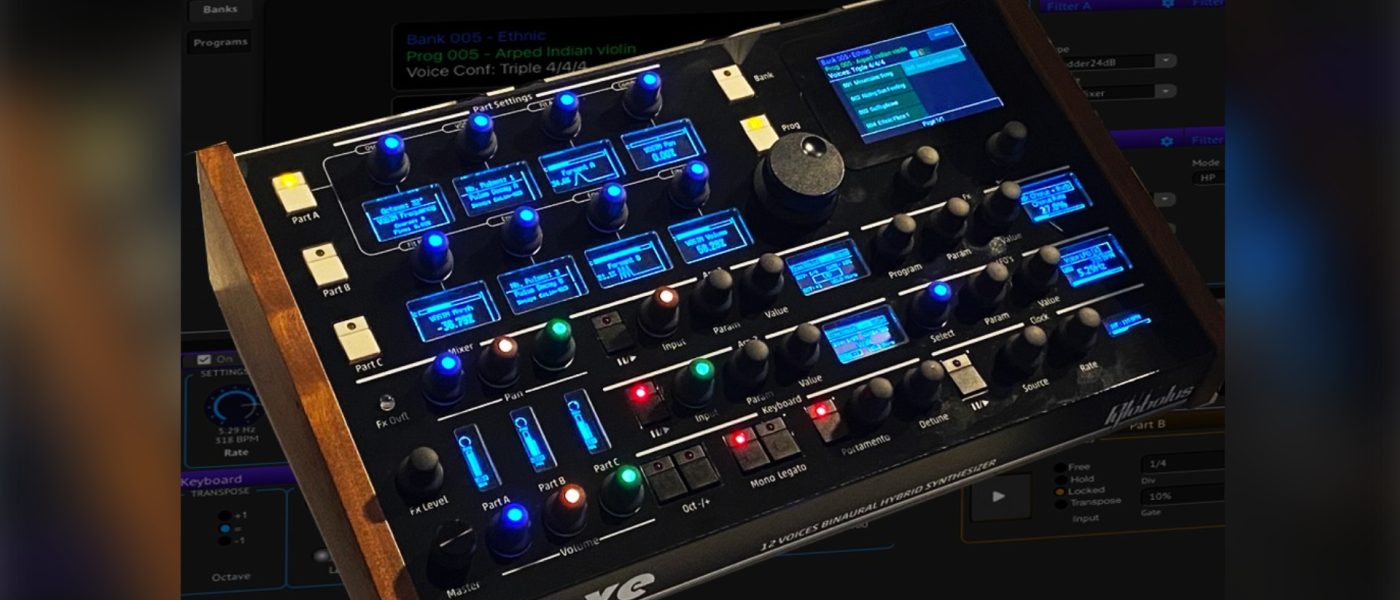
Let’s address the elephant in the room, or rather, the seventeen small screens. The Alkove’s interface is, to put it mildly, unique. It features a staggering 17 screens of various sizes, providing dedicated visual feedback for oscillators, filters, envelopes, and more. A central screen in the upper right handles patch selection. This is beyond the now-common single large display; it’s a distributed information architecture. It reminds me of the Mayer MD-900’s approach but dialed up to a level that suggests the designer might have a side gig as an air traffic controller.
This isn’t just for show. The philosophy appears to be one of absolute immediacy: you look at a section, and its state is right there, no menu diving. Complementing this are numerous parameter knobs with integrated LEDs and click buttons. The eight main “part” knobs have LEDs that can indicate layer or value, and they are fully mappable. It’s an interface that seems to want to give you both deep visual context and direct, personalized tactile control. Whether this is intuitive overload or genius ergonomics will be the key question answered on the show floor.
The Binaural Hybrid Heart
Beneath the glimmering screens lies an engine that is genuinely interesting. Pylobolus describes the Alkove as a “binaural multi-timbral hybrid.” We’ve learned to be skeptical of marketing prefixes, but here, “binaural” seems to be core to the architecture. This isn’t just about slapping a stereo reverb at the end of a mono chain. The synthesis engine is built from the ground up as an integral stereo system, where spatial placement, phase, and depth are part of the sound generation process itself. Each of the 12 voices is true stereo.
The signal path is block-based and highly flexible. You get three oscillators per part, choosing between classic waveforms and the more esoteric formant-based VOSIM oscillators for vocal and unusual textures. These feed into a polymorphic filter section where you can pick from ladder, SEM, state-variable, or comb models, and—crucially—stack up to three of them in any configuration. Modulation is robust, with three DADSR envelopes (one hardwired to the analog stereo VCA) and global/per-voice LFOs. The spatial trick here is the ability to phase-shift and distribute LFOs across the stereo field, creating evolving, moving modulation. It’s hybrid where it counts: digital oscillators and filters, but analog stereo VCAs per voice.
Software as a Synaptic Bridge
Perhaps the most intriguing operational concept is the Alkove’s relationship with software. Recognizing that designing complex, multi-timbral, spatially-aware patches on even 17 screens might be daunting, Gély took inspiration from an unlikely hero: the old Access Virus series. The solution is a complete software editor that acts not as a separate entity, but as a seamless extension of the hardware.
This is “Total Recall” style integration. Tweaking a parameter in the software instantly updates the hardware, and vice-versa. The hardware isn’t a dumb controller; it’s the playback and performance engine. The software becomes the deep-edit environment where you can configure the block-based voice architecture, modulation matrices, and multi-FX with a mouse and larger visual field. Once your sonic sculpture is built, you disconnect and perform it hands-on. It’s a compelling attempt to have the best of both worlds: the limitless flexibility of software editing with the immediacy and reliability of dedicated hardware.
Who Is This For?
So, who is the Pylobolus Alkove for? It’s not for the minimalist seeking a one-knob-per-function analog replica. This is a synthesizer for the modern sound designer and composer who thinks in layers, movement, and space. The musician who appreciates the hands-on nature of hardware but needs the complex, evolving textures that are often easier to plot in a software environment. The multi-timbrality (up to three independent parts) and MPE support point squarely at the modern, expressive performer or studio composer building intricate tracks.
It sits in a curious niche. It’s not a vintage analog revival, nor is it a pure digital wavetable monster. It’s a hybrid with a very specific, spatial identity. Its success will hinge on the execution of that unique interface and the depth of its software integration. If it delivers, it could be a powerful and distinctive tool. With price and availability still TBA, the full picture isn’t clear, but the ambition is undeniable. I, for one, am looking forward to finally getting my hands on it at SynthFest.
Frequently Asked Questions
Is the Pylobolus Alkove analog or digital?
It’s a true hybrid. The sound generation sources (oscillators), filters, and modulation are digital. However, each voice features a dedicated analog stereo VCA (Voltage-Controlled Amplifier), which is where the “hybrid” designation comes from. This blend aims for digital flexibility in sound shaping with the potential for analog character in the final amplification stage.
What does “binaural” mean in this context?
Here, “binaural” refers to a synthesis architecture built around true stereo from the ground up. It’s not just a mono signal panned or sent to stereo effects. Elements like oscillators, filters, and crucially, modulation sources (like LFOs) can be manipulated with phase and spatial distribution across the left and right channels, making the stereo image an active part of the sound design process itself.
Do I need a computer to use the Alkove?
No, you do not *need* a computer to play the Alkove. Once a sound or multi-timbral setup is configured (either via the hardware interface or the software editor), the hardware operates independently as a full synthesizer. The computer-based editor is for deep, complex sound design and patch management, offering an alternative workflow that mirrors and integrates seamlessly with the hardware.
Now, if you’ll excuse me, I need to stare at my single-screen synth and reassure it that it’s still loved, just before I pour another coffee and dream of seventeen tiny displays glowing in the dark.