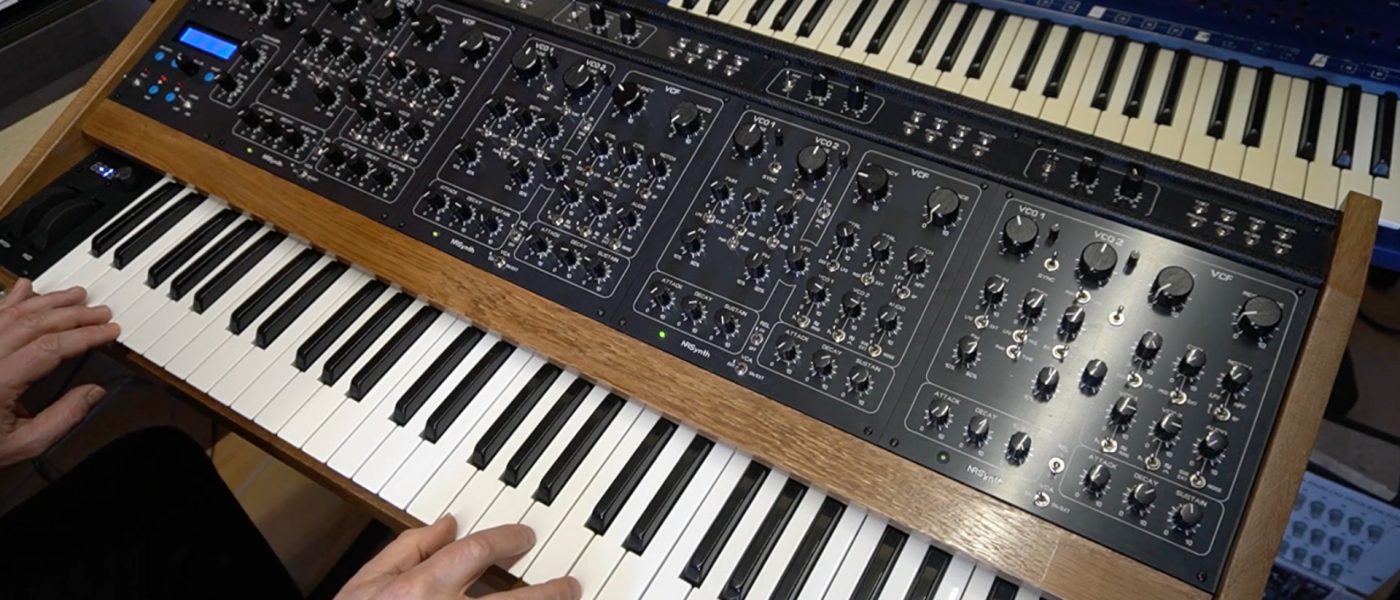
TL;DR: Ahead of SynthFest France 2026, boutique builder NRSynth has unveiled the Quatuor, a hand-built clone of the legendary Oberheim Four-Voice. It faithfully recreates four SEM voices while adding modern extras like a digital LFO, MIDI, a FATAR keybed, and a Eurorack patch bay. It will be built to order, not mass-produced.
- A faithful, four-voice analog clone of the Oberheim Four-Voice, built around four SEM-style voice cards.
- Modern additions include a digital LFO with sync, a Pro-1 style envelope release, sub-oscillators, and a sample & hold generator.
- Features a modern MIDI interface (likely with arpeggiator/sequencer), a 5-octave FATAR keyboard with aftertouch, and a Eurorack-compatible patch bay.
- Built entirely by hand by NRSynth’s Stephen, and will be available on a made-to-order basis only.
- Full pricing and availability details are still to be announced ahead of its debut at SynthFest France 2026.
Reading time: 4 min
Want more synth news before your next coffee break? Join the Noxal newsletter — no spam, just gear worth knowing about.

The Four-Voice Renaissance

Let’s be clear: the Oberheim Four-Voice isn’t just another vintage synth. It’s a monument. It was Tom Oberheim’s brilliant, pragmatic solution to polyphony in the mid-70s: strap four of his iconic Synthesizer Expander Modules (SEMs) to a common keyboard and programmer. The result was a beast of rich, stacked analog tones that defined an era of prog rock and early electronic music. It’s also a beast that rarely leaves its climate-controlled studio, given its rarity, age, and temperamental nature.
Enter Stephen of NRSynth. For years, he’s been the quiet craftsman in the French boutique scene, steadily building a reputation for meticulous, hand-built clones that honor the originals while acknowledging we now live in a world with MIDI. Last year, he laid the groundwork with the Solo, a single SEM clone with some thoughtful enhancements. The logical, glorious next step? The Quatuor. This isn’t a reissue from a large corporation; it’s a resurrection from a single builder who clearly holds the original in deep reverence. The core promise is all there: four independent SEM voices, each with their dual oscillators, that glorious 12dB multimode filter, and the ability to stack them into a wall of sound that can shake plaster loose.
Not Just a Clone: Modern Tweaks
If NRSynth had simply recreated the Four-Voice circuit-for-circuit, it would be an impressive and prohibitively niche achievement. Where the Quatuor gets truly interesting is in Stephen’s subtle but significant modifications. He’s not just building a museum piece; he’s building a player’s instrument. The oscillators now boast a pulse-wave sub-oscillator, instantly thickening up bass and lead sounds. An analog noise generator is onboard for percussion and effects.
The modulation section receives the most thoughtful upgrades. The envelopes feature a switchable release stage borrowed from the Sequential Pro-1, which Stephen himself notes is “more punchy” than the original—a welcome change for sharper attacks and tighter rhythms. Alongside the expected triangle LFO, a digital LFO with eight waveforms, tilt control, sync, and three frequency ranges opens up a world of complex modulation far beyond the 70s spec. Add a syncable sample-and-hold generator, and you have a modulation matrix that, while discreetly integrated, significantly expands the original’s rather austere palette. These are the kinds of features that don’t betray the soul of the instrument but quietly equip it for modern production.
The Whole Package: Keyboard and Connectivity
A polyphonic synth of this caliber deserves a proper controller, and the Quatuor doesn’t skimp. It comes with a five-octave FATAR keybed, complete with velocity and aftertouch. This immediately places it in a different league than the original’s keyboard, offering expressive potential that the Oberheim engineers could only dream of. The aftertouch, in particular, is a game-changer for modulating filter sweeps or LFO intensity with playing pressure.
Then there’s the connectivity, which firmly plants the Quatuor in the 21st-century studio. A modern MIDI interface, developed with Jean-Luc Lartigue (of ozoe fame), is included. If it follows the implementation seen in NRSynth’s other recent work, expect a built-in arpeggiator and sequencer. Most intriguing for the modular crowd is the Eurorack-compatible patch bay on the top panel, using 3.5mm jacks. This isn’t a full modular conversion, but it’s a generous invitation to break the synth out of its fixed architecture and interface with your existing system. It’s a nod to the instrument’s inherently modular DNA, finally given accessible jacks.
Boutique Philosophy and Market Context
It’s crucial to understand what the Quatuor is *not*. It is not a Behringer-style, injection-molded, mass-market clone. The announcement explicitly states it will be “hand-built and available on demand. It will not be mass-produced.” This is the very definition of boutique. For the buyer, this means a direct relationship with the builder, potentially longer wait times, and a price tag that reflects hundreds of hours of skilled labor. We don’t have the number yet, but we can safely assume it will be in the “significant investment” category, commensurate with other high-end, small-batch polyphonics.
This places the Quatuor in a fascinating market position. It’s not competing with a Prophet-5 reissue or a Take 5. It’s appealing to a specific connoisseur: the player who craves the specific, raw, and complex sound of discrete SEM oscillators and filters, who values craftsmanship over convenience, and who sees the original Four-Voice as a holy grail just out of reach. In an era of software emulations and cost-effective polysynths, the Quatuor is a deliberate, analog love letter to a specific sonic ideal. Its debut at SynthFest France—a show known for its celebration of grassroots builder culture—is the perfect venue.
Frequently Asked Questions
When will the NRSynth Quatuor be available and how much will it cost?
Full pricing and specific availability dates are still “TBA” (To Be Announced). The synth will debut at SynthFest France 2026 in Nantes (which is in less than two weeks). Following that, it will be built to order directly by NRSynth. Given its hand-built, four-voice nature, expect a premium price and a likely waiting list.
How does the Quatuor differ from the original Oberheim Four-Voice?
It faithfully clones the core analog voice architecture (four SEMs). The key differences are modern additions: a digital LFO with sync, a Pro-1 style envelope release switch, pulse sub-oscillators, a sample & hold generator, a full MIDI implementation (likely with sequencer/arpeggiator), a 5-octave FATAR keyboard with aftertouch, and a Eurorack-compatible patch bay for modular integration.
Is the Quatuor semi-modular like some other NRSynth products?
It features a Eurorack-compatible patch bay on the top panel, which allows for some modular interfacing and likely some internal signal routing. However, its primary architecture is fixed as a four-voice polyphonic synth. It’s best described as having “modular connectivity” rather than being a fully semi-modular instrument like the company’s Retro One MK2.
I’ll be evaluating the Quatuor’s filter resonance with a freshly brewed espresso in hand at SynthFest, because some tonal assessments require caffeine and a lack of nearby breakables.