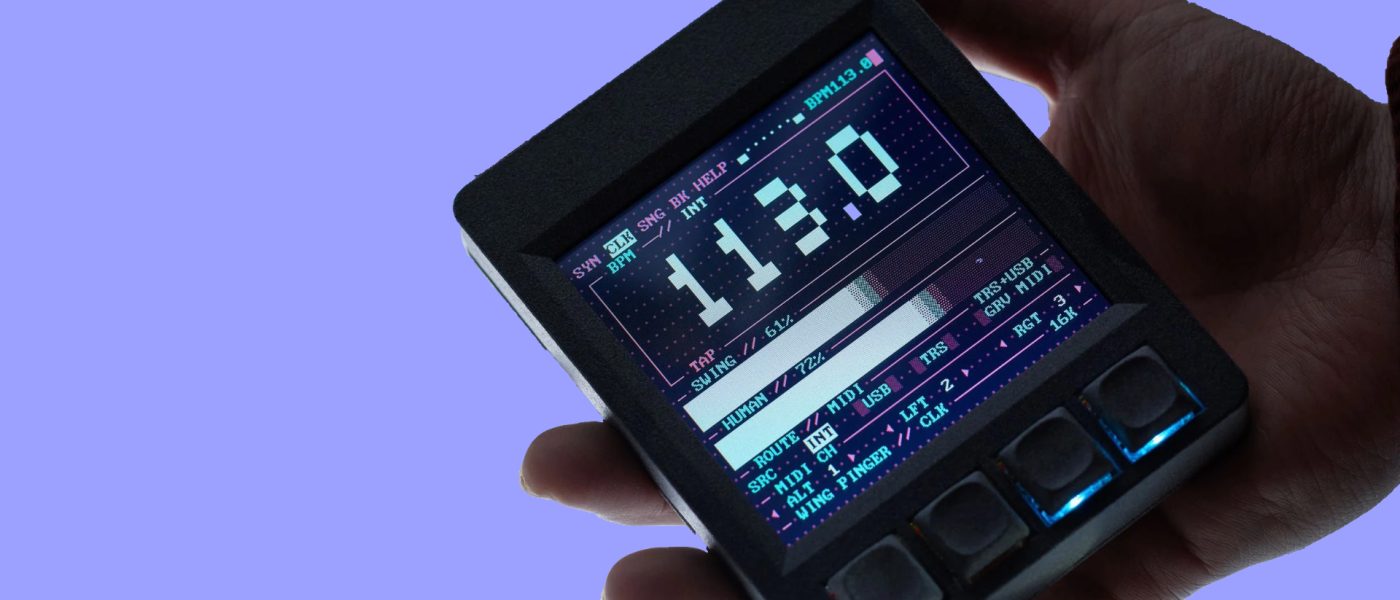
TL;DR: Meng Qi has completely reimagined the Wing Pinger for version 2.0, transforming it from a retro desktop device into a pocket-sized handheld analog feedback instrument with a touchscreen interface and a scriptable engine inspired by Strudel. The core remains a pair of self-oscillating analog filters with cross-feedback, but the new digital layer adds internal modulation, pattern writing, and user-created tools. It’s a radical evolution that turns a niche prototype into a programmable, performance-ready instrument.
- Wing Pinger 2.0 is now a handheld device with a touch display and four clicky buttons, replacing the original’s touch keyboard and knobs.
- The analog core is unchanged: two self-oscillating filters with cross-feedback for plucked-string timbres, chaotic textures, and unstable rhythms.
- A new digital scripting engine, inspired by Strudel, allows users to program modulations, musical patterns, and even create random generators.
- Pricing and release date are TBA; the instrument was shown at Superbooth 2026.
- Meng Qi continues to push boundaries as one of the few true innovators in the synth community, balancing experimental sound design with usable interfaces.
Reading time: 4 min
Want more synth news before your next coffee break? Join the Noxal newsletter — no spam, just gear worth knowing about.

The Evolution: From Desktop to Pocket

We at Noxal have been following Meng Qi’s work since the original Wing Pinger prototype debuted at Superbooth 2019 in the noisy hallway of the FEZ in Berlin. Back then, it was a curious retro device with a touch-sensitive keyboard and tactile knobs—a fascinating but niche oddity. By Superbooth 2020, it had matured into a more playable instrument, but still felt like a prototype in search of an identity.
Version 2.0 is a complete rethink. The touch keyboard and knobs are gone, replaced by a touch display flanked by four clicky buttons. The form factor shrinks to pocket-sized, turning the device into a handheld instrument you can hold and play directly. The new UI has a retro, tracker-like vibe—think LSDJ meets analog feedback. It’s a radical departure, but one that makes sense: by stripping away the bulky interface, Meng Qi has created something that feels more immediate and physical, less like a lab experiment and more like a musical object.
I remember the original prototype’s charm, but this is a leap forward. The whole thing becomes a scriptable feedback system that responds to real-time interruption, guidance, and performance. It’s the kind of design philosophy we don’t see enough of: hardware that doesn’t just sit on a desk, but lives in your hands.
The Analog Core: Unchanged but Refined
At its heart, Wing Pinger 2.0 remains what it always was: a stereo analog feedback instrument built around two self-oscillating filters. The magic lies in the cross-feedback path, which lets each filter feed into the other, creating complex, evolving resonances that can mimic plucked strings, generate chord-like motion, or spiral into chaotic, unstable rhythms.
This core is the soul of the instrument, and Meng Qi has wisely left it untouched. The original’s signature sound—those metallic, ringing textures that can veer from delicate to aggressive—is preserved. What’s new is how you interact with it. The scripting engine (more on that below) lets you modulate filter parameters, create patterns, and build interactions between the analog and digital domains. The result is a system that can produce everything from gentle, melodic sequences to all-out noise assaults—depending on how brave you feel.
One thing we hope has improved: tuning to non-equal temperaments. The original Wing Pinger’s resonators were notoriously difficult to tune outside of standard scales. If version 2.0 makes microtonal exploration easier, it could open up a whole new world for experimental musicians. We’ll need to test it to be sure.
The Digital Brain: Scripting for Sound Designers
The real headline here is the new digital scripting engine, inspired by Strudel (a live-coding environment for music). This isn’t just a preset machine with a few knobs—it’s a fully programmable platform that lets you write your own modulations, patterns, and even create custom tools like random generators.
We at Noxal love this approach because it acknowledges that no single interface can satisfy every user’s needs. Want a chaotic, unpredictable machine? Script it. Want precise, repetitive rhythms? Script it. The scripting layer is designed specifically for Wing Pinger 2.0, meaning it’s tight and focused, not a generic add-on. It’s a bridge between the immediacy of analog and the depth of digital control—a combination that’s rare in hardware.
That said, the demo we’ve heard is… let’s say, less than ideal. One colleague described it as “one of the worst things I’ve ever heard.” But a bad demo doesn’t kill an instrument’s potential. Creative musicians and sound designers should be able to imagine what’s possible: plucked-string timbres, chord progressions that evolve in unexpected ways, textures that feel alive. The instrument is clearly capable of more than the demo suggests.
Market Context and Who Should Care
Meng Qi operates in a fascinating space within the Chinese synth community—far from the budget-focused brands like Behringer or Donner. Alongside other small developers, he’s part of a wave of original thinking that’s increasingly visible at events like Superbooth. The Wing Pinger 2.0 is a statement of intent: that innovation doesn’t require a big budget, just a clear vision and a willingness to take risks.
Who is this for? Not the average musician who wants a straightforward synth with presets. This is for sound designers, experimentalists, and anyone who enjoys programming their own tools. If you’ve ever wished you could script your own modulation sources on a hardware device, this is your jam. It’s also for people who appreciate the physicality of a handheld instrument—something you can hold and perform with, rather than just patch and leave.
Pricing and availability are TBA, but based on Meng Qi’s previous releases, we expect it to be priced for enthusiasts rather than the mass market. If you’re on the fence, wait for more demos from actual users—preferably ones who know how to make it sing.
Frequently Asked Questions
What exactly is the Wing Pinger 2.0’s analog core?
It’s a pair of self-oscillating analog filters with cross-feedback, meaning each filter can feed into the other to create complex, evolving resonances. This is the same core as the original Wing Pinger, producing plucked-string-like timbres, chord-like motion, and chaotic textures.
How does the scripting engine work?
Inspired by Strudel, the scripting engine lets you write code to modulate parameters, create musical patterns, and build custom tools like random generators. It’s designed specifically for Wing Pinger 2.0 and runs on the touch-screen interface with four clicky buttons for navigation.
When will it be available and how much will it cost?
Meng Qi has not yet announced pricing or a release date. The instrument was showcased at Superbooth 2026 in prototype form. We’ll update our coverage as soon as more information emerges.
Now if you’ll excuse us, we need to find a quiet corner and figure out how to script a coffee maker into our Wing Pinger patch. Priorities, people.