
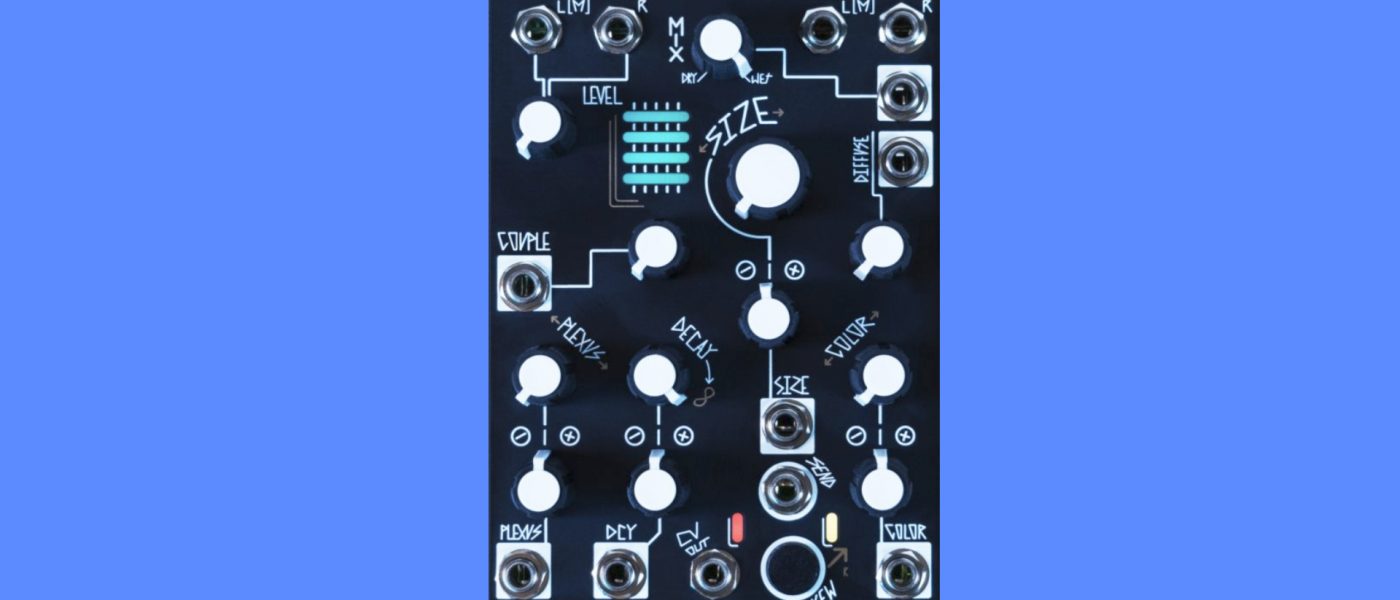
TL;DR: Make Noise and soundhack’s Tom Erbe have unveiled the Plexiphon, a stereo spatial texturizer that refuses to be just a reverb or delay—instead, it morphs continuously between both. Available for pre-order now at $469/€479, it ships June 2026 and offers voltage-controlled exploration of a “modeless” sonic space.
- Plexiphon blends reverb and multi-tap echo without switching algorithms, using a single Plexus control that adjusts feedback paths and their entanglement.
- Stereo manipulation is handled by Couple (from dual mono to fully interlaced) and Skew (inverse or tandem control of left/right Plexus, Size, and Color).
- A Send gate input enables classic dub echo effects, while a CV output provides envelope follower signal for self-patching or external modulation.
- It is not an Erbe-Verb successor—it’s a different beast, with dedicated attenuverters on every parameter.
- Pre-orders are live now, with shipping expected in June 2026.
Reading time: 4 min
Want more synth news before your next coffee break? Join the Noxal newsletter — no spam, just gear worth knowing about.

What is the Plexiphon?

We at Noxal have a soft spot for modules that refuse to fit neatly into a box. The Make Noise Plexiphon, cooked up in collaboration with soundhack’s Tom Erbe, is exactly that: a stereo FX processor that doesn’t call itself a reverb or a delay, and means it. It’s a “modeless spatial texturizer,” and for once, the marketing speak is actually accurate.
Instead of presenting you with a menu of algorithms—hall reverb, shimmer, multi-tap delay—Plexiphon asks you to explore a continuous sonic space. You morph between reverb and echo fluidly, without ever pressing a button or switching modes. It’s the kind of design that forces you to stop thinking about categories and start listening. And yes, everything is voltage-controllable, because what else would you expect from Make Noise?
The Core Architecture
At the heart of the Plexiphon sits the Plexus control. This single knob simultaneously modulates the number of feedback paths in the algorithm and how entangled they are. Turn it one way, you get something that sounds like a room; turn it the other, and you’re in echo territory. The Size parameter, placed prominently near the center, acts as a relationship governor—it behaves like a delay time at one extreme or a room size at the other, depending on where Plexus is set.
Then you have Diffuse and Color, which shape texture and timbre over time. Diffuse moves from soft to sharp, Color from bright to dark. This is where the module’s character really lives. It can sound like a cavern one moment and like Karplus-Strong synthesis on steroids the next. The initial demos we’ve heard are promising, but I suspect the real magic will only emerge once users start patching it into their systems.
Stereo Wizardry
What really sets Plexiphon apart from your average FX module is its stereo architecture. Two parameters here deserve special attention: Couple and Skew. Couple determines how much the left and right sides interact, from dual mono to fully interlaced stereo. Skew offers simultaneous inverse or tandem control of the left and right paths on Plexus, Size, and Color. This is not your grandmother’s ping-pong delay.
There’s also a Send gate input that decides when the input signal feeds into the Plexus—perfect for dub-style effects where you want to trigger repeats at will. And a CV output provides an envelope follower signal that can be patched back into the module’s own controls or elsewhere in your system. Each parameter has its own dedicated attenuverter, so you can dial in exactly how much modulation you want. This is a module that rewards careful patching.
Market Context and Who It’s For
When Make Noise discontinued the Erbe-Verb, many of us expected a direct sequel. Plexiphon is not that. It’s a different animal entirely, and that’s a good thing. The Erbe-Verb was a revelation for its time, but Plexiphon feels like a more mature, more exploratory design. It’s for the user who’s tired of algorithm-switching and wants to live in the gray area between effects.
At $469/€479, it sits in the premium end of the Eurorack FX market, but given the complexity and the collaboration with Soundhack, it feels justified. This is for the modular user who already has a solid foundation of utilities and voices and wants to explore textural, spatial territory that most multi-FX modules can’t touch. It’s also for the Make Noise fan who’s been waiting for something that fits the company’s experimental ethos without being a retread.
Verdict
We at Noxal are cautiously optimistic. The Plexiphon’s modeless approach is genuinely refreshing in a market saturated with algorithm-heavy processors. The real test will come when users get their hands on it and start pushing it into territories even Make Noise didn’t anticipate. The pre-orders are open now, shipping in June 2026, and based on what we’ve seen, it’s a module that could become a staple for anyone interested in texture and space.
I’ll be honest: I’m already planning how to fit it into my own case. The idea of a module that lets you forget whether you’re using reverb or delay is the kind of creative freedom that keeps me coming back to Eurorack. Now if only it brewed coffee.
Frequently Asked Questions
Is the Plexiphon a replacement for the Erbe-Verb?
No. Make Noise has explicitly stated that Plexiphon is not an Erbe-Verb 2. It’s a different design philosophy that blends reverb and delay continuously, rather than offering a single reverb algorithm. If you loved the Erbe-Verb for its specific character, Plexiphon offers a different palette.
Can I use it as a standard delay or reverb?
Kind of. The Plexus and Size parameters let you dial in settings that sound like a reverb or a delay, but you’re always in a hybrid space. There’s no “pure” mode. That’s the point—it forces you to explore the in-between.
What kind of CV control does it offer?
Every parameter has a dedicated attenuverter for CV control. There’s also a Send gate input for triggering the effect and a CV output that provides an envelope follower signal. It’s deeply patchable.
Now if you’ll excuse me, I need to go make another pour-over and stare at the pre-order button until my bank account weeps. The things we do for texture.