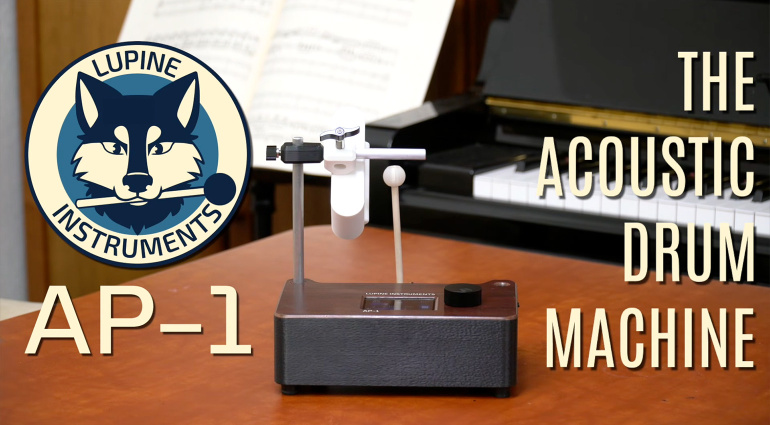
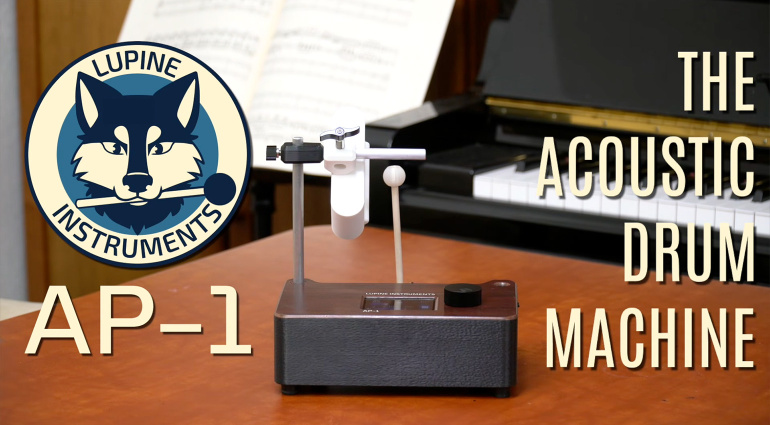
TL;DR: Lupine Instruments has launched the AP-1, a programmable acoustic drum machine that physically strikes percussion instruments with a robotic mallet. Currently a Kickstarter success, it offers both pre-loaded rhythms and MIDI control for a unique hybrid of acoustic sound and electronic precision. Shipping is projected for October 2026.
- It’s a physical robot that holds a mallet or drumstick to strike mounted acoustic percussion like cowbells, woodblocks, or tambourines.
- Features include a touchscreen, two modes (Metronome/Pattern and MIDI), and the ability to load custom rhythms via MIDI files.
- Connectivity is robust with 5-pin MIDI In/Out/Thru, USB-C for data/power, and the ability to chain multiple units.
- The Kickstarter campaign has already tripled its $10,000 goal, with early bird pricing available below the projected $299 retail.
- It’s a niche product for musicians and producers seeking the organic, imperfect sound of real percussion with the programmability of a drum machine.
Reading time: 4 min
Want more synth news before your next coffee break? Join the Noxal newsletter — no spam, just gear worth knowing about.
What Is This Robotic Thing?

Let’s be clear: when we talk about drum machines at Noxal, we’re usually discussing voltage-controlled oscillators, sample layers, or perhaps the tactile joy of a sequencer’s rubber pads. The Lupine Instruments AP-1 is none of those things. It is, instead, a small wooden box with a mechanical arm that quite literally hits things. It’s a robot percussionist, a programmable automaton designed to bring the clatter and ring of actual, physical objects into your electronic workflow. The concept isn’t entirely new—artists like Aphex Twin have famously employed robotic ensembles—but packaging it as an accessible, desktop instrument is a fascinating proposition.
The unit itself is charmingly straightforward. You get the main housing, a “hand” to grip a provided mallet or drumstick half, and two metal rods upon which you can mount virtually any handheld percussion: a cowbell, a jam block (included), a tambourine, a small cymbal. Two built-in clamps allow you to attach it to standard percussion stands, making it a potential studio centerpiece or a quirky live performance tool. The face of the device is dominated by a touchscreen, which feels like a necessary modern concession to control what is, at its heart, a beautifully simple mechanical idea.
Specs and Smarts Under the Hood
Don’t let the rustic “wooden box with a stick” aesthetic fool you; the AP-1 has a digital brain. It operates in two primary modes. The first is a combined Metronome and Pattern mode, where you can adjust tempo and cycle through pre-loaded acoustic rhythms like a clave or a swing pattern. This is where it functions most like a traditional drum machine, albeit one that makes sound through kinetic energy rather than a speaker. The second, and arguably more powerful, mode is MIDI control. Using the 5-pin MIDI In port, you can trigger the left and/or right strike mechanisms from any controller or sequencer, with velocity directly controlling the force of the hit.
The connectivity is thoughtfully comprehensive. Alongside the MIDI In, there’s a MIDI Out/Thru port for daisy-chaining multiple AP-1s—imagine a small robotic percussion section. A USB-C port handles both charging and data transfer, allowing you to upload your own MIDI pattern files directly to the device. The touchscreen lets you fine-tune parameters like a volume slider (which adjusts strike intensity) and specify MIDI channels and note assignments. It’s this marriage of simple mechanics and modern control that makes the spec sheet interesting.
Who Is This For, and Why?
I can hear the purists now: “Why not just hire a percussionist?” or “My Roland TR-8S has amazing cowbell samples.” Both are valid points. The AP-1 isn’t about convenience or sonic perfection. It’s about texture, randomness, and the physicality of sound. It’s for the producer who craves the slight inconsistencies of a real stick hitting wood—the minute variations in timbre and timing that breathe life into a track. It’s for the live performer who wants a visual, kinetic element on stage, a machine that visibly participates in the music. It’s for the studio tinkerer who has a shelf full of exotic percussion but lacks the coordination to play it in time with a sequencer.
This sits in a wonderful niche between the world of modular synthesis (where physical triggers are king) and acoustic recording. It provides the loop-able, programmable precision of electronics but delivers an inherently organic sound. The noise of the mechanism, the resonance of the mounted instrument, the room sound—all of it gets captured by your microphones. It’s a production choice, an aesthetic statement. You’re not buying it because it’s the easiest solution; you’re buying it because it’s a uniquely characterful one.
The Kickstarter Context
As of this writing, the AP-1’s Kickstarter campaign has blasted past its $10,000 goal, sitting comfortably at over triple that amount. This market validation is significant for such a niche product. It tells us there’s a genuine appetite for hardware that breaks the mold, even if it comes with the inherent risks of crowdfunding. The early bird pricing offers a discount from the projected $299 retail, and the package includes a commendable kit: the unit, a jam block, mallets, rods, clamps, and necessary cables.
However, we must note the estimated shipping date: October 2026. That’s a considerable lead time, a reminder that funding a prototype and delivering a manufactured product are worlds apart. While the campaign’s success is promising, backers are essentially pre-ordering a concept with a two-year horizon. For those burned by delayed or failed music tech Kickstarters (a club to which, sadly, I sometimes belong), this requires a leap of faith. Yet, the sheer novelty and executed prototype shown in the campaign videos suggest Lupine Instruments has done more than just scribble an idea on a napkin.
Frequently Asked Questions
Can the AP-1 hit any percussion instrument?
Within reason, yes. It’s designed for handheld percussion that can be mounted on its provided 3/8″ rods or secured nearby. Think cowbells, woodblocks, tambourines, small drums like bongos, or even things like frying pans. Larger or heavier instruments might be a challenge for the mechanism’s striking force and mounting stability.
How do you program your own rhythms?
You have two main paths. First, you can create a MIDI pattern in your DAW, export it as a standard MIDI file, and upload it to the AP-1 via the USB-C port. Second, you can use the MIDI Mode to play it live from a keyboard or sequencer, recording the performance externally. The internal pattern mode is more for playback of pre-set or uploaded sequences.
Is it loud? Can you control the volume?
The volume is purely acoustic and depends on what you’re hitting and how hard. The AP-1 does have a “volume” slider in its interface, which controls the velocity/intensity of the strike. Softer hits will be quieter, harder hits will be louder. There is no internal speaker or audio output—the sound comes solely from the physical percussion instrument being struck.
I’m now seriously considering clearing a space on my desk next to the coffee grinder for a small, polite robot to handle my tambourine duties. The future is oddly charming.