TL;DR: Line 6 has released firmware 1.3 for the Helix Stadium, introducing “Proxy,” a cloud-based amp cloning feature for more detailed profiles. The update also adds five new Agoura amp models and expands the “Showcase” stage automation system. This follows the recent European pre-order availability of the Helix Stadium Floor and XL Floor units.
- Firmware 1.3 introduces “Proxy,” a cloud-powered amp cloning tool for creating detailed profiles of amp+cab, amp, preamp, and distortion pedal setups.
- Five new Agoura amp profiles are added, including models based on a Matchless DC-30 and an Orange Rockerverb 100 MKIII.
- The “Showcase” feature for automating entire stage setups receives additional functionality.
- The Helix Stadium Floor and XL Floor are now available for pre-order in Europe with a 3-4 week delivery estimate.
- The new models feature an 8-inch touchscreen, twelve footswitches, and unique features like drum trigger inputs and preset audio samples.
Reading time: 6 min
Want more synth news before your next coffee break? Join the Noxal newsletter — no spam, just gear worth knowing about.

The Stadium Arrives
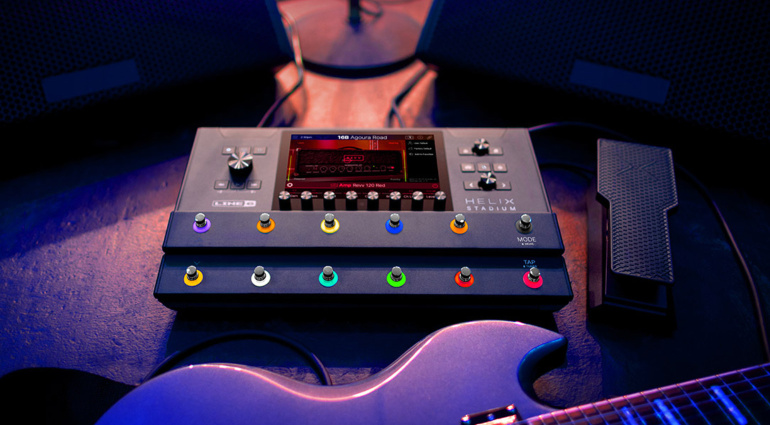
Let’s be clear: we at Noxal typically have our knobs set to filter, not overdrive. But when a piece of hardware pushes the envelope of digital modeling this aggressively, it demands our attention. Announced in June and now finally available for pre-order in Europe, the Line 6 Helix Stadium isn’t just an update; it’s a declaration. It arrives in two flavors: the Helix Stadium Floor and the larger Helix Stadium XL Floor, both built around a frankly intimidating 8-inch touchscreen. This isn’t a subtle tweak to the Helix formula; it’s a complete architectural overhaul aimed at the main stage.
The spec sheet reads like a wish list for the modern gigging musician who secretly wants to be their own front-of-house engineer. Twelve footswitches, a plethora of knobs, and connectivity that would make a small mixer blush. But the real intrigue for us synth-heads lies in the periphery. Two inputs for drum triggers? That’s not just for guitarists; that’s a gateway for electronic percussionists to integrate their rigs. A “Hype” control that continuously morphs between two amp emulations? That’s a textural sweep worthy of any ambient pad. Line 6 is clearly building a command center, not just a pedalboard.
Perhaps the most synthesizer-adjacent feature is the new preset system, which borrows a page directly from soft synths like Serum. Each preset can be tagged with a directly played audio sample. Imagine scrolling through hundreds of patches and hearing a quick riff or chord that instantly tells you what you’re in for, without having to plug in. It’s a simple, brilliant quality-of-life improvement that highlights the Stadium’s software-inspired DNA. For a company with deep roots in guitar tech, this feels like a conscious nod to a broader world of sound design.
Firmware 1.3: Proxy in the Cloud
Now, onto the real news: Firmware 1.3. If the Stadium’s hardware is the body, this update is a significant brain transplant. The headliner is “Proxy,” a new cloud-based amp cloning feature. The concept is fascinating: instead of processing the complex profiling algorithm entirely on the device, you capture the “training data” from your amp, cab, preamp, or distortion pedal, and upload it via a secure connection to Line 6’s servers. Their more powerful hardware chews on the data and sends back a more detailed, nuanced profile to your unit.
This “cloud compute” model for tone cloning is a genuine innovation in the hardware space. We’re used to firmware updates that add models, but this is a framework for adding your models, with potentially greater accuracy. The first iteration supports cloning for four setups: a full amp and cabinet, a standalone amp, a preamp section, or a distortion pedal. It raises immediate questions about latency, internet dependency for creation (not use), and the long-term ecosystem. But as a proof of concept, it’s bold. It suggests a future where your favorite obscure amp, the one no manufacturer will ever model, can live inside your floorboard with studio-grade fidelity.
I have to admit, the idea gives me pause. My studio ritual involves turning on hardware that works, offline, forever. The notion of sending my precious, possibly faulty tube amp’s essence into the ether for processing feels… modern. But it’s also undeniably clever. It offloads intensive DSP work, potentially allowing for more complex algorithms than the Stadium’s onboard processor could handle in a reasonable time. It’s a trade-off: a slice of convenience and potential quality for a sliver of your traditional, offline sovereignty.
More Amps, More Showcase
Of course, Line 6 hasn’t skimped on the more traditional update fodder. Firmware 1.3 adds five new profiles for its “Agoura” modeling engine. We get the “Matchstick 30” (based on a Matchless DC-30) with Channel 1, Channel 2, and a “Jumped” version, and the “Mandarin Rock 30” (based on an Orange Rockerverb 100 MKIII) with Normal and Overdrive channels. This follows the seven Agoura amps added in December’s 1.2 update, which included models based on Fender, Marshall, and Mesa/Boogie classics. The library is building rapidly, showcasing the Agoura engine’s range from pristine clean to saturated high-gain.
The other major pillar getting an upgrade is the “Showcase” feature, introduced in version 1.2. This is Line 6’s ambitious system for allowing the Helix Stadium to automate and control an entire stage setup—think lighting changes, synth patch changes via MIDI, and DAW transport control, all synced to your setlist. Version 1.3 expands its automation capabilities, though the specifics are still emerging. For the solo performer or bandleader, this transforms the Stadium from an instrument processor into the central nervous system of a live show.
Context is key here. These aren’t trivial additions. They represent a dual strategy: deepen the core tone-shaping tools (Proxy, new amps) while exponentially expanding the unit’s role in a performance ecosystem (Showcase). It’s a one-two punch aimed at securing the Stadium’s position as the most comprehensive floor unit on the market. For the musician who does it all, it’s incredibly compelling. For the rest of us, it’s a fascinating case study in how far a “multi-effects processor” can be stretched.
Who Is This For, Anyway?
So, who is the Helix Stadium for? It’s not for the pedalboard purist who cherishes individual analog boxes. It’s not for the bedroom player who just needs a good amp sim. The price point, the footprint, and the feature set scream “professional.” This is for the touring guitarist who needs absolute reliability, vast tonal variety, and deep integration with their show. It’s for the studio session player who needs to recall any sound instantly. It’s for the forward-thinking electronic musician who sees the drum trigger inputs and extensive MIDI implementation as a bridge to their synth rig.
The pre-order situation underscores its professional target. After months of US availability, European players can now order from retailers like Thomann with a 3-4 week lead time. It’s a significant investment, positioning itself against the likes of Neural DSP’s Quad Cortex and Fractal Audio’s FM9. The Stadium’s differentiators are clear: that massive touchscreen, the innovative Proxy cloning, and the expansive Showcase automation. It’s betting on a future where the floor unit is the smartest piece of gear on the stage.
From our synth-centric perch at Noxal, the Helix Stadium is a reminder that the lines between instrument categories are blurring. A device with this much processing power, I/O, and control capability is, fundamentally, a powerful digital audio workstation for your feet. Whether you’re shaping guitar tones, processing synths through its effects loops, or using it to trigger samples and control your modular rack via MIDI, it’s a hub. Firmware 1.3, with its cloud-connected cloning and stage automation, only deepens that reality. It’s less a guitar pedal and more a platform.
Frequently Asked Questions
Do I need an internet connection to use the Proxy amp clones I create?
No. Once the cloning process is complete and the detailed profile is downloaded back to your Helix Stadium from Line 6’s servers, the profile resides entirely on your hardware. You do not need an ongoing internet connection to use it. You only need connectivity during the initial upload and processing phase.
Can I import my presets from an older Helix (LT, HX Stomp, etc.) into the Helix Stadium?
Yes. Line 6 has stated that presets from older Helix models can be imported directly into the Helix Stadium and should open without any change in sound, providing a seamless upgrade path for existing Helix users.
What exactly are the drum trigger inputs for?
The two 1/4″ drum trigger inputs on the Helix Stadium Floor (the XL has other configurations) allow you to connect electronic drum pads or acoustic drum triggers. This lets you use the Stadium’s powerful processing for kick and snare samples, or to trigger other sounds and effects within your rig, effectively integrating live electronic percussion into a guitarist’s—or anyone’s—setup.
I’m going to need a stronger coffee to process the idea of my amp having a cloud-based digital twin. My Juno-60 would never stand for it.