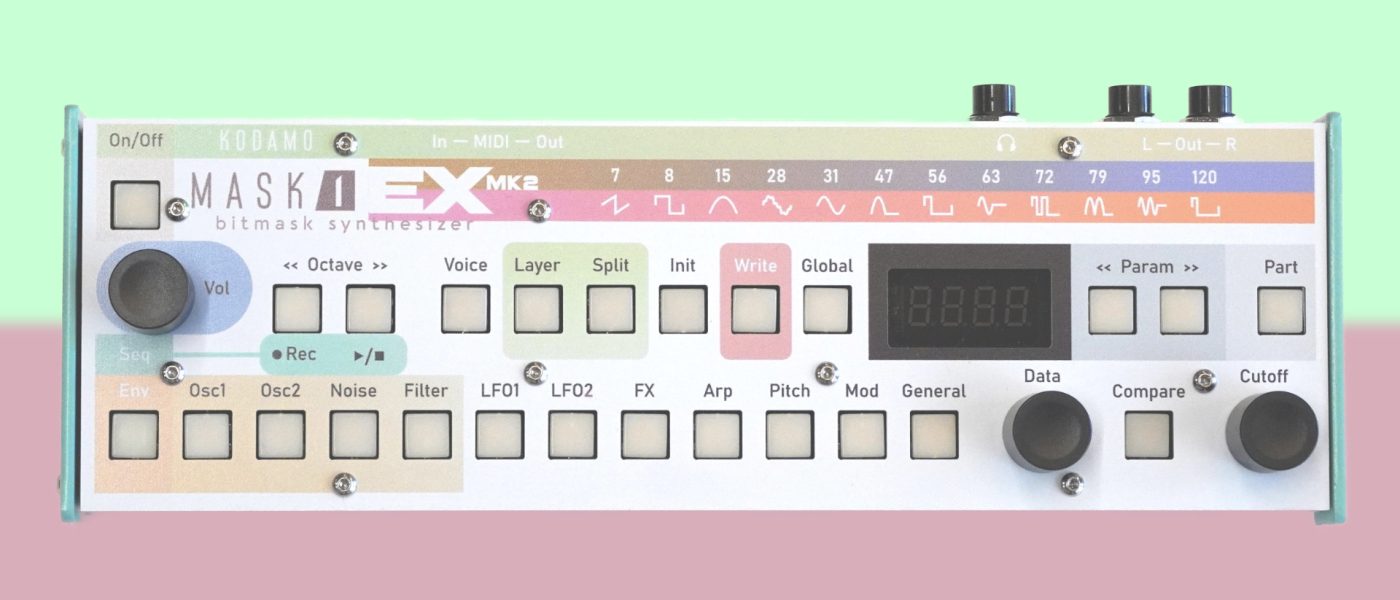
TL;DR: Kodamo has resurrected its compact desktop synth with the MASK1EX MK2, a limited-edition update to the cult-favorite bitmask synthesizer. It packs the same unique digital engine into a new, colorful steel case, adds a dedicated filter knob, boosts the voice count to 14, and promises a half-second boot time. For under €500, it’s a potent, portable box of digital weirdness.
- The MASK1EX MK2 is a limited-edition, 14-voice bi-timbral desktop synth based on Kodamo’s proprietary Bitmask synthesis.
- Key upgrades from the MK1 include a new multi-colored steel case, a dedicated cutoff knob, two extra voices, and a faster 0.5-second startup.
- The core engine features two bitmask oscillators (512 waveforms each) per voice, dual digital filters, four loopable envelopes, and a rich suite of onboard stereo effects.
- It retains the unique, expression-focused performance features like mappable velocity/aftertouch and various slur/poly-mono voice modes.
- Priced at €382 (+VAT), it’s positioned as an affordable, portable entry point into Kodamo’s distinctive sonic world.
Reading time: 4 min
Want more synth news before your next coffee break? Join the Noxal newsletter — no spam, just gear worth knowing about.

The Phoenix of Bitmask

In the world of hardware synths, true originality is a rare bird. More often, we see the same subtractive architectures dressed in new panels. So, when a genuinely novel engine like Kodamo’s Bitmask synthesis appears, its fans tend to hold on tight. The original MASK1 was that kind of synth—a powerful, peculiar, and pricey keyboard that carved out a niche. Its more affordable, desktop offspring, the MASK1EX, then achieved something remarkable: it sold out almost immediately. For a one-man operation, that’s the kind of “problem” you dream of. The demand signaled a hunger for accessible weirdness.
Now, ahead of SynthFest France 2026, Kodamo has answered the call with the MASK1EX MK2. This isn’t just a re-stock; it’s a refinement. The most immediate change is sartorial. Gone is the utilitarian casing, replaced by a new, multi-colored powder-coated steel chassis. It’s a statement piece that weighs in at a featherlight 632 grams, making it arguably one of the most portable desktop powerhouses available. More importantly, it represents the second life of a concept that, frankly, deserved one. As someone who lamented the original MASK1’s departure, seeing its spirit distilled into this compact, travel-ready form is a cause for a celebratory espresso.
Under the Colorful Hood
Don’t let the playful exterior fool you; the MK2’s brain is serious digital business. At its core remains the Bitmask synthesis engine, which uses 512 different waveforms per oscillator—not as wavetables, but as a palette for a more granular, often gritty, form of sound generation. Each of the 14 voices (a bump from the MK1’s 10 and even the flagship MASK1’s 12) gets two of these oscillators, a noise generator, two multimode digital filters (12dB and 24dB), four loopable envelopes, and two multi-waveform LFOs.
The spec sheet reads like a wishlist for digital sound designers. The effects section alone is staggering: two stereo effects in series, with the first offering 64 types of phaser, distortion, bitcrusher, tremolo, and ring mod, and the second providing 48 types of delay, reverb, and comb filter. Bi-timbrality means you can split or layer two completely different patches across your keyboard or sequencer. And with 377 factory presets and 200 user slots (backup-able via computer), the palette is vast from the moment you plug it in. A particular point of pride for Kodamo is the boot time—a blistering 0.5 seconds. In an era of loading bars, that’s a small but profound luxury.
Interface Philosophy and Playability
The original MASK1EX’s button-only interface was a point of fascination and, for some, friction. The MK2 addresses one of the most requested tweaks: a dedicated cutoff frequency knob. It’s a single control, but its impact on usability is massive, making sound-sculpting far more immediate. Beyond that, the interface philosophy remains. Modulation is assigned via a matrix system where you map sources (velocity with 6 destinations, modwheel and aftertouch with 16 each) to targets. It’s menu-driven but logical, trading a sea of knobs for compactness.
Where the MASK1EX MK2 truly sings is in its expressive playability. The various voice modes—slurred, poly-mono, hybrid—dramatically alter how notes interact, creating beautiful, evolving pads or biting, articulate leads depending on your playing style. Couple this with the mappable aftertouch, and you have a desktop module that begs to be played with feeling, not just programmed. The inclusion of an advanced 26-pattern arpeggiator and a looper further cements its status as a potent standalone sketchpad or a dynamic studio voice.
Market Context and the Limited-Edition Gamble
Priced at €382 (plus VAT, bringing it to around €458), the MK2 sits in a fascinating space. It’s more expensive than the MK1 was, but the justification is there: the new metal case, the extra voices, the usability tweak. For under €500, you get a bi-timbral, 14-voice digital synth with a unique engine and pro-grade effects. In a market flooded with $500+ monosynths, that represents significant value for the polyphonically inclined and experimentally minded.
However, the “Jade Vine Limited Edition” tag is a double-edged sword. On one hand, it creates urgency and exclusivity, a proven tactic for small manufacturers to manage cash flow and production risk. On the other, as commenters on the original news rightly pointed out, it risks leaving demand on the table. The MK1 sold out in days; why not plan a standard, ongoing production run? The hope, shared by many enthusiasts, is that this MK2’s success proves there’s a sustainable market for Kodamo’s vision, paving the way for more accessible Bitmask devices—perhaps a drum machine or that rumored rompler—in the future. For now, if you want one, you’ll need to move fast. Again.
Frequently Asked Questions
What exactly is “Bitmask” synthesis?
Bitmask synthesis is Kodamo’s proprietary digital synthesis method. Instead of traditional oscillators or wavetables, it uses a bank of 512 single-cycle waveforms per oscillator that are manipulated using bitwise operations (hence “bitmask”). This can generate everything from classic analog-style waves to complex, evolving, and often digitally-textured sounds that are distinct from typical wavetable or FM synthesis, offering a unique palette for sound design.
Is the MASK1EX MK2 a good first hardware synth?
It’s a fantastic and powerful synth, but its interface—relying heavily on a button matrix and menu for modulation—has a learning curve. For a absolute beginner wanting a straightforward, knob-per-function analog poly, there might be simpler options. However, for a beginner fascinated by digital sound exploration and willing to learn a unique system, its bi-timbrality, effects, and preset library offer immense creative potential right out of the box.
Can it run on batteries or is it USB bus-powered?
The MASK1EX MK2 requires an external DC power supply (included). It is not USB bus-powered, nor does it have a battery option. The USB port is for MIDI, audio, and preset data transfer only. Its lightweight design is for portability between studios or gigs, not truly untethered operation.
Now, if you’ll excuse me, I need to clear a spot on my desk for a colorful new box and refresh the ‘checkout’ page repeatedly. My coffee’s getting cold, but some rituals are worth it.