
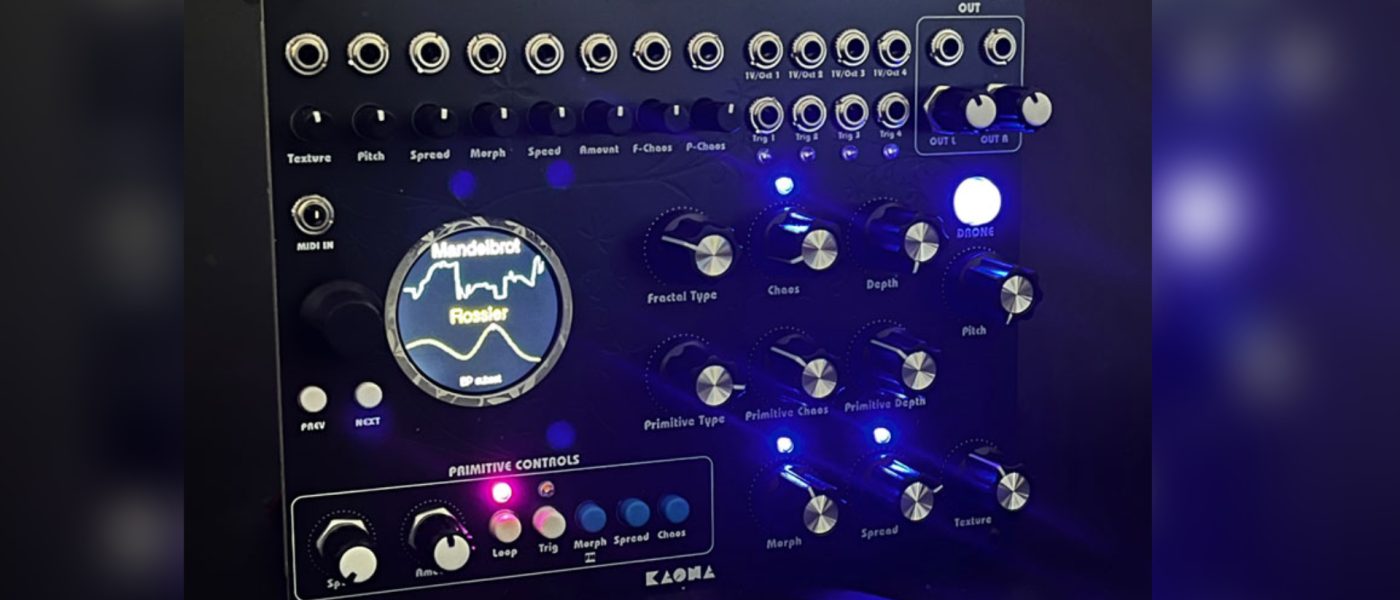
TL;DR: Kaona has unveiled the Fractaos, a 32HP, 4-voice polyphonic oscillator and synth voice for Eurorack that eschews classic waveforms for fractal synthesis. It generates up to eight real-time fractal shapes, offering a path to complex, organic, and decidedly non-analog timbres. Pre-orders are open at an early-bird price of €474.30, with shipping slated for the end of May 2026.
- Fractal Synthesis Core: Generates sound from fractal shapes, not traditional waveforms, for complex and moving timbres.
- 4-Voice Polyphony & Drone Mode: Can be played polyphonically via MIDI or four 1V/oct CV inputs, or drone all eight internal oscillators.
- Dual Fractals Per Voice: Each of the four voices features a main fractal shape and a modulating fractal primitive for deep sound shaping.
- Complete Synth Voice: Includes a polyphonic ADSR envelope, extensive CV modulation (8 bipolar inputs), and internal preset memory.
- Experimental Digital Niche: Aims to bring a rarely implemented synthesis method into the hardware modular domain.
Reading time: 4 min
Want more synth news before your next coffee break? Join the Noxal newsletter — no spam, just gear worth knowing about.

Beyond the Sine Wave: What is Fractal Synthesis?
Let’s be honest: the Eurorack landscape is lush, but sometimes it feels like a forest of sawtooth trees. We love our analog VCOs—the warmth, the drift, the immediate familiarity. But the digital revolution within the rack has opened doors to rooms we didn’t even know existed. First came wavetables, then granular clouds, and now, from the mind of Gilles at Kaona, comes a module that asks: what if your oscillator wasn’t a wave at all, but a shape that repeats itself infinitely at different scales?
That’s the premise of fractal synthesis. Instead of cycling through a predefined voltage pattern to create a sine, triangle, or square, the Fractaos generates audio from mathematical fractals. Think of the Mandelbrot set or a Koch snowflake—structures where the same intricate pattern appears no matter how far you zoom in or out. Kaona claims this approach yields sounds that are “more complex, moving, and almost organic.” It’s a synthesis method that has lived mostly in academic software or bespoke Max/MSP patches. To see it distilled into a dedicated, performance-ready 32HP module is, frankly, audacious.
The implications are significant. This isn’t just another digital oscillator with a fancy filter; it’s a fundamentally different sound generation engine. The timbres won’t mimic a Minimoog or a Prophet. They’ll be their own strange, textured, and evolving thing. In a world chasing vintage emulation, Fractaos isn’t looking backward. It’s peering into a mathematical abyss and asking it to sing.
The Fractaos Breakdown: Voices, Shapes, and Controls
So, what are you actually getting in this 32HP package? At its heart, the Fractaos is a four-voice polyphonic synth voice. Each voice is built from a dialogue between two fractal elements: a main fractal shape and a “fractal primitive” that can modulate, bend, and drift the primary shape. That gives you eight real-time fractal oscillators to play with. Control over this relationship is where the magic happens. You can morph between them, detune, create chords, or push into FM-style interactions.
The panel offers shaping via “chaos” and “calculation depth” controls, likely governing the complexity and recursion level of the fractal algorithms. It features a dedicated polyphonic ADSR envelope, turning it into a complete voice straight out of the box. Connectivity is robust: four 1V/oct inputs for CV polyphony, a 3.5mm MIDI input (with velocity and aftertouch support), eight bipolar CV inputs for modulation, and four trigger inputs. It also has internal memory to save your meticulously crafted fractal landscapes.
Notably, it offers two primary modes: a true 4-voice polyphonic mode for playing chords, and a drone mode where all eight oscillators activate continuously for massive, shifting textural beds. The power draw is very reasonable for a digital module of this capability at +12V: 210 mA; -12V: 40 mA. The spec sheet paints a picture of a deeply considered instrument, not just a tech demo.
Market Context and Courage
We have to tip our hat to Gilles at Kaona. Following last year’s intriguing Sisyphus granular filter, Fractaos continues a clear mission: to port deeply experimental, computer-centric synthesis methods into the tactile, voltage-controlled world of Eurorack. This is not the safe path. As the source text notes, many developers avoid such niches, fearing commercial failure. The market for a fractal synthesis module is, by definition, smaller than the market for a 3340-based VCO.
Yet, this is precisely how the modular ecosystem grows and stays vital. Modules like Fractaos, Error Instruments’ Sputnik Radio, or other “boutique brain” devices expand the palette available to patchers. They are the modules that make a system uniquely yours, that generate sounds you simply cannot get elsewhere. The first demo recordings confirm this: the sound is digital, strange, and oddly compelling. It won’t replace your primary oscillator, but it might become the secret weapon for cinematic rises, alien atmospheres, or percussive sounds that feel grown, not manufactured.
Its announcement alongside more traditional gear like the ELTA Music POLIVOKS PM-02 highlights the beautiful dichotomy of modern synth culture. One side draws from the rich, comforting past; the other, like Kaona, is sketching a possible future, one fractal at a time.
For Whom is the Fractal Calling?
Who is the Fractaos for? It’s not a beginner’s first oscillator. If you’re building a classic east-coast subtractive voice, you’ll want something more foundational. This module is for the explorer, the sound designer, the patcher whose rack already has the staples and is hungry for new frontiers. It’s for composers working in film, game audio, or experimental music who need to generate unique, evolving textures and uncanny melodic content.
It’s also a powerful tool for drone musicians. The dedicated drone mode, leveraging all eight oscillators, promises a rich, living tapestry of sound that could be the centerpiece of an ambient performance. The extensive CV modulation inputs mean these complex textures can be manipulated in real-time with LFOs, sequencers, and pressure, making the static very much dynamic.
At an early-bird price of €474.30 (rising to €558), it’s a significant investment. You’re paying for specialized R&D and a unique sonic identity. If your goal is to have a rack that sounds like no one else’s, and you’re fascinated by the intersection of mathematics and music, the Fractaos isn’t just an option—it might feel like a necessity. Just don’t expect it to sound like your grandmother’s polysynth. Expect it to sound like a conversation between two infinitely complex shapes.
Frequently Asked Questions
Is the Kaona Fractaos analog or digital?
The Fractaos is a digital module. Its core is a processor running algorithms for real-time fractal generation. This allows for the complex, evolving waveforms and polyphonic capabilities that would be extremely difficult, if not impossible, to achieve with analog circuitry alone.
Can I use it without a MIDI keyboard or sequencer?
Absolutely. While it has MIDI and multi-CV polyphonic input, the Fractaos also has a dedicated drone mode. In this mode, all eight internal fractal oscillators activate continuously, allowing you to shape and modulate a massive drone texture directly from the panel and its CV inputs, no external controller needed.
What does “fractal synthesis” actually sound like?
Based on early demos and the nature of the technique, expect sounds that are complex, inharmonic, and often textural. They can range from metallic, bell-like tones and formant-like vowels to gritty, noisy atmospheres and evolving drones. The character is described as “organic” and “moving,” distinct from the static purity of basic analog waveforms or the curated slices of a wavetable.
I’ll be over here, attempting to visualize the Mandelbrot set in my coffee foam while my bank account quietly weeps at the prospect of another uniquely esoteric module.