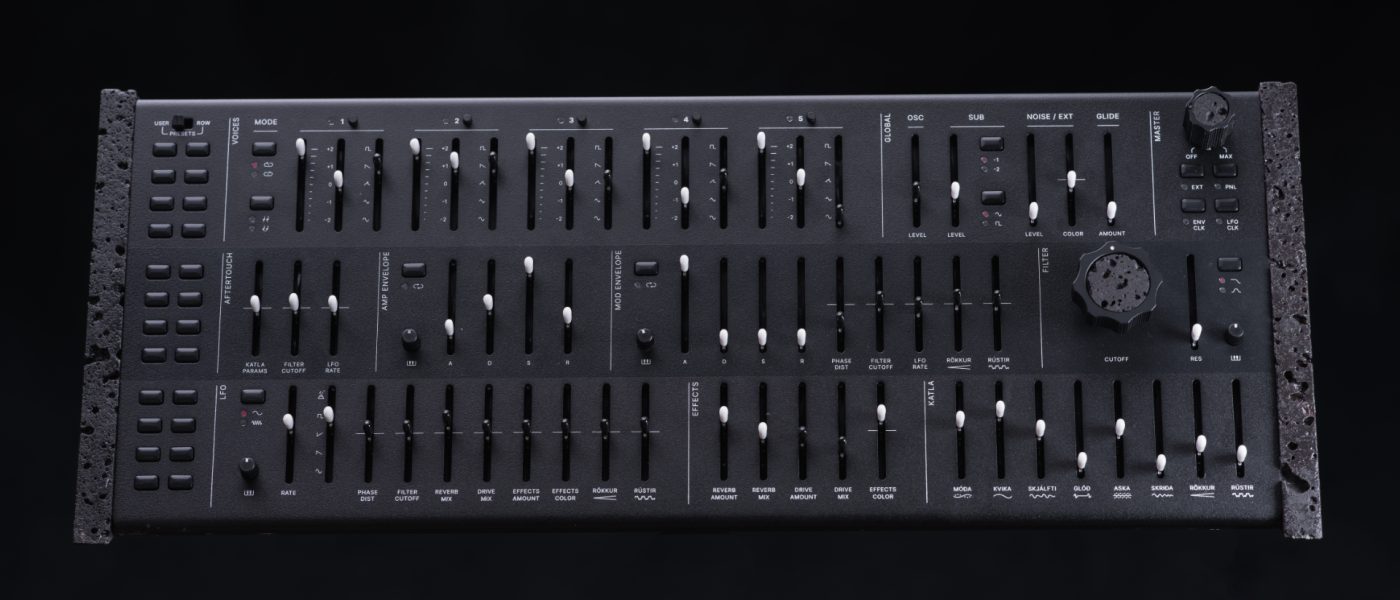
TL;DR: The Genki Katla, a hybrid polyphonic synthesizer with a unique rotating voice engine and panels forged from Icelandic lava, is now shipping. Announced at the end of 2024, this desktop synth blends digital oscillators with a complex, characterful analog signal path. It’s available now for a volcanic 4990€.
- Katla is a 5-voice hybrid synth with digital oscillators and a fully analog filter, wavefolder, distortion, and amplifier section.
- Its core feature is a rotating voice engine with six modes (three round-robin, three unison) that dynamically allocate notes across its five discrete voices.
- Each voice has individual filters, amps, LFOs, and envelopes, plus a suite of “Katla” parameters that add organic instability like tuning drift and tape wow/flutter.
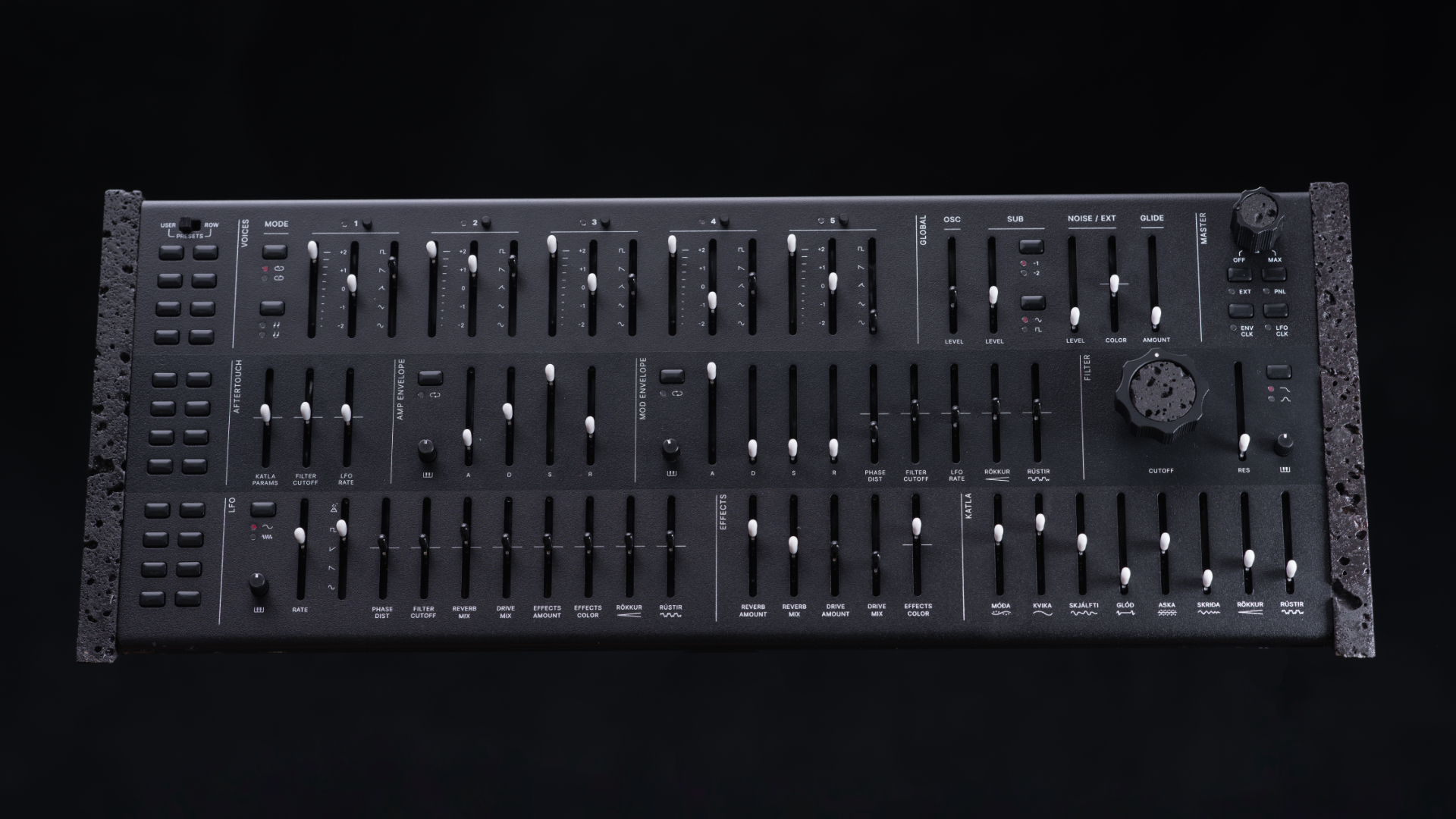
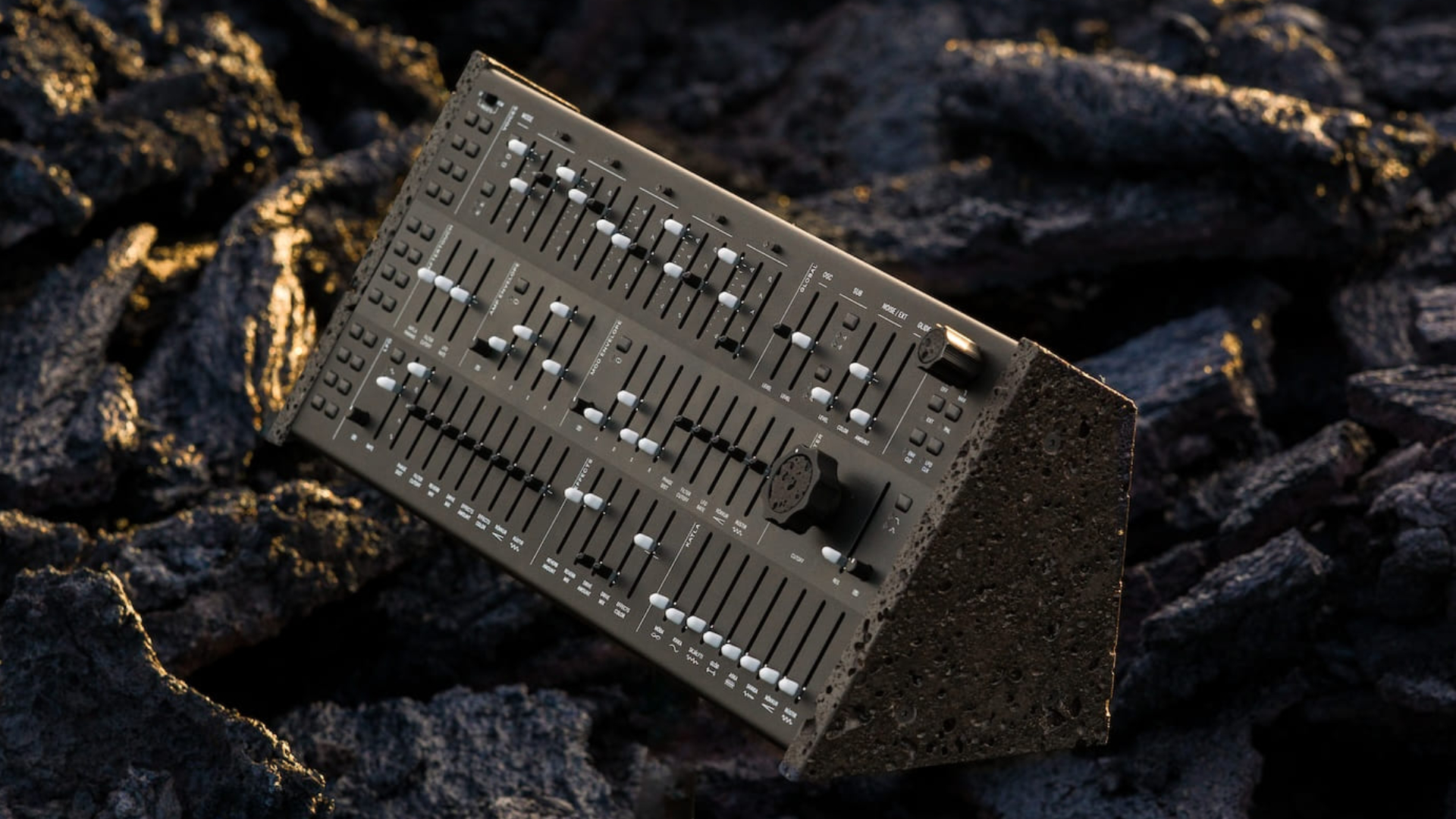
- The physical design includes side panels and knobs made from authentic Icelandic lava rock, making each unit visually unique.
- It features extensive connectivity, including five external audio inputs (one per voice), MPE support, and three USB-C ports for power, data, and USB host functionality.
Reading time: 5 min
Want more synth news before your next coffee break? Join the Noxal newsletter — no spam, just gear worth knowing about.
The Volcano Awakens
When Genki Instruments—the folks behind the Wave MIDI ring—first showed images of the Katla synth in late 2024, many of us dismissed it as an artful marketing stunt. A synth with lava rock panels? A “volcano” synthesizer? It sounded like the kind of hyperbolic, Instagram-bait concept that fades away after NAMM. But Genki did something unusual: they kept working. They released development updates, showed it at Buchla & Friends 2025, and have now done the unthinkable: they’ve actually shipped it. The Katla is real, it’s here, and it costs a tectonic 4990€.
The concept is rooted in literal earthiness. Named after Iceland’s largest and most notorious volcano, Katla aims to sonically embody chaos, instability, and raw natural power. This isn’t just poetry; the synth’s side panels and several knobs are forged from authentic Icelandic lava rock. Genki claims this isn’t a veneer or a composite, but the real, porous, unpredictable stuff. The result is that no two Katalas will look exactly the same, each bearing the unique geological fingerprint of its source material. It’s a bold statement in an industry often obsessed with sterile, anodized aluminum.
The Rotating Heart of Katla
Beneath the rocky exterior lies the synth’s truly innovative engine: a multimodal voice allocation system for its five discrete polyphonic voices. This isn’t your standard static voice assignment. Katla gives you six ways to route incoming notes. You get three round-robin modes: forward, backward, and random. In these modes, each new note you play is assigned to the next voice in the sequence, creating a constantly rotating tapestry of sound where subtle differences between voices become a compositional feature, not a bug.
Then you have three unison modes: Staccato (envelopes re-trigger with every note), Legato (envelopes re-trigger only after all keys are released), and a Mono mode that piles all five voices onto a single note for a thick, stacked sound. This rotating concept is the Katla’s central nervous system. It promises evolving, never-static textures, especially when paired with the synth’s other secret weapon: the “Katla” parameters, a suite of digital modulators designed to inject beautiful, organic instability into every note.
Analog Inferno, Digital Core
Katla is a hybrid in the classic sense: digital oscillators into an analog signal path. The five digital voices are individually tunable and feature waveform morphing. But the magic—and the promised “warmth, grit, and dynamic character”—happens in the analog domain. The signal hits a classic multimode filter (with cutoff, resonance, and keytracking) before being fed into what Genki calls the “Inferno quartet”: four distinct analog distortion stages.
This includes a phase distortion, a West Coast-style wavefolder dubbed “Rústir,” a stereo CMOS distortion for “juicy” colorations, and a gentler signal overdrive. It’s a distortion playground. Furthermore, each voice has its own independent analog VCA, VCF, LFO, and looping envelope, allowing for deep, voice-specific modulation. To top it all off, there’s a lush stereo digital reverb for ambiance and full MPE support, making this desktop module a potentially expressive performance tool.
Forged in Fire, Wired for Chaos
The connectivity here is as thoughtful as it is extensive. On the back, you’ll find five individual external audio inputs, each hard-routed to one of the five voices. This allows you to process external audio sources—drum machines, other synths, a coffee grinder—through Katla’s unique rotating voice engine and its characterful analog distortion path. It’s a brilliant feature that transforms Katla from a mere synth into a potent stereo effects processor and audio mangler.
MIDI is handled via 5-pin DIN, with a dedicated channel matrix for control. The USB implementation is notably robust, featuring three separate USB-C ports: one for power, one for data connection to a computer, and one for USB host functionality (a big plus for connecting controllers directly). The interface itself is a sea of sliders and knobs, promising a hands-on experience, with patch memory managed by buttons on the left side—a layout that recalls the intuitive immediacy of the PWM Mantis.
Who Is This Geological Beast For?
Let’s be blunt: at 4990€, the Katla is not for everyone. It’s a statement piece, an instrument for sound designers, composers, and performers who are bored with the predictable and are actively seeking new, organic textures. The musician who looks at a pristine, perfectly tuned polysynth and thinks, “This needs more geological fault lines,” is Katla’s target audience. It’s for those who value instability as a feature, who want their pads to drift and shimmer with life, and who see the rotating voice engine as a new frontier for generative or evolving composition.
It will polarize. Some will see it as a overpriced boutique oddity. Others will hear the demos of its smoky, shifting, distortion-laden tones and find it utterly inspiring. I fall into a conflicted middle ground. I admire its audacity, its genuine innovation in voice allocation, and its stunning physical design. Would I buy one? At that price, probably not—my studio budget has a lower melting point. But does the synth world need more brave, weird, and conceptually complete instruments like the Katla? Absolutely. It’s a eruption of creativity in a landscape that can sometimes feel like a flat, well-tilled field.
Frequently Asked Questions
Is the lava rock just for looks?
Primarily, yes, it’s an aesthetic and conceptual choice that makes each unit unique. However, Genki has used it for the side panels and specific knobs, integrating it physically into the design rather than as a mere decal. It won’t affect the sound, but it firmly establishes the synth’s “organic instability” theme before you even power it on.
Can you use Katla as an effects processor?
Yes, and this is one of its most compelling features. The five external audio inputs, each mapped to a voice, allow you to run any audio source through Katla’s rotating voice engine, analog filter, and the four-stage “Inferno” distortion/wavefolding section. This makes it a incredibly powerful and unique stereo effects box.
What’s the real-world benefit of the rotating voice modes?
Beyond creating evolving, non-static pads, the rotating modes mean that subtle differences between the five voices—whether from the organic “Katla” instability parameters, slight tuning variances, or different modulation settings—become part of the note-to-note texture. It can prevent the “static stack” sound of typical unison and add a living, breathing quality to sequences and arpeggios that is difficult to achieve with standard voice allocation.
Now, if you’ll excuse me, I need to pour a fresh cup and stare at my own, decidedly non-lava-based synths, wondering if they’d sound better with a little more geological pressure.