
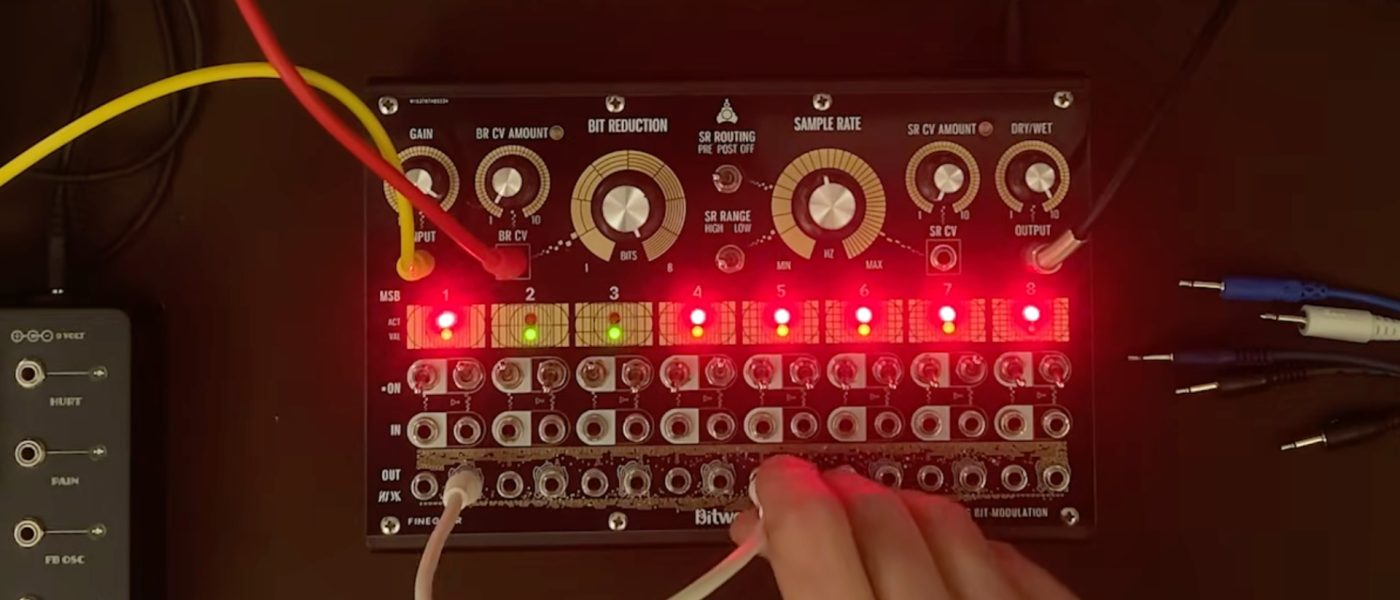
TL;DR: Finegear’s Bitweaver is a fully analog 8-bit bit-crusher for Eurorack that eschews digital emulation for pure, squelchy, transistor-driven chaos. Each of the eight bits can be toggled, inverted, overridden by CV, or even swapped with one another, making it as much a wave-shaper as a destruction tool. No price or release date yet, but it’s already a strong contender for the most fun you can have with 8 HP and a soldering iron.
- All-analog bit-crushing: no code, no emulation—just op-amps, transistors, resistors, and capacitors doing the dirty work.
- Full bit-level control: each of the 8 bits can be switched on/off, inverted, overridden with another bit’s value, or replaced entirely with a CV signal.
- Flexible sample-rate reduction routing: place it before the bit engine, after it, or bypass it entirely with a simple switch.
- Per-bit LED activity display: red and green lights show current bit state, because you should see the chaos you’re causing.
- Dedicated outputs for each bit: meaning you can patch individual bit-crusher configurations into different places in your rack—mad science, properly wired.
Reading time: 3 min
Want more synth news before your next coffee break? Join the Noxal newsletter — no spam, just gear worth knowing about.

Analog Bit-Crushing, Because Digital Is Boring

Let’s be honest: most bit crushers are just digital effects in a metal box. They sample your audio, run it through an algorithm, and spit out something that sounds like a 1990s video game falling down stairs. That’s fine, but it’s also tired. Finegear, the Romanian boutique builder known for their Dirt Magnet multi-FX, has a different idea. The Bitweaver is a fully analog bit crusher. That means the ADC and DAC are built from discrete components—op-amps, transistors, resistors, capacitors—all carefully arranged to do a deliberately imperfect job.
According to Finegear, the Bitweaver’s circuit converts audio between analog and digital without a sampling clock. Bits flip whenever the signal crosses a threshold, not at fixed intervals. This continuous, threshold-driven behavior gives the module its signature squelchy, fuzzy character—a kind of organic glitch that no algorithm can replicate. It’s the difference between a photograph and a painting: one is accurate, the other is art.
We at Noxal have a soft spot for any module that turns a perceived flaw into a feature. The Bitweaver is not trying to be clean. It’s trying to be warm, squelchy, and unpredictable in the best possible way. And honestly, isn’t that what we’re all here for?
Bit-by-Bit Control: The Modular Mind Game
The Bitweaver gives you access to all 8 bits. Not just a “bit depth” knob that reduces the resolution until everything sounds like a crushed can—actual access to each individual bit. You can switch bits on and off, invert them, or override one bit with the value of another. You can even replace any bit with an incoming CV signal. That means you can patch an LFO into bit 3, an envelope into bit 7, and suddenly your kick drum is doing a rhythmic stutter that no sample-and-hold could replicate.
Each bit has its own red and green LED, so you can see exactly what’s happening under the hood. This is not just for show; it’s a practical tool for understanding how your patching affects the signal. Finegear claims that all bit manipulations remain harmonically related to the input signal, which means the Bitweaver doubles as a wave-shaper. You can coax melodic artifacts out of what would otherwise be pure noise. That’s the kind of depth that separates a gimmick from a genuinely useful tool.
I’ll admit: the first time I read about overriding bits with CV, I had to sit down. This is the kind of feature that makes you rethink how you approach bit crushing entirely. It’s not just about destroying sound—it’s about reshaping it, bit by bit, until it becomes something new.
Specs and Patching: What You Can Actually Tweak
The front panel is laid out with typical Finegear clarity. You get a gain input knob, a bit reduction control, sample rate reduction, and a dry/wet mix. Each of these has CV inputs with dedicated amount knobs, so you can modulate the intensity of the effect without losing the core sound. There’s a switch for routing the sample-rate reduction—before the bit engine, after it, or bypassed entirely—and a switch for selecting high or low range.
Perhaps the most understated feature is the dedicated output for each bit. That’s right: you can patch individual bit outputs to different destinations in your rack. Want bit 1 to trigger an envelope? Bit 4 to modulate a filter? Go ahead. This turns the Bitweaver from a simple effect into a voltage source, a CV processor, and a wave-shaper all in one. It’s the Swiss Army knife of analog destruction.
Finegear says the module delivers sounds ranging from sub-audio tremolo (when the bit depth is low enough to create rhythmic pulsing) to classic bit-crusher grid artifacts. We’d add that the analog nature means there’s a warmth and richness to the distortion that digital crushers often lack. It’s the difference between a hand-cranked grinder and a blender: both will destroy your vegetables, but only one leaves texture.
Who Should Buy the Bitweaver?
This module is not for everyone. If you want pristine, clean digital effects, look elsewhere. The Bitweaver is for the noise enthusiasts, the lo-fi lovers, the modular masochists who believe that sound should have teeth. It’s for the people who spend hours patching and repatching, chasing that one sweet spot where everything falls apart beautifully.
It’s also for the experimenters who aren’t afraid to think in binary. The ability to manipulate individual bits with CV opens up a world of possibilities that go far beyond simple bit crushing. You could use it as a weird oscillator, a rhythm generator, a distortion unit, or a signal router. The only limit is your patience with patch cables.
Price and availability are still TBA, but we’ll update as soon as Finegear announces them. For now, start saving your coffee money. This one is worth the beans.
Frequently Asked Questions
Is the Bitweaver truly analog, or does it use digital processing?
It is fully analog. The ADC and DAC are built from discrete op-amps, transistors, resistors, and capacitors. There is no microcontroller or digital processor involved. The bits flip based on threshold crossings, not a sampling clock, which gives it a unique, organic character.
Can I use the Bitweaver as a CV source or modulator?
Yes. Each bit has a dedicated output, so you can patch individual bit signals to modulate other modules. You can also replace bits with CV inputs, allowing external signals to control bit states. This makes it a flexible voltage source and wave-shaper, not just a simple effect.
How does the sample-rate reduction routing work?
The module has a three-position switch that lets you place sample-rate reduction before the bit engine, after it, or bypass it entirely. This gives you control over the order of processing, which dramatically affects the final sound. Combined with the high/low range switch, you have a lot of tonal flexibility.
Now if you’ll excuse me, I need to go re-patch my coffee machine to run through a bit crusher. I’m told the results are “squelchy” and “fuzzy,” which are words I use to describe both my morning brew and my studio habits.