TL;DR: EMW has released the WCS-X, a compact hybrid desktop synthesizer. It packs three digital oscillators, an analog filter, and now ships with a firmware update adding oscillator sync, wave folding, and a transient sample engine. It’s available now for $389, hand-built in Brazil.
- The WCS-X is a hybrid synth with three digital oscillators (30 waveforms each) running into a two-mode analog VCF.
- New firmware adds major features: oscillator sync, PWM, wave folding, and a transient sample player for OSC3 with 64 samples.
- It includes two analog LFOs, one ADSR envelope, 128 patch memories, and is housed in a distinctive desktop case.
- Priced at $389, it’s positioned as a hand-built, affordable instrument from a small Brazilian company.
- The feature set, while expanded, remains focused, with one envelope and analog modulation limiting complex routings.
Reading time: 4 min
Want more synth news before your next coffee break? Join the Noxal newsletter — no spam, just gear worth knowing about.

What Is The EMW WCS-X?

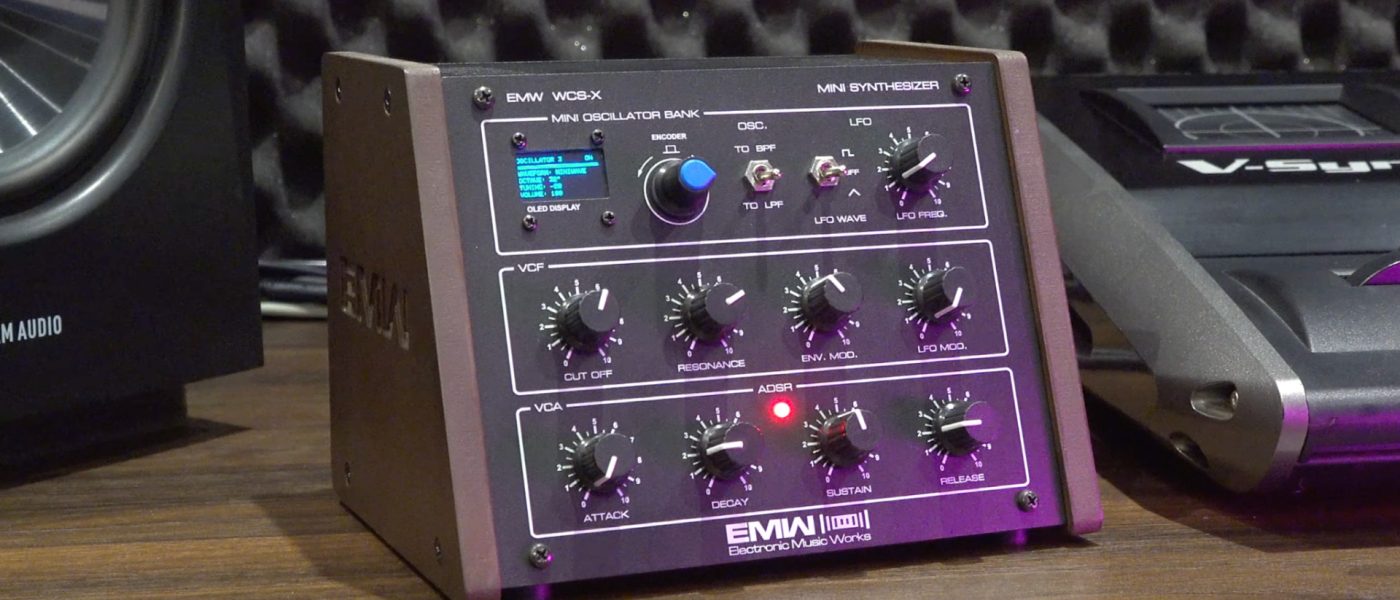
Let’s cut through the noise. The EMW WCS-X is a new, compact desktop synthesizer from Brazilian boutique outfit Electronic Music Works. It’s a hybrid instrument, which in this case means the oscillators and brains are digital, while the filter, amplifiers, and modulation sources are proudly analog. This isn’t a teaser or a pre-order; the synth is shipping now, complete with a significant firmware update that addresses some of the initial limitations noted when it was first previewed late last year.
Physically, it’s a distinctive little box. EMW has a certain utilitarian aesthetic that I’ve come to appreciate—it looks like a piece of gear, not a lifestyle accessory. The interface is knob-per-function for the critical parameters, with a small display and encoder handling deeper oscillator edits. It’s a desktop module, so you’ll need a MIDI controller and an audio interface, but that’s the norm for this category. The promise here is a focused, hands-on synthesizer voice that doesn’t try to do everything, but aims to do a few things with character.
The Hybrid Heart: Digital Oscillators Meet Analog Guts

The core sound generation comes from three digital oscillators. Each one offers a selection of 30 waveforms, which is a solid palette to start from. You can independently adjust the waveform, octave, fine-tuning, and level for each, plus there’s a noise generator. This is managed via the display and encoder—a pragmatic solution to avoid a front panel the size of a dinner plate. Some might find this menu-diving a slight friction, but for a synth at this price and size, it’s a reasonable compromise.
The signal then hits the analog section, which is where the “soul” is supposedly injected. The analog filter is a highlight, offering two modes—low-pass and band-pass—selected by a switch. It has dedicated cutoff and resonance knobs, and can be modulated by the LFO or the envelope. Speaking of modulation, you get two analog LFOs and a single analog ADSR envelope generator. This is the most traditional, and arguably most limiting, part of the architecture. One envelope means you’re typically tying filter and amplitude modulation together, which restricts sound design possibilities. They’ve added some digital modulation features in the update (like per-oscillator A/D generators for pitch), but the core analog modulation suite is simple.
The Firmware Update That Actually Matters

Here’s where the story gets interesting. The WCS-X that’s shipping now isn’t quite the synth that was announced. EMW used the development time to pack in a host of new features, transforming it from a basic hybrid into a much more compelling instrument. The headline act is the new transient sample engine for the third oscillator. You can now load it with one of 64 included samples (clicks, hits, percussion textures), effectively turning OSC3 into a mini sample player. This is a fantastic addition for adding rhythmic interest or percussive layers to patches.
Beyond samples, the firmware adds oscillator sync and PWM for classic thickening and movement, and a wave folding function for more complex, digital harmonics. There’s also a “vintage” parameter for adding warmth and drift, new glide modes, and crucially, 128 slots of patch memory. These aren’t minor tweaks; they’re fundamental expansions that directly address the “limited playability” concern that hovered over the initial announcement. It’s a lesson in how a small company can iterate quickly and meaningfully.
Market Context And The $389 Question
So, it’s $389. In a market saturated with capable, budget-friendly synths from larger manufacturers, that price requires justification. EMW provides it: this is a hand-built instrument from a small Brazilian company, not a mass-produced unit from a global factory. You are, in part, paying to support that kind of operation. Whether that value proposition resonates is personal. For comparison, this sits in a crowded field with the likes of the Sonicware Liven series, the Korg NTS-1 (with its custom oscillators), and various used-market options.
Who is it for? It’s for the synthesist who values a distinct, hybrid architecture in a compact desktop form, and who is intrigued by the unique character a small builder can impart. It’s for someone who doesn’t need a million modulation destinations but appreciates the immediacy of analog filters and LFOs. It is likely not for the power programmer seeking complex modulation matrices or polyphony. The WCS-X is a focused mono/paraphonic voice with a specific, slightly gritty charm. If the idea of a hand-built box from Brazil with a recently supercharged feature set makes you lean forward, this might just be your next caffeine-fueled studio obsession.
Frequently Asked Questions
Is the EMW WCS-X polyphonic?
The WCS-X is primarily a monophonic synthesizer. However, with its three oscillators each capable of being tuned to different notes, it can create paraphonic chords, though they would all be gated and filtered by the single, shared analog envelope and VCF/VCA.
Can I load my own samples into the transient engine?
Based on the available information, the transient sample engine comes with a fixed library of 64 samples. There is no indication from EMW that user sample loading is a feature. The sample set is intended as a built-in sound design resource.
How does the WCS-X connect to my setup?
It’s a desktop module, so you’ll need to provide your own MIDI controller via the 5-pin DIN MIDI input and an audio interface or mixer via its 1/4″ mono output. It also has a USB-C port, likely for firmware updates only, as MIDI over USB is not specified. Power is supplied via a standard DC barrel connector.
Now, if you’ll excuse me, the hiss of my analog filter warming up is perfectly synced with the kettle boiling for a fresh pot. A happy accident, I’m sure.