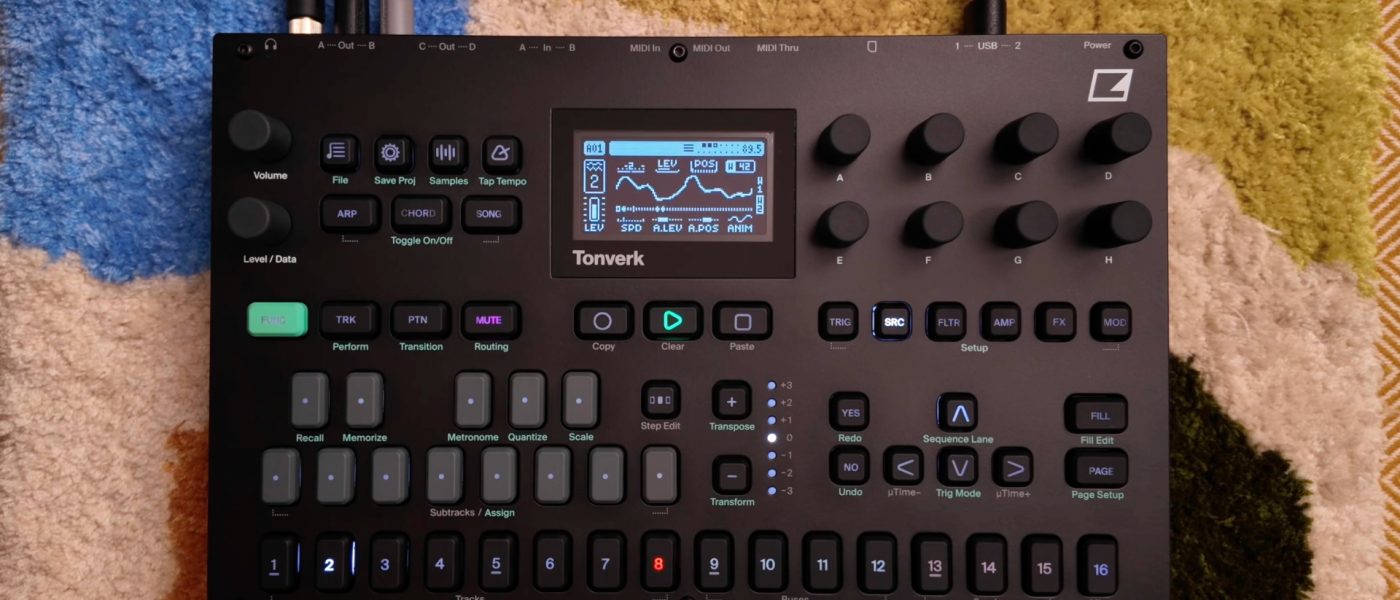
TL;DR: Elektron has dropped firmware 1.3 for its Tonverk sampler, transforming the 16-track powerhouse into a legitimate wavetable synthesizer. This isn’t just a new oscillator mode; it’s a fundamental reimagining of the machine’s sonic DNA, baked into its existing architecture. The spiritual Octatrack successor just got a lot more… spiritual.
- Firmware 1.3 adds a dedicated Wavetable oscillator mode to the Tonverk’s sample engine.
- The implementation uses the existing 16-track polyphony and modulation matrix, allowing for complex, evolving textures.
- Wavetable position can be modulated via LFOs, envelopes, and the performance macros.
- This update is free for all Tonverk owners, significantly expanding the unit’s synthesis capabilities.
- The move positions the Tonverk as a direct competitor to dedicated wavetable synths, not just samplers.
Reading time: 5 min
Want more synth news before your next coffee break? Join the Noxal newsletter — no spam, just gear worth knowing about.

From Samples to Spectra

When Elektron unveiled the Tonverk last year, the chatter was immediate and deafening. Here was a 16-track polyphonic multi-sampler from the masters of workflow-centric grooveboxes, boasting an interface that promised to untangle the spaghetti of sample management. Many of us saw it, quite rightly, as the long-awaited heir to the Octatrack’s dusty throne—a machine built for the modern era of performance and sound design. It was impressive, but it was, at its core, a sampler. A glorious, deep, polyphonic sampler, but a sampler nonetheless. You loaded sounds into it; you didn’t necessarily *generate* them from first principles.
Firmware 1.3 changes that equation entirely. With this update, Elektron hasn’t just added a feature; they’ve performed a quiet act of alchemy on the Tonverk’s very soul. The sample engine, once a repository for captured audio, can now function as a native wavetable oscillator. This isn’t a bolt-on synth engine running in parallel; it’s a fundamental new mode for the existing voice architecture. It means every one of those 16 tracks can now be a complex, morphing wavetable voice, with all the modulation and performance tools of the Tonverk immediately at its disposal. The shift from a sampler that *can* play static wavetables to a synthesizer that *generates* evolving spectra is profound.
What I find most compelling about this move is its philosophical alignment with the Elektron ethos. This isn’t about chasing specs for a marketing sheet. It’s about expanding the creative *space* of the instrument. They looked at the deep modulation matrix, the performance macros, the lush effects, and asked: “What if the source material could be as fluid and dynamic as the processing?” The answer, it turns out, is wavetable synthesis. It feels less like an addition and more like a revelation of what the Tonverk was always meant to be.
The Wavetable Weave

So, how does it work? In practice, loading a single-cycle waveform or a curated wavetable file into a sample slot now gives you the option to engage Wavetable mode. This unlocks a new set of parameters centered around the Wavetable Position. Suddenly, that static waveform becomes a timeline of spectral evolution. The genius of the implementation is its integration. The position can be swept manually, of course, but the real magic happens when you patch an LFO to it for cyclical movement, an envelope for one-shot spectral sweeps, or—most powerfully—map it to the performance macros.
This is where the Tonverk’s architecture sings. Imagine a pad where macro one sweeps the wavetable position for timbral shift, macro two modulates filter cutoff, and the aftertouch you’re applying is driving the LFO rate that’s also nudging the wavetable. You have 16 tracks of this potential, each with two LFOs, three envelopes, and that lush effects section. The complexity you can build from a single oscillator is staggering. It transforms the machine from a playback device into a living, breathing sound generator. The barrier between sampling and synthesis doesn’t just blur; it evaporates.
The spec sheet is now quietly terrifying. Sixteen-voice polyphonic wavetable synthesis with individual outs, a comprehensive modulation matrix per voice, parameter locking, and the legendary Elektron sequencer. This isn’t just an update; it’s a second launch. The Tonverk now sits in a rarefied category of hardware: the true hybrid. It can multi-sample your Prophet, morph through wavetables for a lead, slice up a breakbeat, and sequence it all in perfect sync, without ever needing a computer. That’s not just power; that’s a complete sonic ecosystem in a box.
Context and Competition

Let’s be frank: the market for high-end hardware samplers and synthesizers is crowded, but also strangely segmented. You have dedicated wavetable synths like the Waldorf Iridium or Hydrasynth. You have powerhouse samplers like the MPC Key 61 or the still-revered Octatrack. The Tonverk, with this update, plants its flag squarely in the intersection of that Venn diagram. It’s now a direct competitor to both, not by matching them feature-for-feature, but by offering a uniquely integrated alternative. Its workflow is pure Elektron—immediate, performative, and slightly obsessive—which already sets it apart from the menu-diving of an MPC or the sprawling architecture of an Iridium.
This move also feels like a statement of intent from Elektron regarding the “spiritual Octatrack successor” narrative. The Octatrack was beloved for its chaos, its ability to mangle and destroy. The Tonverk, with wavetable synthesis onboard, leans into a different kind of power: generation and evolution. It’s less about taking a recorded sound and twisting it beyond recognition (though it can do that) and more about building a complex, organic sound from the ground up and having total performative control over its life cycle. It’s a more compositional, perhaps even more musical, approach to the same goal of sonic sovereignty.
Furthermore, releasing this as a free update is a masterclass in customer loyalty and product confidence. It signals that Elektron views the Tonverk as a platform, not a product. It builds immense goodwill and transforms existing owners’ machines overnight. In an era of paid expansion packs, this feels refreshingly generous. It also raises the stakes for the competition. How do you respond to a sampler that just became a top-tier wavetable synth via a software update? You can’t. You just have to admire the play.
Who Is This For Now?
Before 1.3, the Tonverk was a must-look for sample-based performers, composers needing a versatile polyphonic brain, and Elektron completists. Now, the net is cast much wider. Sound designers who live in the spectral morphing spaces of Serum or Pigments now have a serious hardware counterpart that offers tactile, performable control. Ambient and textural musicians have just been handed a 16-voice texture factory. Even keyboard players looking for a deeply programmable poly-synth with a killer sequencer should give this a long, hard look. The barrier of “needing to manage a sample library” is lowered when the machine itself is a prolific source of original content.
That said, the Elektron workflow remains a defining characteristic. This isn’t for everyone. If you crave traditional keyboard-style synthesis programming with a one-knob-per-function front panel, you might find the parameter-paging-and-encoder approach abstract. The Tonverk demands engagement with its system. It rewards those who think in terms of tracks, patterns, and parameter locks. It is, at heart, a sequencer-centric instrument. The wavetable update makes its sonic palette infinitely richer, but it doesn’t change its fundamental, gloriously opinionated nature.
So, who is it for? It’s for the artist who wants a single, deep instrument at the center of their setup. It’s for the performer who needs to build evolving sets without a laptop. It’s for the sound explorer who believes the journey from a raw waveform to a finished, moving composition should be seamless. With firmware 1.3, the Elektron Tonverk is no longer just a potential successor to a classic. It has confidently defined its own kingdom.
Frequently Asked Questions
Does the wavetable mode replace the sampler?
No, it complements it. The wavetable oscillator is a new mode within the existing sample engine. You can load a standard sample or a wavetable file and choose how to play it. This means a single project can contain traditional multi-sampled instruments, drum hits, and complex wavetable synth voices all playing polyphonically across the 16 tracks.
Can I import my own wavetables?
Yes. The Tonverk treats wavetable files as a type of audio sample. You can import standard single-cycle waveforms or curated multi-position wavetable files (like those in .wav format) via the computer-based management software or directly onto the device’s storage. The firmware then interprets them correctly in Wavetable mode.
How does this affect polyphony and CPU?
The wavetable synthesis uses the same voice architecture as sample playback, so you still have up to 16 voices of polyphony to allocate across your tracks. Elektron’s implementation is optimized to run on the Tonverk’s hardware, so there’s no reduction in voice count or overall performance. It’s a remarkably efficient translation of the concept into the existing system.
I’m off to brew a particularly complex, slowly evolving cup of pour-over. Some machines deserve a beverage that matches their newfound depth. The Tonverk 1.3 is one of them.