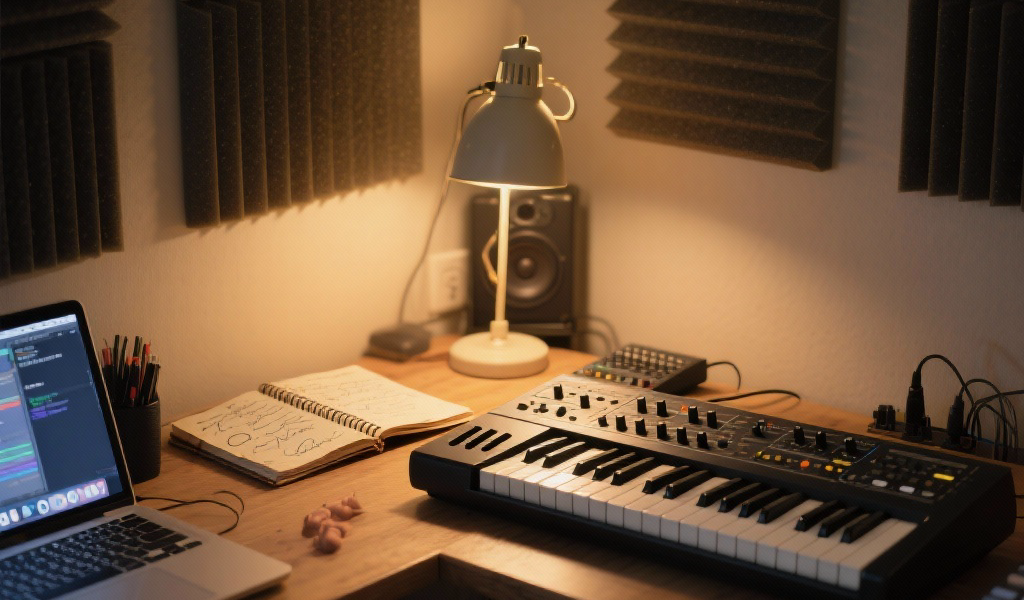
- The evolution of electronic music tools reflects the fusion of creativity and technology.
- Understanding sound synthesis is crucial for maximizing production potential.
- Hybrid workflows combining analog and digital tools promote innovative sound design.
- Creativity should take precedence over the latest tech advances.
- Fearless experimentation drives true musical innovation.
Table of Contents
- The Genesis: Early Experiments and the Birth of Synthesis
- The MIDI Revolution: Unifying the Electronic Orchestra
- The Sampling Surge: Capturing and Reshaping Reality
- The Digital Revolution and the DAW Era: The Studio in a Box
- Hybrid Workflows and the Analog Resurgence: A Best of Both Worlds Approach
- The Enduring Truth: Creativity Trumps Gear
- Practical Takeaways for Your Production Journey
The Genesis: Early Experiments and the Birth of Synthesis
Imagine a world where “electronic music” was a radical concept, not a genre. In the mid-20th century, that was reality. Before sequencers, DAWs, or even MIDI, intrepid innovators were exploring the very nature of sound with nascent electronic circuits. Early pioneers like Pierre Schaeffer’s musique concrète utilized turntables and tape recorders to manipulate acoustic sounds, laying groundwork for sampling. Concurrently, visionaries like Robert Moog and Don Buchla were building instruments from scratch, harnessing electricity to generate entirely new sonic universes.
When I think of these early days, I can almost feel the hum of the vacuum tubes and the crackle of the patch cables. The sheer audacity of creating sound out of nothing was profound. The Moog synthesizer, for instance, wasn’t just an instrument; it was a sonic laboratory. Its core principle, subtractive synthesis, allowed users to sculpt sound by starting with harmonically rich waveforms (like sawtooth or square waves) and then using filters to remove frequencies. This opened up a vast new world of expressive possibilities, from searing leads to rich, resonant basses. Suddenly, musicians could create sounds that mimicked acoustic instruments, but also utterly alien, futuristic textures never before heard. This wasn’t just an expansion of a sound palette; it was the creation of entirely new colors on the sonic canvas.
These early tools were expensive, complex, and often temperamental. Operating a modular system required a deep understanding of signal flow and a lot of patience. Yet, it was precisely these challenges that forced early electronic musicians to truly understand the physics of sound, fostering a level of mastery that we sometimes overlook in our age of instant gratification. Artists like Wendy Carlos, with her groundbreaking Switched-On Bach, showcased the musicality and expressive potential of these machines, pushing synthesizers from mere novelty to legitimate musical instruments.
The MIDI Revolution: Unifying the Electronic Orchestra
If early synthesis was about discovering new sounds, the 1980s brought about the era of connecting them. The introduction of MIDI (Musical Instrument Digital Interface) in 1983 was, arguably, the single most transformative moment in the history of electronic music production. Before MIDI, integrating different electronic instruments was a nightmare of proprietary connections and voltage standards. With MIDI, a single keyboard could control multiple synthesizers, drum machines could be perfectly synchronized, and computers could orchestrate entire electronic ensembles.
Suddenly, a composer could layer sounds from a Yamaha DX7 (with its groundbreaking FM synthesis, offering metallic, bell-like, and percussive sounds previously impossible to achieve with analog), an Oberheim OB-Xa (known for its lush pads), and a Roland TR-808 (whose iconic kick and snare defined genres like electro and hip-hop) all from one central controller. The “sound palette” wasn’t just expanding in terms of individual timbres; it was expanding exponentially through the ability to layer, combine, and synchronize them seamlessly.
I vividly remember the first time I patched a MIDI cable between two synths and heard them respond in unison. It felt like unlocking a secret language, a universal translator for machines. This technical detail – a simple serial communication protocol transmitting data about note on/off, velocity, pitch bend, and control changes (CCs) – truly democratized the electronic studio. It allowed for complex arrangements, intricate sequencing, and the birth of genres where precise synchronization and rhythmic interplay were paramount, from Chicago House to Detroit Techno.
The Sampling Surge: Capturing and Reshaping Reality
Hand-in-hand with MIDI, the rise of affordable digital sampling tools in the late 80s and early 90s opened another Pandora’s Box of sonic possibilities. Before digital samplers, recording and manipulating sound was a painstaking analog process. Devices like the Akai MPC series, E-mu SP-1200, and later, software-based samplers, allowed producers to record any sound – a drum hit, a vocal snippet, an environmental noise, an orchestral phrase – and then manipulate it, pitch-shift it, chop it, loop it, and integrate it into their compositions.
The ability to sample didn’t just expand the sound palette; it made anything a potential sound source. This concept, fundamentally, changed the nature of music production. Hip-hop, in particular, was built upon the art of sampling, creatively repurposing existing recordings into entirely new musical contexts. The technical leap here was significant: the ability to convert analog audio into digital data, store it, and recall it with precision. Early samplers had limitations – short sample times, low bit rates – but these very constraints often fueled incredible creativity, forcing producers to be resourceful and innovative in their sound design. Think of the raw punch of an SP-1200’s drums, or the gritty warmth of an Akai S900. These were not pristine sounds, but they possessed character and energy.
The Digital Revolution and the DAW Era: The Studio in a Box
As computing power increased, the electronic music studio began its migration from dedicated hardware to the personal computer. The late 90s and early 2000s saw the ascendancy of Digital Audio Workstations (DAWs) like Cubase, Logic Pro, Pro Tools, and later, Ableton Live and FL Studio. These software environments consolidated nearly every aspect of music production – recording, sequencing, mixing, and mastering – into a single, integrated platform.
For me, the shift to a DAW-centric workflow was a seismic event. Suddenly, I had an entire arsenal of tools at my fingertips that would have cost a fortune in hardware form. The development of Virtual Studio Technology (VST) and Audio Units (AU) plugin formats meant that software synthesizers and effects processors could run directly within the DAW. This allowed producers to access thousands of different synth emulations (like faithful recreations of classic Moogs or Junos) as well as entirely new, complex digital synthesizers and effects.
This era truly democratized music production. No longer did you need a million-dollar studio to create professional-sounding tracks. A powerful computer and a good DAW became the new foundation. The sound palette expanded infinitely, not just through new sounds, but through the unprecedented flexibility in manipulating them. Non-linear editing, automation of every parameter, and the ability to instantly recall entire project states revolutionized the creative process. It allowed for meticulous sound design, complex arrangements, and a level of sonic refinement that was previously unimaginable for the independent artist.
Hybrid Workflows and the Analog Resurgence: A Best of Both Worlds Approach
Today, we live in an exciting era where the lines between hardware and software are increasingly blurred. Many producers embrace hybrid workflows, combining the tactile satisfaction and unique sonic character of analog synthesizers and outboard gear with the power, flexibility, and recallability of DAWs and software instruments.
The resurgence of modular synthesizers, particularly the Eurorack format, is a testament to our enduring fascination with hands-on sound design. While software modular environments like VCV Rack offer incredible power, there’s something uniquely captivating about patching cables on a physical system, feeling the electricity flow, and hearing the immediate sonic response. These systems offer unparalleled flexibility in creating entirely unique signal paths and generating sounds that can range from traditional synth tones to chaotic, evolving soundscapes. Understanding CV/Gate (Control Voltage/Gate), the analog language of modular synths, opens up a deeper understanding of how sounds are generated and manipulated at their core.
This contemporary landscape encourages exploration across the entire spectrum of electronic music tools. Want the warmth of an analog filter? Patch in a hardware unit. Need complex, evolving textures? Dive into a granular synthesis plugin. Craving the raw power of a classic drum machine? There’s a perfect software emulation, or perhaps you’ve invested in a hardware re-issue. This “best of all worlds” approach means that the potential sound palette is richer and more diverse than ever before. We at Noxal are particularly excited by this era, as it encourages artists to truly define their unique sonic fingerprint, drawing from the vast tapestry of tools available.
The Enduring Truth: Creativity Trumps Gear
As we marvel at this incredible journey of technological advancement, it’s crucial to anchor ourselves to a fundamental truth that resonates deeply with us at Noxal: creating matters more than the gear.
The shiny new synth, the latest plugin, the coveted vintage drum machine – these are all powerful temptations. And yes, they can inspire and open new doors. I’ve certainly spent countless hours researching new gear, dreaming of the sounds I could make. But I’ve also personally experienced how sometimes, my most profound creative breakthroughs have occurred not with the most expensive or cutting-edge equipment, but when I’m forced to work within limitations.
Think of artists who made groundbreaking music with incredibly sparse setups. Early techno and house producers crafting masterpieces on a single Roland 808/909 and a cheap synth. Aphex Twin creating complex sonic worlds with basic hardware and clever programming. The legendary Daft Punk, often using classic gear not because it was “the best,” but because they knew it intimately and could extract every ounce of its sonic character.
The tools are merely conduits for your ideas. A talented painter can create a masterpiece with basic brushes and paints. A brilliant chef can craft an exquisite meal with simple ingredients and a well-used pan. The same applies to electronic music. Understanding the core principles of sound design, developing a keen ear, and honing your musicality will always be more valuable than simply accumulating the latest gadgets.
We at Noxal encourage a mindset of deep engagement with your chosen tools. Learn them inside out. Push their boundaries. Find their sweet spots and their quirky flaws. Discover how they inspire your unique voice. Don’t let gear acquisition become a substitute for creative output. The true power lies in your imagination and your willingness to experiment.
Practical Takeaways for Your Production Journey
So, how do we navigate this incredible, ever-expanding world of electronic music tools?
- Understand the Fundamentals: Whether you’re using hardware or software, take the time to learn the core principles of synthesis (subtractive, FM, additive, granular, wavetable, etc.) and sampling. This knowledge will empower you to craft your own sounds, rather than just relying on presets.
- Embrace Hybridity: Don’t feel obligated to choose between hardware and software. Experiment with blending the tactile joy of analog gear with the flexibility of your DAW. A simple analog synth running through a complex software effect can yield incredible results.
- Go Deep, Not Wide: Instead of constantly buying new gear or plugins, try to master what you already have. You’ll be amazed at the sounds you can coax out of familiar instruments when you truly explore their full potential.
- Listen Actively: Pay attention to how different eras of electronic music used the tools available to them. What made the sound of a certain track so iconic? Often, it was the clever and innovative use of specific gear.
- Prioritize Creativity: Always bring your focus back to the music. Are you solving a creative problem with a new tool, or are you just chasing the next shiny object? Let your artistic vision guide your tool choices.
- Experiment Fearlessly: The evolution of these tools has been driven by curiosity and experimentation. Don’t be afraid to break the rules, misuse a tool, or try an unconventional approach. That’s where true innovation often happens.
Frequently Asked Questions (FAQ)
Q: What is the most important electronic music tool for beginners?
A: Starting with a Digital Audio Workstation (DAW) is essential. It combines recording, sequencing, and mixing, providing a solid foundation for any producer.
Q: How do I choose between analog and digital synthesizers?
A: It ultimately depends on your preferences. Analog offers warmth and character, while digital provides flexibility and a broader range of sounds. Experiment to see what resonates with you.
Q: Can I make quality music with free plugins?
A: Absolutely! Many free plugins are highly capable and can help you create professional-sounding music without a big investment.