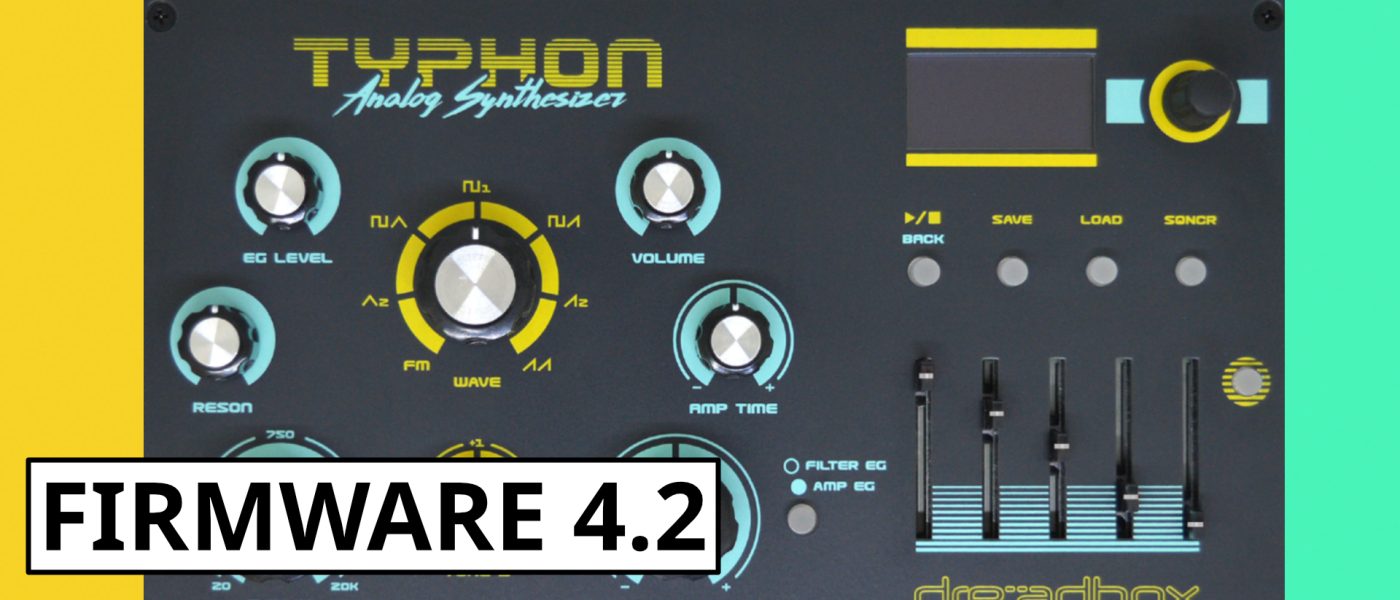
TL;DR: Dreadbox has released firmware version 4.2 for its beloved Typhon desktop monosynth. This isn’t a minor bug fix; it’s a substantial upgrade that transforms the synth’s MIDI capabilities, most notably by adding MIDI CC output, effectively turning the Typhon into a powerful control surface for your other gear.
- MIDI CC Output is the headliner, allowing the Typhon’s knobs and mod matrix to send control data to external hardware or software.
- Enhanced MIDI Clock handling improves synchronization stability in complex setups.
- New MIDI Channel per Part functionality offers greater flexibility for sequencing and layering.
- General bug fixes and performance improvements ensure a smoother overall experience.
- It’s a free update, reinforcing the Typhon’s reputation as a high-value, ever-evolving instrument.
Reading time: 4 min
Want more synth news before your next coffee break? Join the Noxal newsletter — no spam, just gear worth knowing about.

The Typhon Redux

Let’s rewind for a moment. When the Dreadbox Typhon first landed on our crowded desks, it was an immediate standout. Here was a company known for lush, sometimes quirky analog circuitry packing a shockingly complete monosynth voice—analog oscillators and filter, digital effects, a powerful mod matrix, and a sequencer—into a blue box the size of a paperback. It felt like a secret weapon. The sound was, and is, unmistakably Dreadbox: rich, characterful, and capable of everything from pristine leads to utterly corrupted textures, thanks in no small part to its fantastic built-in stereo effects. We at Noxal have always appreciated gear that punches above its weight class, and the Typhon did so with a distinct Hellenic flair.
But hardware, especially in this golden age, is often a story of software. A synth’s journey doesn’t end at the factory; it’s defined by the updates that follow. Dreadbox has been commendably proactive in this regard, treating the Typhon not as a finished product but as a platform. Previous updates added features like the wonderful “Nyx Hall” reverb algorithm, proving the company listens to its community. Firmware 4.2, however, isn’t just an added bell or whistle. It’s a fundamental re-evaluation of the Typhon’s role in your studio, shifting its identity from a brilliant standalone voice to a potential central nervous system for your other gear.
The MIDI Revolution
The centerpiece of the 4.2 update is the introduction of MIDI CC output. For the uninitiated, this might sound like technical minutiae. For the patching enthusiast, it’s a game-changer. Previously, the Typhon’s knobs—its filter cutoff, resonance, effect parameters, LFO rates—only controlled its internal circuitry. Now, these physical controls can be mapped to send Continuous Controller data out over MIDI. This means you can turn the Typhon’s cutoff knob to sweep the filter on your external analog poly, use its mod wheel to control the delay time on a pedal, or assign its LFO to modulate a parameter in your DAW. The tactile, immediate nature of the Typhon’s interface suddenly becomes a control surface for your entire setup.
This is amplified by the Typhon’s already-robust modulation matrix. You’re not limited to just knob twists. You can set up an internal envelope or LFO to modulate a parameter, and have *that* modulation data sent out as a MIDI CC stream. Imagine a slow, random LFO patched to “MIDI CC Out” controlling the wavetable position on a digital synth, or an envelope follower driving the distortion drive on a guitar plugin. The creative possibilities for generative, evolving control sequences are immense. Coupled with improvements to MIDI Clock stability and the new ability to set independent MIDI channels for different “parts” of the synth, the Typhon 4.2 graduates from being a brilliant sound module to a sophisticated sequencing and control hub.
Specs in Context
Let’s talk brass tacks. The Typhon is a digital/analog hybrid desktop monosynth. Its core voice is pure analog: two DCOs (with cross-mod) and a 24dB/octave low-pass filter (the same one from the famed Erebus and Hades) that is an absolute joy. This is surrounded by a 32-bit digital effects engine featuring delays, reverbs, choruses, and a bitcrusher that are far more than an afterthought—they’re integral to its sound. It has a 64-step sequencer with parameter locks, an extensive 16-slot modulation matrix, and 512 patch memories. All this in a unit that runs on a simple USB-C power supply.
In the market of compact desktop synths, the Typhon has always competed with units like the Korg Monologue or the more recent Roland SH-4d. Its advantage was its profound, effects-laden sound character. With firmware 4.2, its competitive edge sharpens in a different direction. While others may have more voices or specific workflows, none in this price bracket (~$350) offer this combination of a premium analog voice, deep internal modulation, *and* comprehensive MIDI control output. It’s a unique value proposition that blurs the line between instrument and studio utility.
Who Is This For?
First and foremost, this update is a gift to every existing Typhon owner. It’s free, it’s significant, and it fundamentally expands the instrument’s functionality. If your Typhon has been sitting in a corner, this is the reason to plug it back in and rediscover it as a new instrument. For the Dreadbox devotee, it reinforces the brand’s commitment to long-term support, making the initial investment feel even wiser.
For those considering a Typhon, the calculus has changed. If you’re a musician with a small, curated setup—say, a drum machine, one other synth, and a laptop—the Typhon 4.2 now serves a triple role: a phenomenal lead/bass/texture machine, a master sequencer, and a hands-on control surface. It reduces desktop clutter and mental menu-diving. For the modular curious, it acts as a perfect bridge, offering complex modulation and sequencing in a friendly package that can now directly talk to your Eurorack system via a MIDI-to-CV converter. In short, it’s for anyone who values density, character, and smart, forward-thinking design in their hardware.
Frequently Asked Questions
Is the Typhon 4.2 firmware update free?
Absolutely. Like all previous Typhon firmware updates, version 4.2 is a free download from the Dreadbox website. You’ll need a USB cable and the Dreadbox firmware update tool to install it.
Can I use the Typhon to control parameters in my DAW?
Yes, that’s a primary use case for the new MIDI CC output. Once you enable CC output in the settings and assign a knob or modulation source to a specific CC number, your DAW should receive that data just like it would from any other MIDI controller. You’ll need to set up MIDI learn or manual mapping on the plugin parameter you wish to control.
Does this update change the actual sound of the Typhon?
Not directly. The core analog sound generation and the digital effects algorithms remain unchanged. However, by unlocking new control possibilities, it dramatically changes how you can *interact* with and integrate that sound into a larger production, which can profoundly affect the music you make with it.
Now, if you’ll excuse me, I need to brew a fresh pot of Greek coffee and spend the afternoon making my Polybrute jealous by controlling it entirely from this little blue box. Some revolutions are quiet, but they smell fantastic.