
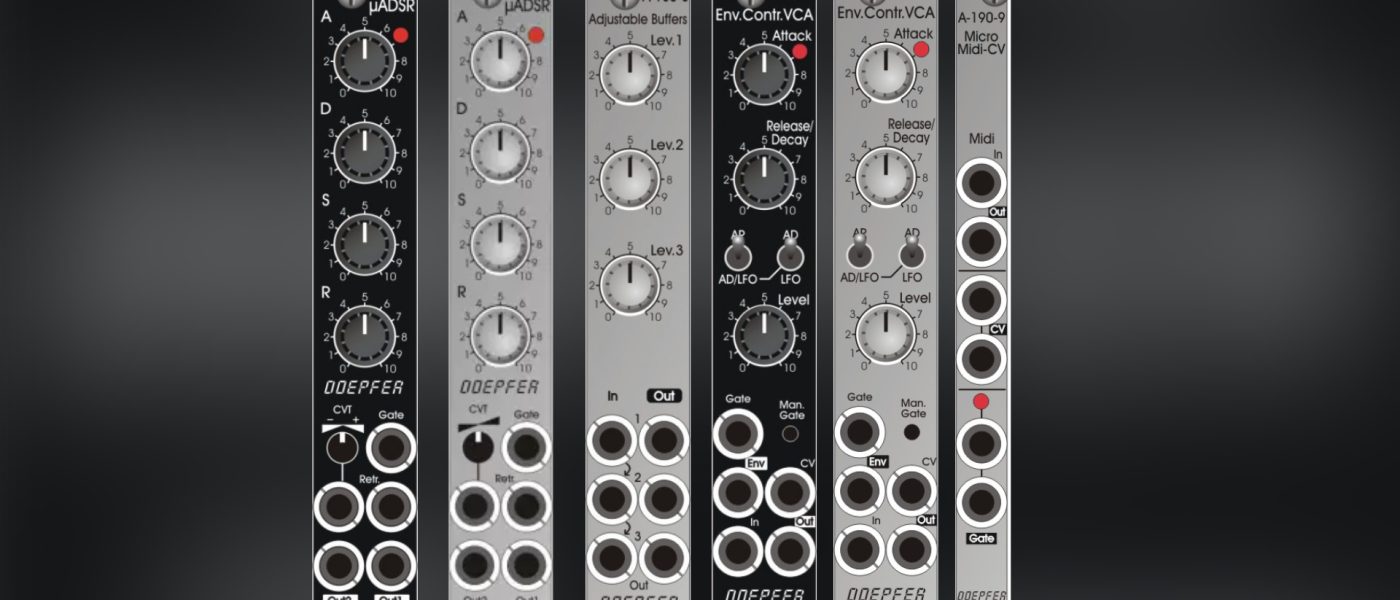
TL;DR: Doepfer has quietly launched a new “Micro” series of compact utility modules ahead of Superbooth 2026. The initial four modules include a 4HP ADSR, an envelope-controlled VCA, a triple buffer, and a tiny 2HP MIDI-to-CV interface. This is classic Doepfer: no-nonsense, affordable, and designed to fill the essential gaps in a small system.
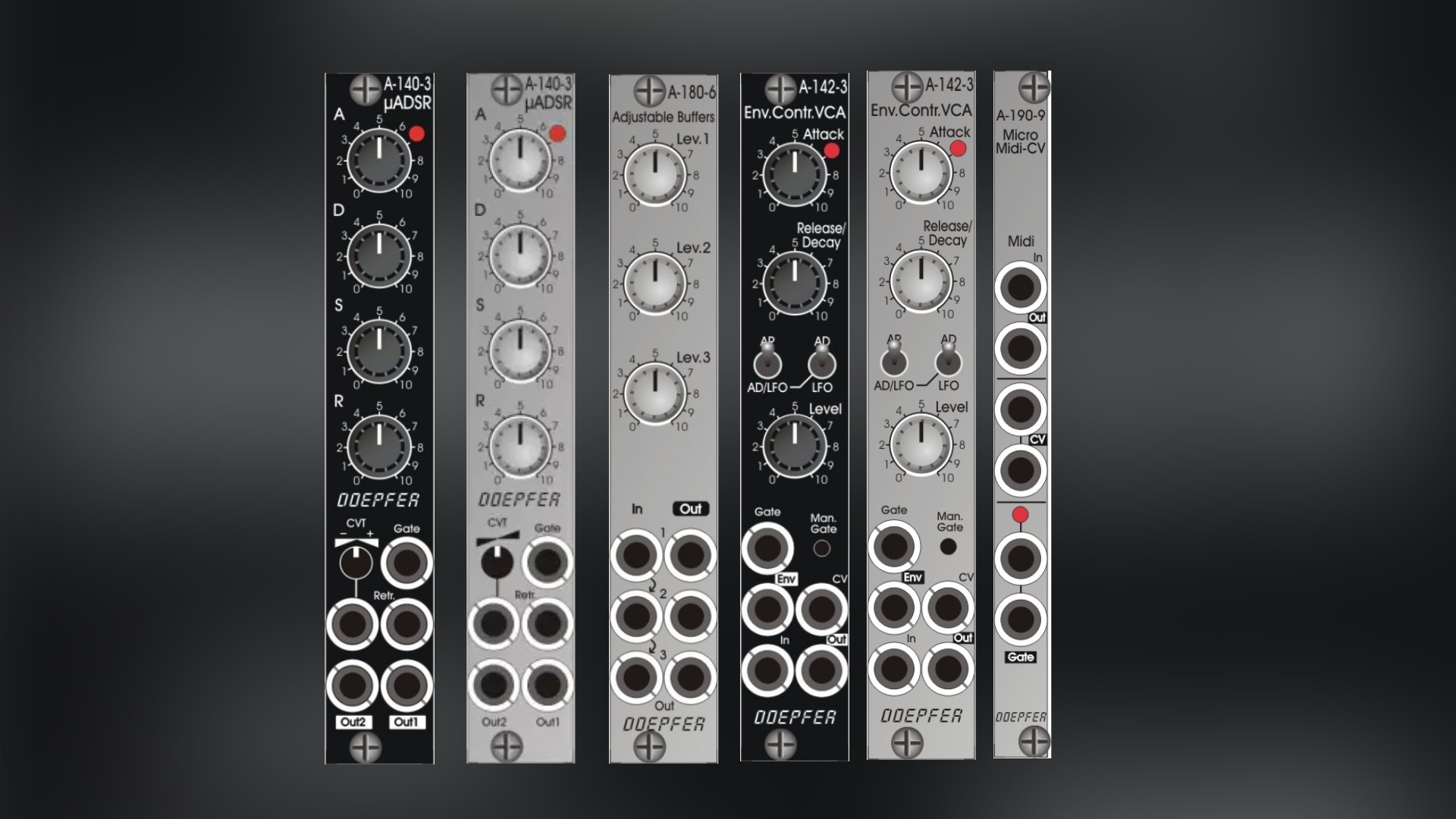
- Four new compact modules: A-140-3 Micro ADSR (4HP), A-142-3 Envelope VCA (4HP), A-180-6 Triple Buffer (4HP), and the A-190-9 MIDI-to-CV (2HP).
- The 2HP A-190-9 is a barebones monophonic MIDI interface that unlocks quantized CV output from Doepfer’s own A-155-2 sequencer.
- The A-142-3 VCA is AC-coupled (CEM3381-based), meaning it’s for audio only, not CV processing, but includes a built-in AD/AR envelope and LFO mode.
- All modules feature extensive internal configuration via jumpers and trimmers for inverting outputs, scaling CV ranges, and normalizing signals.
- Pricing is quintessentially Doepfer, starting at 65€ for the MIDI module and topping out at 109€ for the ADSR and VCA.
Reading time: 5 min
Want more synth news before your next coffee break? Join the Noxal newsletter — no spam, just gear worth knowing about.
The Micro Manifesto

In a landscape where eurorack announcements often feel like competitive spec-sheet one-upmanship, Doepfer’s approach remains a comforting constant. While the synth world holds its breath for the impending storm of Superbooth 2026 news, Dieter Doepfer has simply… shipped. No fanfare, no cryptic teasers, just a quiet update to the website announcing four new modules. It’s a move so quintessentially Doepfer it almost feels like a statement. The statement is this: here are the tools you need, in the size you need them, at a price that doesn’t require a second mortgage. We at Noxal have a deep appreciation for this philosophy. It’s the hardware equivalent of a perfectly pulled espresso—simple, effective, and without unnecessary froth.
The new “Micro” series, as it’s being called, isn’t about reinventing the wheel. It’s about machining that wheel down to its most efficient, reliable, and rack-mountable form factor. Ranging from 2HP to 4HP, these modules are the definition of utility. They are the interstitial glue of a modular system, the unsung heroes that make the flashy oscillators and complex filters actually playable. In an era of increasingly dense and menu-divey micro-modules, Doepfer’s offerings stand out for their immediate, knob-per-function (or switch-per-function) tactility. They assume you want to patch, not navigate.
This launch also serves as a gentle reminder of Doepfer’s foundational role. Dieter invented the Eurorack format. When his company decides to focus on compact utilities, it’s not following a trend; it’s reinforcing the bedrock. These modules are for the pragmatist, the space-conscious patcher, and the beginner who needs reliable, understandable building blocks. They are, in essence, the purest expression of the modular ethos: function over form, where the form is still a pleasing, no-nonsense panel of knobs and jacks.
Deconstructing the Quartet
Let’s get our hands on these new tools. The A-140-3 Micro ADSR is the most familiar face. A 4HP distillation of the classic A-140 lineage, it offers voltage control over each stage of its exponential envelope, two outputs (one invertible via jumper), and retrigger capabilities. It’s the workhorse envelope generator you slot in when you need modulation now, not after configuring a sub-menu. I’ve had its bigger sibling in my rack for years, and its reliability is absolute. This micro version is that same trusted circuit, stripped to its essentials.
Perhaps more interesting is the A-142-3 Micro Envelope VCA. This 4HP module is a clever two-in-one: a linear, audio-only VCA (based on the CEM3381 chip) paired with an AD/AR envelope generator. The inclusion of an LFO mode on the envelope is a delightful bonus, making this a surprisingly versatile modulation and audio-gating hub in a tiny space. The crucial note—and one Doepfer is upfront about—is that the VCA is AC-coupled. This means it’s designed for audio signals, not for processing control voltages. It’s a specific, intentional design choice that keeps the module focused and the signal path clean for its intended purpose.
Completing the 4HP set is the A-180-6 Triple Buffer/Attenuator. This is pure utility, and every rack eventually needs one. It buffers up to three separate signals, preventing load-dependent voltage drops, which is critical for accurate pitch CV distribution. Its clever normalization allows it to act as a multi-channel distributor or three independent buffers. With jumper-selectable gain and the ability to normalize an input to +5V (turning it into a handy CV source), this module is the definition of a problem-solver. It’s the kind of module you don’t know you need until you patch it in, and then you can’t imagine your system without it.
The 2HP Wonder
The star of the show, for its sheer minimalist audacity, is the A-190-9 Micro MIDI-to-CV/Gate. In a mere 2HP, it provides a monophonic gateway from your DAW or keyboard into your rack. It’s spartan: a single stereo TRS MIDI input, a 1V/oct CV output, and two gate outputs. It responds only to note on/off messages—no velocity, no pitch bend, no CC. This is MIDI-to-CV in its most fundamental, stripped-back form.
And yet, its true genius is in its system integration. Doepfer explicitly notes that this module can be paired with the A-155-2 Miniature Analog Sequencer to act as a simple breakout for MIDI input. More importantly, this pairing allows you to output *quantized* CV from the A-155-2. This is a significant unlock for a beloved, hands-on sequencer, effectively giving it a new, precision-focused feature. For the cost of 65€ and 2HP, you can now have your cake (play the sequencer manually) and eat it too (have it spit out quantized melodies via MIDI). It’s a brilliantly targeted design that enhances existing Doepfer ecosystem gear, proving that innovation isn’t always about new features; sometimes, it’s about better connections.
This module embodies the “Doepfer Difference.” It solves a specific, common problem (getting MIDI in) in the most direct way possible, with zero bloat. It doesn’t try to be a polyphonic, multi-timbral brain. It’s a key that fits a specific lock, and for the patcher who needs just that, it’s perfect. In a world of 2HP modules that often hide their functions behind button combos, the A-190-9’s simplicity is a breath of fresh air.
Context and Conclusions
Where do these modules sit in the current market? In a sea of ultra-compact modules from brands like 2HP, After Later Audio, and Ladik, Doepfer’s Micro series enters with a distinct advantage: the Doepfer name. It carries a legacy of reliability, sensible design, and unparalleled customer support. The pricing is also firmly in the “accessible” bracket. Starting at 69€ for the buffer and capping at 109€ for the ADSR and VCA, these modules undercut many competitors while offering that classic, bullet-proof German engineering.
Who are they for? Primarily, they are for the patcher building a compact, performative “skiff” or a tightly focused travel case. They are for the beginner who wants to learn on robust, unambiguous tools. And they are for the seasoned veteran who needs to fill those last few HP with something dependable, not experimental. They are not for the patcher seeking wild digital textures or complex generative algorithms. They are the nuts, bolts, and wrenches of the modular world.
We at Noxal see this launch as a reaffirmation of core values. In the rush towards the new and the complex, it’s vital to remember the modules that make everything else work. Doepfer hasn’t just released four new products; they’ve released a toolkit for sanity. They are the quiet, competent modules that will be quietly making music long after the hype of next month’s Superbooth has faded. And for that, we raise our coffee mugs.
Frequently Asked Questions
Can the A-142-3 Micro Envelope VCA process control voltages?
No. Doepfer specifies that the VCA section is AC-coupled (based on the CEM3381 chip), which makes it suitable only for audio signals. Using it for CV processing will not work as intended. Its envelope/LFO section, however, can of course generate control voltages.
What is the main use of the A-180-6 Triple Buffer?
Its primary function is to buffer (i.e., isolate and strengthen) control voltage signals, most critically pitch CV (1V/oct), to prevent them from dropping in voltage as they are multed to multiple destinations, which would cause tuning instability. It can also be used as a simple attenuator or, with a jumper setting, as a source of +5V or +10V CV.
Does the A-190-9 MIDI-to-CV module support velocity or clock sync?
No. The A-190-9 is a deliberately simple, monophonic interface. It responds only to MIDI Note On and Note Off messages for pitch and gate. It does not respond to velocity, pitch bend, control change messages, or MIDI clock. Its purpose is to get basic pitch and gate information into your rack in the smallest possible footprint.
Now, if you’ll excuse me, I need to see if I can squeeze this 2HP MIDI module into my lunchbox case. The coffee can wait; this is a spatial logic puzzle.