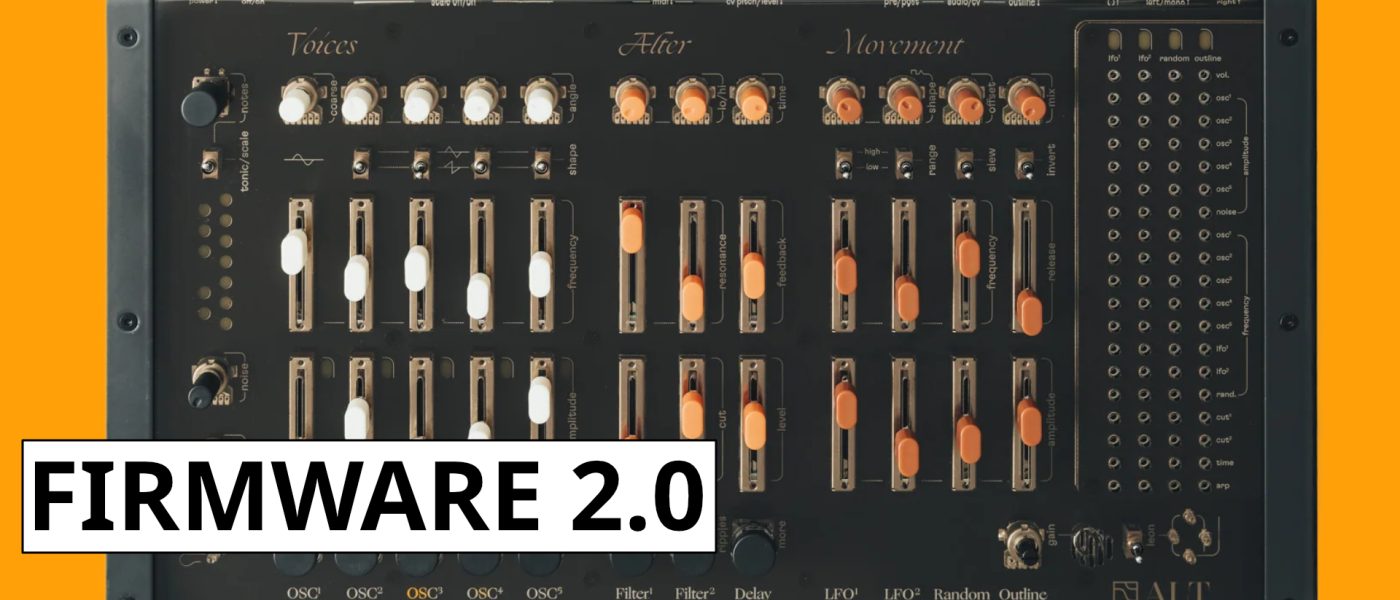
TL;DR: Cyma Forma’s unique pin-matrix analog synth, the ALT, has received a significant free firmware update to version 2.0. The update expands its capabilities beyond pure drone-making with MIDI-controllable envelopes, portamento, and advanced microtonal scale editing, making it a more flexible sound design instrument. This follows a major hardware revision from its initial Kickstarter campaign, which saw the introduction of DCOs, a second stereo filter, and enhanced external audio processing.
- Free 2.0 Firmware: A substantial free update adds MIDI CC control over envelopes for oscillators 2-5, portamento, and a new real-time scale editing MIDI mode for chord progressions.
- Microtonal Mastery Enhanced: Revamped scale system with 15 presets (Western, Just Intonation, non-Western) and per-note microtuning of +/- 50 cents within any scale.
- From Drone to Dynamic: The new envelope control allows the ALT to be played more responsively via MIDI, moving it beyond static soundscapes into more traditional, playable synth territory.
- Post-Kickstarter Hardware Revisions: The shipping unit differs from the original prototype, now featuring DCOs for stability and quantized scales, a cascading second stereo filter, and an external input that can route to the output, turning the ALT into an effects processor.
- Pin-Matrix Prowess: The core analog signal path and expansive pin-matrix modulation system remain, now with new modulation destinations like random frequency and second filter cutoff.
Reading time: 5 min
Want more synth news before your next coffee break? Join the Noxal newsletter — no spam, just gear worth knowing about.

Not Your Average Pin Matrix

Let’s be clear: when we first saw the Cyma Forma ALT at Superbooth, it immediately stood out in a sea of familiar architectures. Here was a synth that looked at the classic pin-matrix—a format we associate with raw, West Coast chaos or the pristine, if esoteric, logic of a Serge—and asked, “What if we made this primarily for immersive, evolving soundscapes?” The result is a five-oscillator analog beast where the primary interface for routing modulation isn’t a menu or a sea of tiny patch cables, but a satisfying grid of pins connecting sources to destinations. It’s tactile, immediate, and visually represents your patch in a way a screen never could.
The core promise is an instrument built for depth and drift. Five analog oscillators (more on their nature later) feed into a characterful, MS-20-inspired stereo analog filter, with everything from LFOs and envelopes to random sources and even an envelope follower for external signals available on the matrix. The original concept was unabashedly focused on the drone, the texture, the infinite pad. It invited you to set a complex, interlocking harmonic structure and then let it breathe and mutate over time. In a market saturated with polysynths that want to play chords, the ALT wanted to be the chord—a living, breathing entity.
The 2.0 Firmware: Unshackling the Drone
The new 2.0 firmware is a fascinating evolution, almost a philosophical shift. While the ALT’s soul remains in textural exploration, this free update systematically addresses the question: “What if I also want to play it?” The most significant answer is the introduction of MIDI CC-controllable envelopes for oscillators 2 through 5. Previously, these oscillators were essentially always on for drone purposes. Now, when triggered via MIDI or the arpeggiator, they can have amplitude shaped by an envelope, making the ALT respond like a more traditional—if wildly complex—polyphonic synth. This is a game-changer for integrating its unique sound into a more dynamic performance.
Equally important are the refinements to its microtonal heart. The scale system has been reorganized, now offering 15 presets that run the gamut from standard Western equal temperament to Just Intonation and various non-Western scales. The real magic, however, is the new per-note microtuning capability, allowing you to nudge any note within any scale by +/- 50 cents. This isn’t just academic; it’s about finding the beating, living dissonance or perfect harmony within your custom tonal world. Couple this with the new MIDI Mode 4, which lets you define a scale in real-time by holding a chord on your keyboard, and you have a system that encourages melodic exploration within its expansive harmonic framework. Adding portamento for oscillators 2-5, also MIDI-controllable, is the final touch that makes playing leads and bass lines a fluid, expressive possibility.
The Journey from Prototype to Production
It’s crucial to understand that the ALT you can buy today (or receive from the Kickstarter) is not exactly the synth shown at Superbooth ’24. The French team, led by the two Vincents, has been iterating aggressively. The most notable hardware change is the shift from VCOs to DCOs. Before the analog purists recoil, understand the rationale: digital control brings rock-solid tuning stability, which is paramount for the intricate, layered harmonies and microtonal scales the ALT specializes in. This shift also enabled the built-in harmonic quantizer, allowing each oscillator’s pitch to be locked to a scale—essential for melodic play with the faders or sequenced modulation.
The other major hardware upgrade is the addition of a second stereo filter that cascades after the first. This transforms the filtering capabilities, offering bandpass, notch, a steeper 4-pole lowpass, and a 2-pole highpass. Furthermore, the external input section has been cleverly reworked. You can now route an external audio signal through the ALT’s filter and “Alter” section (its unique wavefolding/saturation circuit) and out again, effectively turning the synth into a monstrous stereo effects processor for your other gear. These changes, along with added modulation destinations in the pin matrix and proper MIDI implementation, show a developer listening to the needs of modern musicians, transforming the ALT from a brilliant niche idea into a robust, versatile instrument.
Who Is This For, Anyway?
So, who should be looking at the Cyma Forma ALT? It’s not your first, second, or even third synth. It’s for the sound designer who feels constrained by standard architectures, the ambient musician seeking a dedicated engine for endless pads, or the modular enthusiast who craves the depth of a complex patch but desires the stability and immediacy of an all-in-one instrument. The pin matrix demands a different mindset—it’s about creating modulation ecosystems rather than linear signal paths.
With the 2.0 firmware and the hardware revisions, its appeal has broadened. It’s now also for the performer who wants a synth with a truly unique voice that can still handle melodic and harmonic duties in a track, especially within experimental, electronic, or cinematic contexts. At just over €1000, it sits in a competitive space, but its combination of a pure analog signal path, vast modulation, and now, genuine playability, makes it a compelling alternative to both traditional polysynths and the daunting cost of an equivalent modular setup. It’s a statement piece that insists sound can be a physical, malleable substance you sculpt with pins and patience.
Frequently Asked Questions
Is the Cyma Forma ALT a true analog synthesizer?
Yes, the audio signal path is fully analog. The oscillators are now DCOs (Digitally Controlled Oscillators), meaning their pitch is set by a digital counter for extreme stability, but the actual waveform generation is analog. The filters, VCAs, and modulation sources are also analog. The digital component handles tuning, scale quantization, MIDI, and system functions without touching the audio.
Can I save and recall patches on the ALT?
No, the ALT is proudly a “no-preset” synthesizer. Your sound is defined by the physical positions of the knobs, faders, and the pins in the matrix. The philosophy is one of immediacy and exploration. However, the 2.0 firmware does allow certain system settings (like MIDI configurations and envelope/portamento toggle states) to be saved across power cycles.
How does the pin matrix work compared to a modular synth?
The pin matrix is a normalized, fixed-architecture modulation routing system. Instead of plugging cables between arbitrary points, you insert pins into a grid to connect a specific set of modulation sources (top row) to a specific set of destinations (left column). It’s less freeform than a true modular but far more immediate, organized, and reliable—there’s no patching “behind the panel,” and you can see your entire modulation scheme at a glance. It encourages complex, multi-source modulation that would require a much larger modular system to replicate.
Now, if you’ll excuse me, I need to re-caffeinate. My attempt to microtune a harmonic minor scale by ear has left me with a drone that sounds suspiciously like my espresso machine’s grinder.