
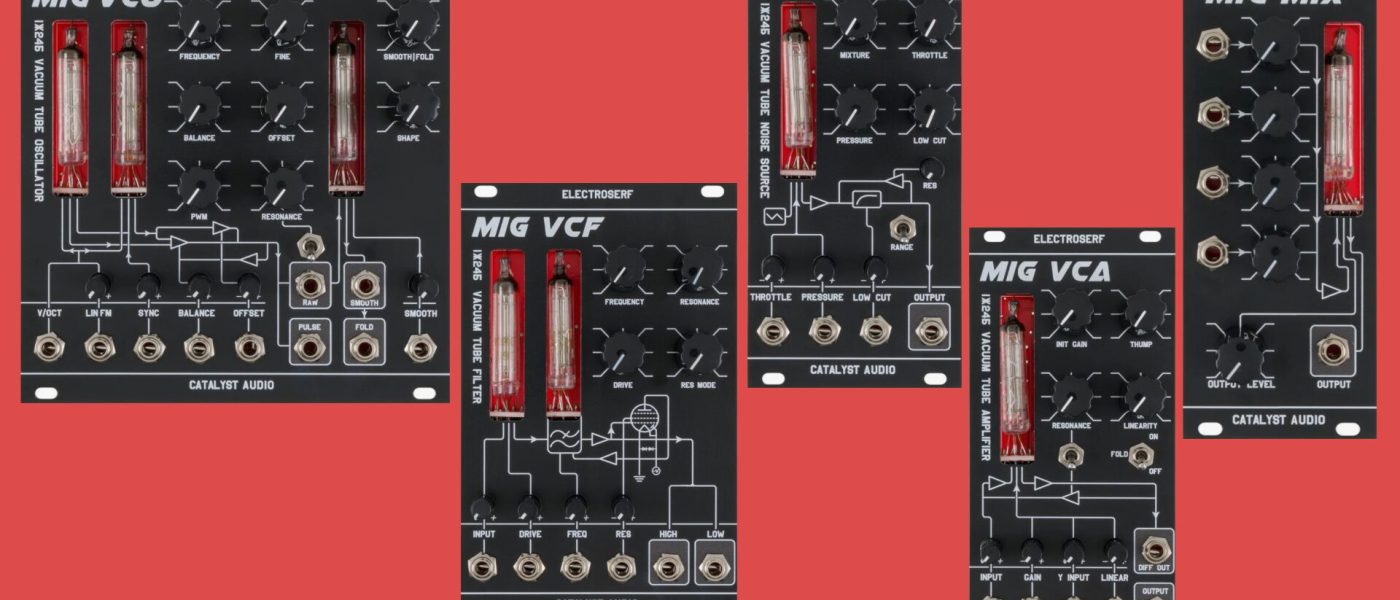
TL;DR: Catalyst Audio has officially released the MIG series, a new line of Eurorack modules built around obsolete Cold War-era Soviet vacuum tubes originally designed for MiG fighter jets. The lineup includes a VCO, VCF, VCA, Thruster noise generator, and Mix, each offering warm, crunchy tube character without requiring a dedicated power supply. Developed in collaboration with Electroserf, these are not clones but original circuits designed from the ground up around the 1j24b tube.
- Five modules available: MIG VCO ($549), MIG VCF ($449), MIG Thruster ($349), MIG VCA ($349), and MIG Mix ($249).
- Uses the 1j24b vacuum tube, originally fabricated for Soviet MiG fighter jets during the Cold War.
- All modules feature low power draw, meaning no external power supply is needed beyond standard Eurorack power.
- The VCO includes a feedback path, wave folding, linear FM, and dedicated outputs for raw, pulse, smooth, and fold waveforms.
- The VCF offers simultaneous high and low-pass outputs with resonance mode blending and CV control over drive, frequency, and resonance.
Reading time: 4 min
Want more synth news before your next coffee break? Join the Noxal newsletter — no spam, just gear worth knowing about.

The Return of David Small

We at Noxal have a soft spot for synth designers who disappear into the workshop for years and emerge with something genuinely weird. David Small of Catalyst Audio did exactly that. Back in 2018, he was making Buchla clones for Eurorack — we remember seeing his demo at Superbooth, before Tiptop Audio and Buchla made it official. Then, silence. Until 2024, when he reappeared with an entirely new concept: modules built around vacuum tubes pulled from Cold War-era Soviet fighter jets.
Now, in 2026, the MIG series is officially available. And no, these aren’t just another batch of tube-based modules with a vintage aesthetic slapped on. These are original circuits, designed from the ground up around the 1j24b vacuum tube. That tube was originally fabricated for use in Mikoyan-Gyurjevich (MiG) fighter jets. So yes, your next patch might literally be powered by technology designed to shoot down NATO aircraft. We find that mildly poetic.
The MIG Philosophy: Cold War Tubes in a Modern Rack
The 1j24b tube is the heart of every MIG module. Catalyst Audio and Electroserf collaborated to build the circuits around this specific component, using additional analog circuitry for buffering and processing where needed. The result is not a clone of anything — it’s a fresh take on tube synthesis, built from available NOS (New Old Stock) tubes that would otherwise gather dust in military surplus warehouses.
One of the first things we noticed: the power draw is surprisingly low. You don’t need a dedicated power supply or a separate rack for these modules. They sit happily in your standard Eurorack case, sipping power like a polite guest at a dinner party. This is a relief, because the last thing we need is another module that requires its own nuclear reactor.
A Closer Look at the Modules
The MIG VCO ($549) is the flagship. It generates true tube waveforms, with shape and smooth/fold controls that let you dial in everything from clean sine waves to snarling, folded textures. Pulse width, sync, and linear FM are all on board. But the real party trick is the built-in feedback path, controlled by balance and offset knobs. This is where things get wild — think howling, saturated, unpredictable sounds that feel alive. The front panel offers dedicated outputs for raw, pulse, smooth, and fold, plus CV inputs for FM, balance, and more.
The MIG VCF ($449) is a vacuum tube filter with simultaneous high and low-pass outputs. Cutoff, resonance, and drive are all there, but the resonance mode knob is the standout feature — it blends between different resonance types, letting you go from smooth and musical to aggressive and squelchy. CV control over drive, frequency, and resonance gives you full modular flexibility. We’d describe the character as warm, crunchy, and slightly unpredictable — exactly what you want from a tube filter.
The MIG Thruster ($349) is a tube-powered noise generator. Controls include throttle, pressure, mixture, and low-cut with adjustable resonance. Internal feedback pathways add extra grit and texture. The demos we’ve heard sound like standing in front of a crackling fireplace — organic, chaotic, and full of life. Throttle, pressure, and low-cut all accept CV, so you can modulate the chaos.
The MIG Mix ($249) is the easiest way to inject tube warmth into any signal. It’s a 4-channel mixer powered by NOS tubes, with individual volume controls. Simple, effective, and surprisingly affordable for a tube-based module.
The MIG VCA ($349) is not just an amplifier — it’s a sound sculpting tool. It features manual and CV control over input gain, internal feedback, and linear response. Two outputs are available: a main output and a DIFF output that feeds back into the signal for howling, saturated goodness. There’s also a wavefolding circuit and resonance that can be activated with a switch. This is the kind of VCA that makes you want to patch everything through it.
Pricing and Availability
The MIG modules are available now. Pricing breaks down as follows: MIG VCO at $549, MIG VCF at $449, MIG Thruster and VCA at $349 each, and the MIG Mix at $249. These are not cheap, but they’re competitive for boutique tube modules. Given the scarcity of the tubes and the original circuit design, we’d say the price is justified — especially if you’re chasing that elusive tube saturation without the hassle of a separate rack.
There aren’t many demo videos on YouTube yet, but there are some on Instagram. From what we’ve heard, they sound lovely — full of energy, crunchy, and warm. Exactly what you’d expect from tube modules, but with a character that feels distinctly their own.
Who Is This For?
These modules are for the Eurorack user who has tried every VCO and VCF on the market and still feels something is missing. They’re for the person who loves the idea of tube saturation but doesn’t want to deal with the heat, power, and size of traditional tube gear. They’re for the synthesist who appreciates the story behind the components — the Cold War provenance, the collaboration with Electroserf, the original circuit design.
If you’re looking for clean, predictable, sterile sound, look elsewhere. These modules have personality. They crackle, they howl, they saturate. They’re not polite. And we at Noxal wouldn’t have it any other way.
Frequently Asked Questions
Do I need a special power supply for the MIG modules?
No. All MIG modules feature low power draw and are designed to work with standard Eurorack power supplies. No external power supply is required.
Are these modules clones of existing designs?
No. Catalyst Audio and Electroserf designed the MIG series from the ground up around the 1j24b vacuum tube. They are original circuits, not clones of Buchla or any other system.
How do the MIG modules sound compared to other tube-based Eurorack modules?
The MIG series uses NOS Cold War-era Soviet tubes, which have a distinct character. Expect warm, crunchy, and slightly unpredictable saturation — less polished than modern tube emulations, but more alive and organic.
We at Noxal are now considering whether our morning espresso would benefit from being routed through a MIG VCA. Probably not. But we’re tempted to try anyway.