TL;DR: Behringer has opened pre-orders for the D Mini, a 99€ 3-voice paraphonic synthesizer based on the Minimoog Model D but in a compact, Volca-sized format. It drops the full-size keys and second envelope of its bigger brother in favor of a built-in sequencer, motion recording, and full MIDI CC control over every knob. Think of it as a Minimoog-flavored sketchpad for the budget-conscious traveler.
- Pre-order price is 99€, with final availability expected soon — a fraction of the 199€ Model D.
- Three-voice paraphony, not true polyphony: all voices share a single ADS envelope, but you get unison, ring mod, and other voice modes.
- Full MIDI CC implementation for every knob means you can automate and save patches via a software editor — a feature the larger Model D lacks.
- Built-in 16-step sequencer with motion recording, plus a 27-key touch keyboard that doubles as a menu interface.
- USB-C powered, designed for mobile use with a smartphone, power bank, or laptop.
Reading time: 5 min
Want more synth news before your next coffee break? Join the Noxal newsletter — no spam, just gear worth knowing about.

A Minimoog for Your Coat Pocket

Behringer’s relationship with the Minimoog Model D is a long and complicated one — like a marriage that’s survived multiple arguments over who left the patch cables on the floor. They’ve cloned it in Eurorack format, in desktop format, and now they’ve shrunk it into a lunchbox-sized affair with a touch keyboard. The D Mini (formerly known as the D Soul) is finally available for pre-order in the EU at 99€, and we at Noxal have been watching this one simmer since its prototype days back in 2022.
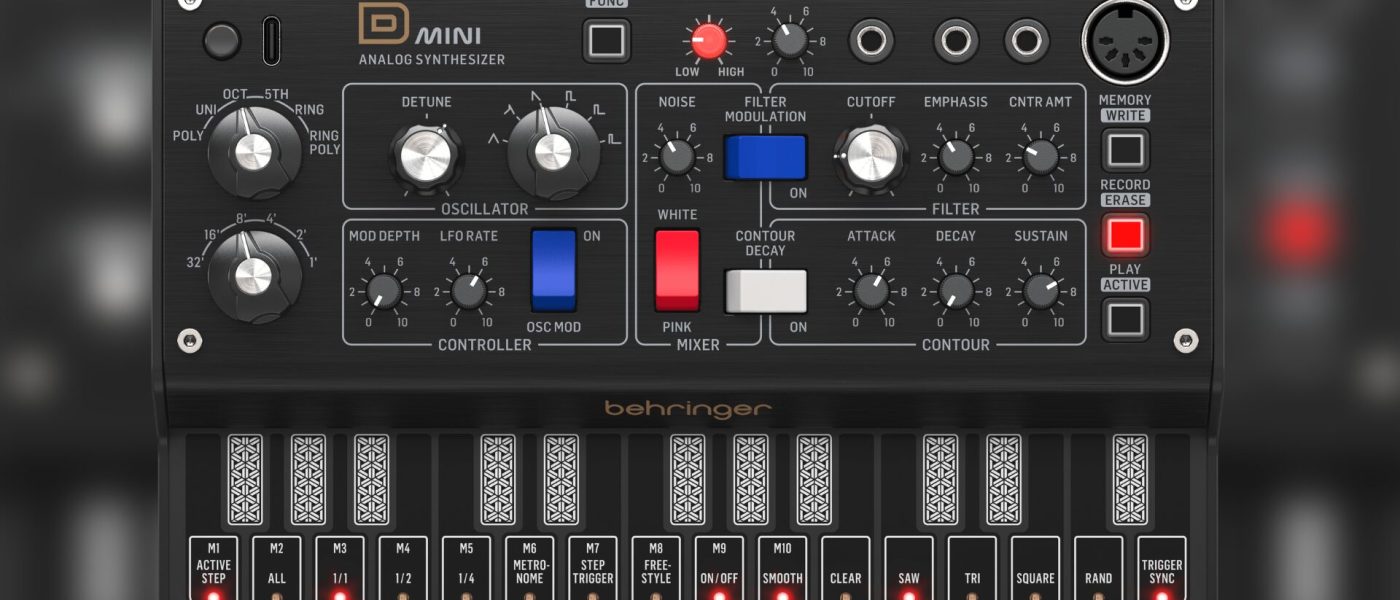
The pitch is simple: take the three-oscillator, ladder-filter heart of the Minimoog, strip away the bulk, and add the kind of modern conveniences that make a synth feel like it belongs in 2026 rather than 1970. The result is a 3-voice paraphonic machine with a built-in sequencer, motion recording, and full MIDI control over every parameter. It’s not a Minimoog replacement — it’s a Minimoog-flavored idea generator for people who don’t have a road case or a studio budget.
What’s Missing and What’s Won
Let’s address the elephant in the room, or rather the missing envelope. The D Mini has one ADS envelope, not two. The larger Model D gives you separate envelopes for the filter and the VCA, which is a big part of that classic Minimoog snappiness. Here, you get one envelope that can modulate the VCA, oscillator, and filter — but you have to choose. It’s a compromise, but one that makes sense at this price point and size. The trade-off is a synth that fits in a backpack and costs less than a night out at a decent restaurant.
What you do get is the authentic ladder lowpass filter with resonance, three analog oscillators with saw, triangle, shark, square, and pulse waveforms, plus a noise generator with white and pink noise. The oscillators are all tuned together with a single knob — a limitation that forces you to think more about timbre than tuning quirks. For some, that’s a loss of character. For others, it’s a welcome simplification. We at Noxal lean toward the latter, especially when the alternative is missing the bus because you were trying to dial in three separate tuning knobs.
The Sequencer and the Touch Keyboard
The D Mini’s built-in 16-step sequencer is the real star here. It has eight memory slots and motion recording, which means you can record knob movements into your patterns. That’s the kind of feature that turns a simple bassline into a living, breathing performance. The 27-key touch keyboard is, well, a touch keyboard — it’s fine for programming notes and chords, but don’t expect to channel your inner Keith Emerson on it. The keyboard also doubles as a menu interface for the sequencer and other settings, which is a clever way to keep the panel uncluttered.
For live jams, the voice modes are where the fun begins. You get poly (3-voice paraphonic), unison, ring mod, and more. Paraphony means all three voices share the same filter and envelope, so it’s not true polyphony, but it’s enough to add harmonic movement to your sequences. Unison mode turns it into a fat mono beast, and ring mod adds that metallic, sci-fi edge. It’s a versatile little box for the size.
Connectivity and the Software Editor Dream
On the back panel, you’ll find a USB-C port for power and data, a headphone jack, sync in/out for connecting to other gear, and a 5-pin TRS Mini input for MIDI. The USB power means you can run it from a smartphone, power bank, or laptop — ideal for the portable studio or the coffee shop jam session. But the real headline is the full MIDI CC implementation. Every knob sends and receives MIDI, which means you can build a software editor, save patches externally, and automate everything from your DAW.
This is a significant advantage over the larger Model D, which relies on physical knob positions and has no patch memory. The D Mini isn’t just a Minimoog clone — it’s a Minimoog clone that plays nice with modern production workflows. For those of us who have spent hours trying to recreate a patch from an old recording, this is a godsend. I, for one, have a coffee-stained notebook full of patch settings that I can never quite replicate. This synth might finally let me throw it away.
Market Context and Who’s It For
At 99€, the D Mini sits in the same budget-friendly territory as the Korg Volca series, but with a distinctly different flavor. Where the Volca Bass offers three-note polyphony with a Roland-style sound, the D Mini brings the Moog-style ladder filter and three analog oscillators. It’s a direct competitor to the Volca Bass, the Arturia MicroFreak (though that’s digital), and Behringer’s own other mini synths like the Pro VS Mini and the Edge.
Who is this for? It’s for the producer who wants a portable analog sketchpad for basslines and leads. It’s for the live performer who needs a compact, versatile synth that fits in a messenger bag. It’s for the beginner who wants to explore subtractive synthesis without spending a mortgage payment. And it’s for the veteran who just wants a Minimoog-flavored sound source without the weight or the price tag. We at Noxal would argue it’s also for anyone who’s ever looked at a Model D and thought, “I love the sound, but I’d rather spend the other 100€ on a good pair of headphones.”
Frequently Asked Questions
Is the Behringer D Mini a true polyphonic synth?
No, it’s 3-voice paraphonic. All three voices share a single ADS envelope and filter, so it’s not true polyphony like a Juno-106. But it does offer unison and ring mod modes, which add flexibility.
Can I save patches on the D Mini?
There’s no internal patch memory, but the full MIDI CC implementation means you can save and recall patches via a software editor or your DAW. That’s a major upgrade over the larger Model D.
Does it sound like a real Minimoog?
It uses the same circuit topology for the oscillators and ladder filter, so it will get you in the ballpark. But the single envelope and shared tuning mean it won’t replicate the exact behavior of a vintage Model D. It’s a Minimoog-inspired instrument, not a clone.
Now if you’ll excuse me, I need to clear off my desk — the D Mini pre-order confirmation arrived, and my coffee mug needs a new neighbor that’s cheaper than therapy and sounds better than my last mix.