TL;DR: Bastl Instruments has unveiled the Kalimba, a portable hybrid instrument that combines acoustic kalimba tines with a digital synthesis engine. After three years in development and a wildly successful Kickstarter raising nearly €1,000,000, this 310-gram box of future-twang offers physical modeling, FM synthesis, a looper, arpeggiator, and built-in speaker — all controlled by plucking, touching, or even shaking it. It’s the high-tech kalimba Korg’s Phase 8 wished it was.
- 12 touch- and velocity-sensitive steel tines excite a dual sound engine with physical modeling and FM synthesis, plus a multi-FX processor with five effect categories.
- Built-in accelerometer lets you shape sound by tilting and rotating the unit, while the internal microphone picks up percussive hits on the casing or tines.
- Six bipolar knobs control macro parameters (timbre, excite, blend, detune, body, decay), and you can micro-pitch each tine independently across 12 scales.
- Includes a destructive looper (free/tempo sync with undo/redo), an arpeggiator, 16 preset slots, MIDI I/O (1/8″ TRS Type A and USB-C), analog clock I/O, and a rechargeable battery.
- Weighs 310g, measures 144 × 95 × 50 mm, and fits neatly in two hands — early bird Kickstarter pricing starts at €389, retail will be ~€550, shipping December 2026.
Reading time: 4 min
Want more synth news before your next coffee break? Join the Noxal newsletter — no spam, just gear worth knowing about.

What Is the Bastl Kalimba?

Let’s get one thing straight: the Bastl Kalimba is not a toy. It’s also not a “synth with keys” that happens to look like a thumb piano. This is a genuine acoustic-electronic hybrid that began life three years ago as a sketch in a Czech workshop, and it has now materialised as a 310-gram, 144 × 95 × 50 mm slab of weird genius. At Superbooth 2026, I had the chance to hold one for all of ninety seconds during setup day. My first thought was, “This is what the Phase 8 should have been.” My second thought was, “I need coffee, but I also need this.”
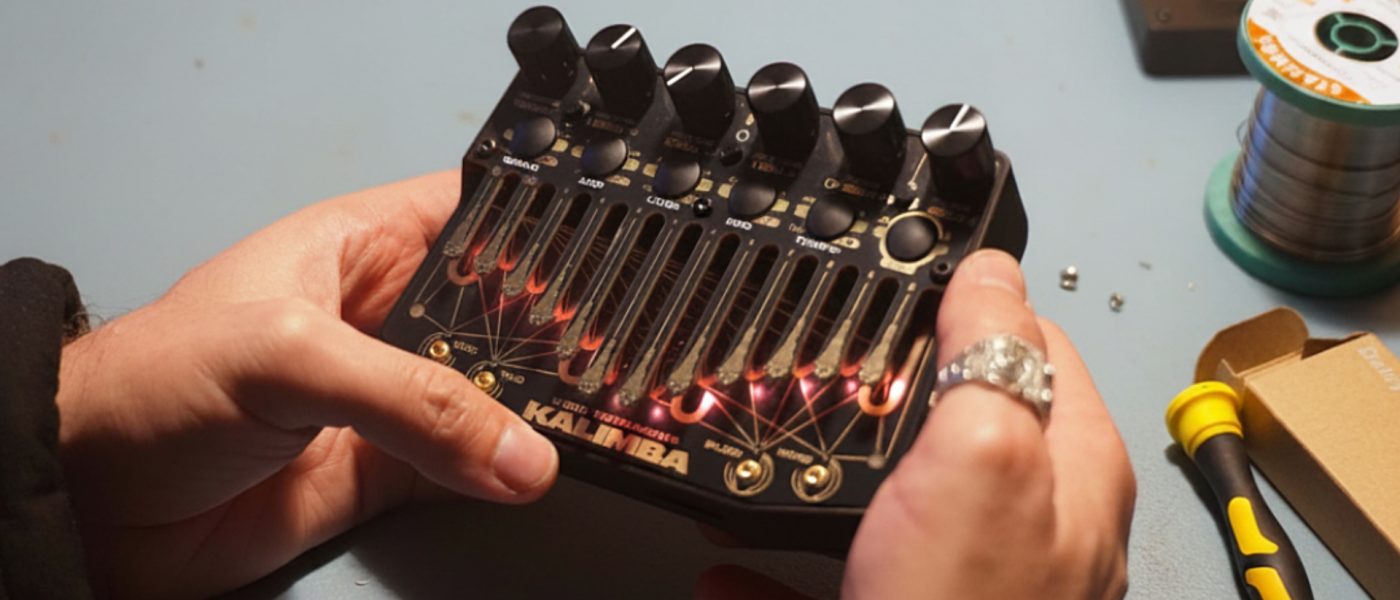
The core interaction is deceptively simple: twelve steel tines sit atop a wooden-ish body, each one touch- and velocity-sensitive. You can pluck them like a traditional kalimba, or you can simply touch them. The internal microphone picks up not only the tines but also percussive knocks on the casing. There’s an accelerometer inside that acts as an alternative exciter, dynamically filtering left and right channels as you rotate or tilt the instrument. It feels like playing an acoustic instrument that secretly dreams of being a modular synth.
We at Noxal admire the restraint here. Bastl didn’t slap a keyboard on it. They committed to the kalimba form factor and made the interaction the star. There are function-based touch points for pads and pitch slides, plus two assignable functions on the back. It’s the kind of design that forces you to abandon muscle memory and learn something new — which, frankly, is what we need more of in 2026.
The Engine Behind the Tines
Under the hood, the Bastl Kalimba houses a six-voice digital sound engine that blends physical modeling (stereo digital resonators) with FM synthesis. Six bipolar knobs — labelled timbre, excite, blend, detune, body, and decay — give you interactive macro control over the sound. You can switch octaves on the fly, micro-pitch each tine independently, and choose from twelve scales. If you’ve ever wanted your thumb piano to sound like a glass harmonica run through a broken tape machine, this is your gateway drug.
The multi-FX processor is comprehensive without being overwhelming: filters (low/high), crunch (downsampler, bit-crusher, distortion), modulation (chorus, flanger, tape emulation), time (two delay modes), and space (two reverb modes). There’s also a built-in looper with a destructive looping concept — meaning you can re-record the looper using the built-in effects, which is a clever way to avoid the usual “loop then process” workflow. It supports free and tempo-synced looping, plus one-layer undo/redo. And yes, there’s an arpeggiator with multiple modes.
All settings can be saved in 16 presets. It’s a synth, after all. But it’s a synth that asks you to play it like a percussive instrument, not like a pianist. The sound design possibilities are broad enough to keep you busy for months, especially if you enjoy the sweet spot where acoustic resonance meets digital instability.
Playback and Connectivity
On the back, the Bastl Kalimba reveals its synth DNA. You get a headphone/line-level output, MIDI input and output on 1/8″ TRS (Type A), and analog clock I/O via the same jacks. USB-C handles MIDI, firmware updates, and charging. The built-in rechargeable battery means you can take this thing to the park, the café, or the back of a van at a festival. There’s also a built-in speaker — because why wouldn’t you want to annoy your friends with micro-pitched kalimba drones at a campsite?
Neck and wrist strap holes are included, which makes the Kalimba genuinely portable. At 310 grams, it’s lighter than most tablets and smaller than a paperback. I’d argue it’s the most pocketable serious synth since the Korg NTS-1, but that’s like comparing a bicycle to a unicycle — both are transport, but one demands more of you.
We at Noxal appreciate that Bastl didn’t cut corners on connectivity. The MIDI and clock I/O options mean you can integrate this into a larger setup, even if its primary use case is as a standalone, tactile instrument. The USB-C port is standard and sensible. No proprietary nonsense here.
Market Context and Who It’s For
The Bastl Kalimba enters a curious market space. Korg’s Phase 8, released earlier this year, was described by many as a “high-tech kalimba.” But the Phase 8 is fundamentally a synthesizer with a unique controller. The Bastl Kalimba is a kalimba that happens to contain a synthesizer. That distinction matters. The Kickstarter raised nearly €1,000,000 — a clear signal that musicians are hungry for instruments that don’t look like black slabs with keys.
Who is this for? The experimentalist who owns a Lyra-8 and a handful of pocket operators. The field recordist who wants to layer physical gestures with digital processing. The bedroom producer who’s tired of staring at a screen and wants to hold sound in their hands. It’s not for everyone — the learning curve is real, and the lack of a traditional keyboard will frustrate anyone who just wants to play chords. But for those willing to explore, the Bastl Kalimba offers a genuinely new way to interact with synthesis.
Pricing starts at €389 for early bird Kickstarter backers, with retail expected around €550. The first batch of 1500 units ships in December 2026. That’s a long wait, but good things take time — and coffee takes patience.
Frequently Asked Questions
Is the Bastl Kalimba a MIDI controller or a standalone synth?
It’s a standalone synthesizer with a built-in sound engine, looper, arpeggiator, and speaker. It also sends and receives MIDI over TRS and USB-C, so you can use it as a controller for other gear, but it doesn’t need a computer or external module to make sound.
How does the accelerometer affect the sound?
The accelerometer acts as an alternative exciter for the sound engine, dynamically filtering the left and right channels based on how you move and rotate the instrument. This means tilting or shaking the Kalimba changes the stereo image and timbre in real time.
Can I change the tuning of individual tines?
Yes. The Bastl Kalimba allows micro-pitching of each of the 12 tines independently, with 12 different available scales. You can also switch octaves on the fly, giving you significant control over the instrument’s tuning beyond the standard kalimba layout.
I spent half an hour trying to decide whether the Bastl Kalimba would fit in my jacket pocket. It would. My wallet, however, is already mourning the €389. Time to brew another pour-over and stare at the Kickstarter page.