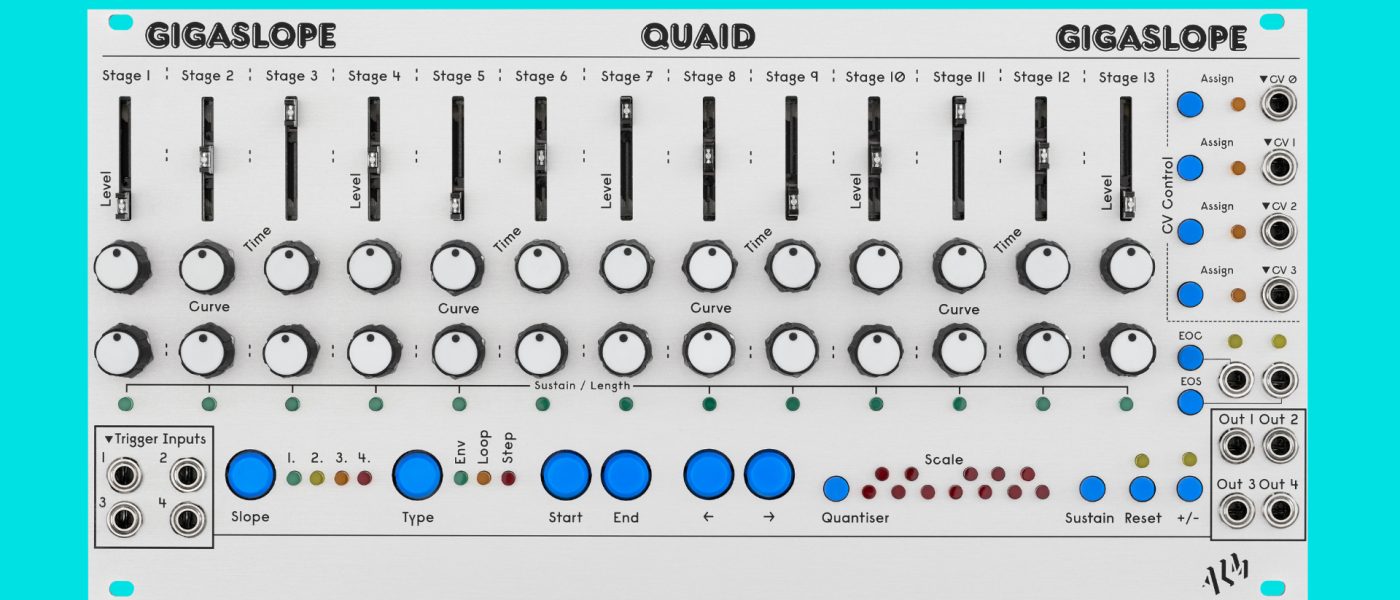
TL;DR: ALM has supersized its Megaslope concept into the Quaid Gigaslope, a 52HP quad multi-stage modulator for Eurorack. It offers four independent channels of complex envelopes, LFOs, or quantized sequencers with up to 13 stages each, all in a menu-free, knob-per-function design. It’s a modulation powerhouse that demands significant rack real estate and a budget of $849.
- A massive 52HP quad-channel modulator based on the multi-stage “slope” concept.
- Each channel can be a complex envelope, LFO, or quantized step sequencer with up to 13 stages.
- Fully knob-per-function, menu-free interface with state retention across power cycles.
- Features per-stage CV control, 19 built-in musical scales for quantization, and multiple trigger outputs.
- Priced at $849 / £699, positioning it as a flagship modulation centerpiece.
Reading time: 4 min
Want more synth news before your next coffee break? Join the Noxal newsletter — no spam, just gear worth knowing about.
Beyond the ADSR: The Multi-Stage Modulation Arms Race

We at Noxal have a soft spot for modules that attempt to translate software fluidity into tangible hardware. In the digital realm, complex multi-stage envelopes and modulation sequencers are commonplace—look at the recent u-he Zebra 3 reveal. In Eurorack, this concept is more of a premium feature, pioneered by modules like the Xaoc Devices Zadar and, notably, ALM’s own Quaid Megaslope. These are the tools that move you beyond simple attacks and decays into the world of evolving, morphing, and intricately timed control voltages.
ALM has now decided that if two stages are good, and ten are better, then four channels with up to thirteen stages each must be…gigantic. Enter the Quaid Gigaslope. This isn’t an incremental update; it’s a declaration. It takes the brainy concept of the Megaslope and scales it both in physical size and functional ambition, aiming to be the central modulation nexus for a large system. It feels like ALM is responding to a patcher’s hunger for more—more channels, more stages, more direct control—and is willing to carve out a half-foot of your rack to deliver it.
Gigaslope Dissected: Four Brains, No Menu
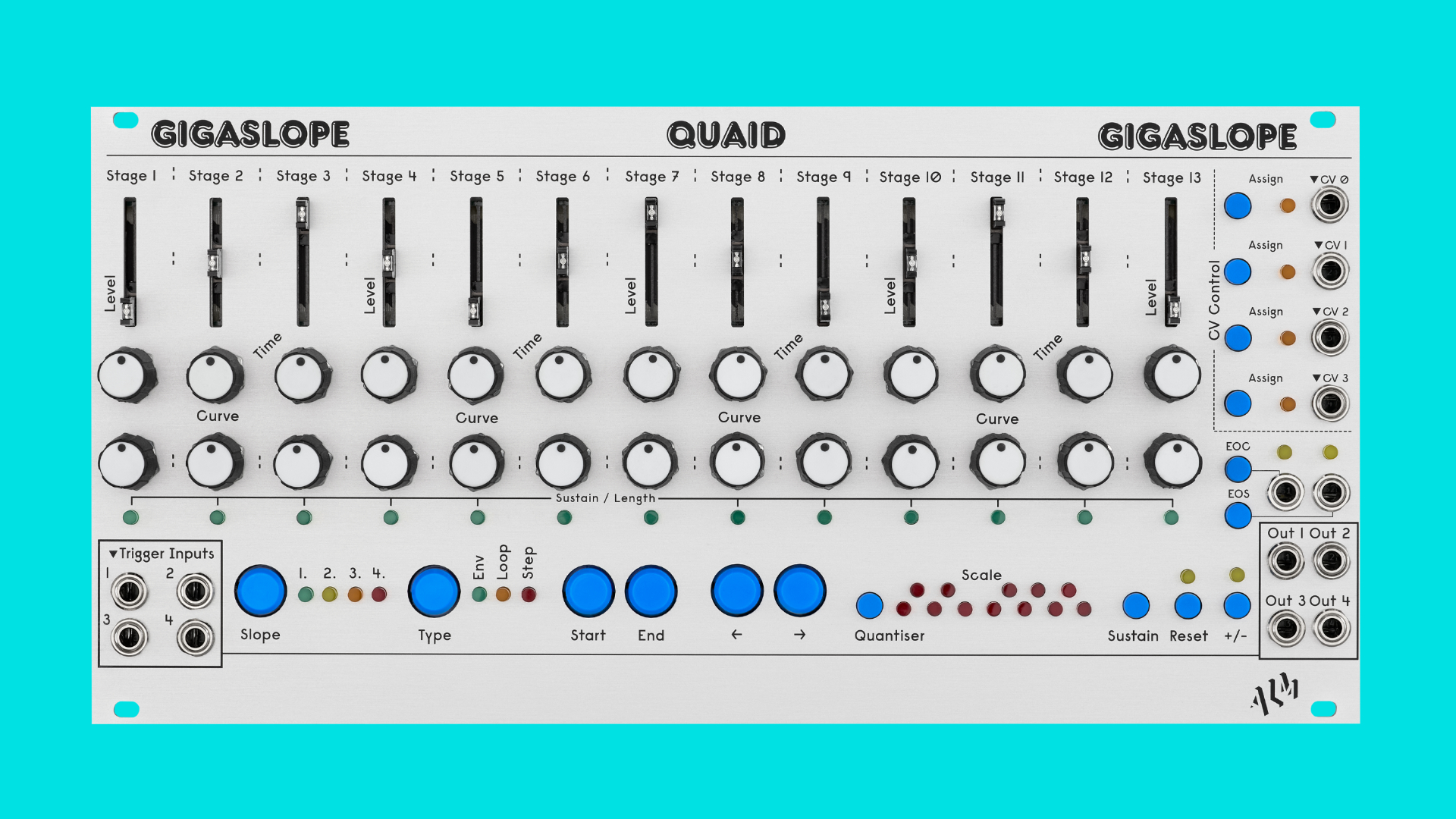
So, what exactly are you getting in this 52HP behemoth? Four completely independent “slope” channels. Each slope is a blank canvas that can be configured as a complex multi-stage envelope, a flexible LFO with variable waveforms, or a step sequencer. The magic word here is “multi-stage”: each slope can have up to 13 segments. These stages can be discrete or can overlap, allowing for shapes that swell, stutter, and step in ways a simple ADSR could never dream of.
The philosophy is staunchly hands-on. Every critical parameter—stage level, duration, and curve shape—has a dedicated knob. There is no menu to dive into, and while you can’t save presets, the module remembers everything exactly as you left it when you power down. This makes it immensely playable and “jam-friendly,” as ALM puts it. Beyond the core shaping, it gets clever: the output range of each channel can be set and quantized to one of 19 built-in musical scales, instantly turning any wiggly slope into a melodic sequence. It also spits out trigger pulses at the end of each stage and the end of each slope cycle, providing perfect timing cues for the rest of your rack.
Connectivity is robust, with four freely assignable CV inputs on the main panel and the option to add an AXON expander for four more. This means you can externally modulate stage parameters, creating modulation that modulates your modulation—a meta-patching paradise. The assignable EOC/EOS (End of Cycle/End of Stage) output adds another layer of patch-programmable logic.
For Whom The Slope Tolls: The Target Patcher
Who is this for? I look at the Gigaslope and see a module for the synthesist who has moved beyond needing just a couple of function generators. This is for the architect building a large, performance-oriented case or a complex generative ambient machine. It easily handles the boring stuff—your standard ADSR duties for four voices—but its true calling is experimental patching.
Imagine one channel as a 13-step sequencer modulating a complex wavetable position, while another channel provides an overlapping, CV-able envelope to a filter, with its end-of-stage triggers advancing a drum pattern. You can cross-patch channels, use slopes to modulate other slopes, and create self-generating, ever-changing modulation matrices. It’s a module that rewards deep exploration and systematic thinking. If your patching style is “set and forget,” the Gigaslope might be overkill. But if you view modulation as the primary instrument, this is your new control center.
The HP Elephant in the Room
Let’s address the monolithic presence in the room: 52HP. That’s not a module; that’s a statement. It’s wider than some popular semi-modular synths. For many, this will be the immediate and insurmountable dealbreaker. Your 104HP skiff just became a 52HP Gigaslope with a couple of friends. ALM themselves suggest considering a dedicated 4ms Pod or similar case for it, which is a telling recommendation.
This brings us to the price: $849. It’s a significant investment, positioning the Gigaslope as a flagship, centerpiece module. You’re paying for the immense density of high-quality components, four channels of incredibly powerful logic, and that glorious knob-per-function interface. The value proposition hinges entirely on whether you need and will use this depth and breadth of modulation. For a large, performance-focused system where modulation is king, the cost-per-HP calculation starts to make sense. For a modest travel case, it’s a non-starter. As for me, I’m already mentally rearranging my rack and mourning the perfectly good modules I’d have to evict to make room for this modulation metropolis.
Frequently Asked Questions
Can the Quaid Gigaslope save and recall presets?
No, there is no preset system in the traditional sense. However, the module is fully stateful, meaning it remembers all knob positions, switch settings, and stage configurations exactly as you left them when you turn your system off and on again. Its design philosophy is immediate, hands-on control rather than menu-based snapshot recall.
How does it differ from the older Quaid Megaslope?
The Gigaslope is a massive expansion of the Megaslope concept. The key differences are scale: the Gigaslope has four independent channels (vs. one), offers up to 13 stages per slope, includes musical scale quantization, and provides many more trigger outputs and CV assignment options. The Megaslope is a powerful single channel; the Gigaslope is a comprehensive quad modulation workstation.
Is the AXON expander necessary?
Not necessary, but highly recommended for maximizing the module’s potential. The main panel has four assignable CV inputs. The AXON expander adds four more, giving you a total of eight CV inputs to modulate stage parameters across the four channels. For complex, evolving patches where you want extensive external control over your modulation shapes, the expander is a logical addition.
Now, if you’ll excuse me, I need to measure my last remaining rack space and then brew a very strong coffee to contemplate my life choices. The eternal struggle: more modulation or more lunch?