

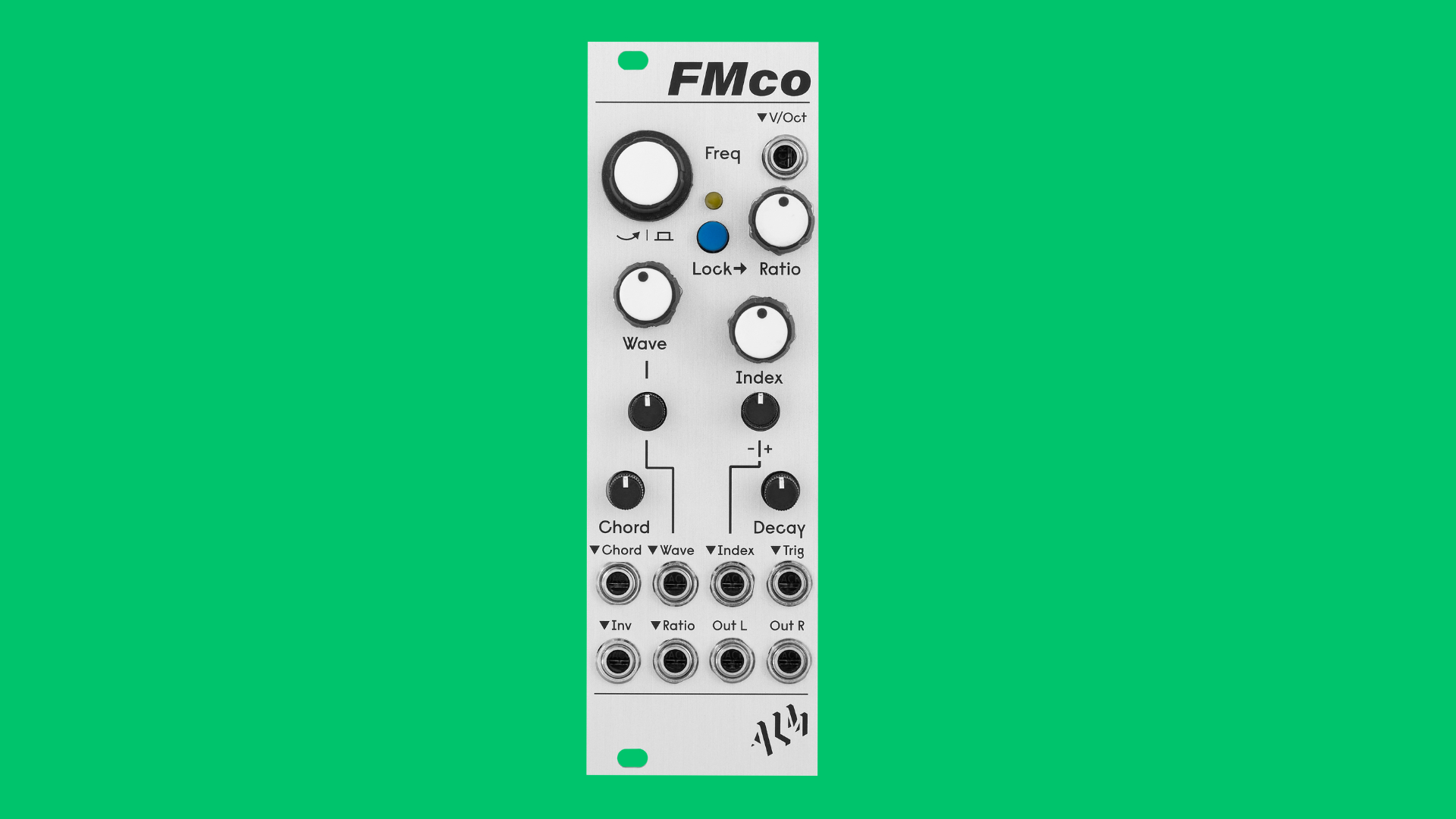
TL;DR: ALM Busy Circuits has released the FMco, a compact 8HP Eurorack synth voice dedicated to 2-operator FM synthesis. It promises a more immediate, hands-on approach to FM sound design with direct controls, voltage-controlled chord mode, and a built-in VCA and stereo output. It’s available now for $299.
- An 8HP, 2-operator FM synth voice designed for immediacy and hands-on control, inspired by ALM’s own Akemie modules.
- Features direct encoder tuning, CV control over FM index and operator ratios, and a voltage-controllable four-voice chord mode.
- Functions as a complete voice with a decay envelope, VCA, and stereo outputs with a widening effect.
- Priced at $299 / £239, positioning it as an accessible entry point into dedicated FM synthesis in Eurorack.
- Includes a USB-C port for drag-and-drop firmware updates, hinting at potential future expansions.
Reading time: 4 min
Want more synth news before your next coffee break? Join the Noxal newsletter — no spam, just gear worth knowing about.
The Two-Operator Proposition

Let’s address the elephant in the modular case: in a world where FM synths proudly tout 6, 8, or even more operators, why would anyone build—let alone buy—a module with just two? ALM Busy Circuits’ new FMco asks this question and answers it with a shrug that says, “Because it’s fun, and you’ll actually use it.” We at Noxal have a soft spot for constraints that breed creativity, and the 2-operator FM architecture is a masterclass in that philosophy. It strips away the labyrinthine complexity of a full DX7-style engine, leaving you with the fundamental, beautiful interaction of a carrier and a modulator. The result is a synth voice that is direct, less cryptic, and arguably more musical for spontaneous patching.
This isn’t ALM’s first foray into FM; the FMco is explicitly inspired by their popular Akemie’s Castle and Taiko modules. But where those are expansive, almost fantastical sound generators, the FMco is described as being “tuned for more immediate use and a more modern sound.” It feels like a distillation—taking the core FM concept from their previous work and packaging it into a focused, playable instrument. For the Eurorack user who’s been intimidated by FM or simply wants a dedicated, knob-per-function voice that doesn’t require a manual and a flowchart, this is a compelling proposition.
Hands-On in a Digital Realm
The most significant achievement of the FMco, on paper at least, is its commitment to analog-style immediacy. This is a digital DSP engine wearing an analog control panel, and that’s high praise. The centerpiece is a dedicated encoder for tuning the two operators “quickly, easily, and accurately.” No menu diving, no shift functions to access coarse tune. This directness extends to the FM index (depth) control, which has its own knob, CV input, and attenuverter. Similarly, the operator ratio control features a lock switch, letting you jump between free, experimental intervals and precise, musical ratios.
I can already hear the purists: “But it’s monophonic.” ALM, in a clever bit of digital trickery, has pre-empted that critique. The FMco includes a voltage-controllable chord mode with inversion, allowing you to generate chords with up to four voices from its monophonic core. This isn’t just a paraphonic cheat; it’s a thoughtful feature that dramatically expands the module’s utility in a mix, letting you create pads, stabs, and harmonic movement without consuming multiple oscillators or voices in your system. It’s this kind of smart, musical implementation that makes a compact module feel much larger.
Specs, Features, and Hidden Depth

Let’s run down what’s in the 8HP frame. At its heart is the original 2-operator DSP engine with eight operator waveforms (the specific shapes are, as of now, a delightful mystery). It’s a complete voice: a decay envelope triggered by a gate input can be routed to both the FM depth and the onboard VCA’s output level. Yes, there’s a VCA on board, meaning you can plug in a pitch CV and a gate, and you have a full synthesizer voice ready to go. This completeness is a huge boon for small systems or for those who want FM as a distinct layer without patching half a case to support it.
The outputs are stereo (L&R) with a built-in stereo widening effect, a nice touch that adds spatial interest without external modules. And then there’s the USB-C port on the side. Labeled for “drag and drop” firmware updates, this is the module’s nod to the future. In an ecosystem where a product can evolve, this port suggests the FMco’s feature set isn’t necessarily static. Could we see new waveforms, chord types, or even a third virtual operator down the line? The potential is an enticing part of the package. For $299, you’re getting a lot of thoughtfully integrated functionality.
Context and Competition
Where does the FMco sit in the market? It’s not competing with the monstrous, multi-operator powerhouses like the Synthesis Technology E352 or complex digital oscillators with FM modes. Its real competition is inertia—the temptation to just use a basic analog VCO and call it a day. It’s also competing against other compact, characterful digital voices like the ALM MCO MkII (a sibling module focused on 90s digital textures) or the Plonk. The FMco carves its niche by being singularly devoted to a specific, classic synthesis method and making it approachable.
For the beginner, it’s a fantastic educational tool. For the seasoned patcher, it’s a quick, inspiring sound source that won’t derail a session with complexity. In a landscape where new modules often feel like they’re solving problems that don’t exist, the FMco feels refreshingly purposeful. It answers a simple question: “What if I want the crisp, clangorous, and sweet sounds of FM synthesis, but I want to tweak them with my fingers in real-time, like a proper instrument?” Based on the specs alone, ALM seems to have delivered exactly that. Now, if you’ll excuse me, I need to see if I have 8HP of free space next to my coffee mug holder.
Frequently Asked Questions
Is the ALM FMco a complete voice module?
Yes. It includes a 2-operator FM oscillator, a decay envelope that can modulate both FM depth and amplitude, and a built-in VCA. Provide it with pitch CV and a gate trigger, and it will produce a full sound without requiring external envelope generators or VCAs.
Can the FMco do polyphony?
It is a monophonic voice at its core. However, it features a voltage-controllable chord mode that can generate up to four-note chords from its single engine, including inversion options. This allows for harmonic, chord-based sounds without needing multiple independent oscillators.
How does it update, and is it expandable?
The module features a USB-C port on its side for “drag and drop” firmware updates. While ALM has not announced specific future features, this port strongly suggests the module’s capabilities could be expanded or refined via firmware, which is a significant plus for long-term value.
Now, to clear a perfect 8HP space in my rack, a ritual that always involves spilling coffee on something less important. Priorities.