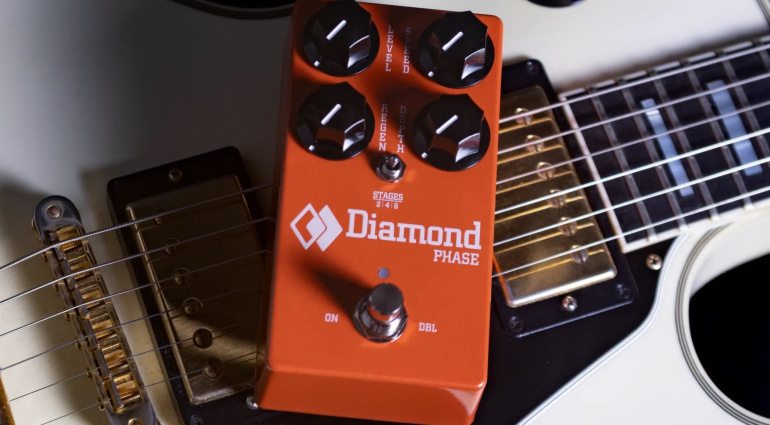
TL;DR: Diamond Pedals has shrunk its classic analog phaser into a new, pedalboard-friendly enclosure without sacrificing sound quality. The redesigned Diamond Phase retains its all-analog signal path with matched JFETs but now offers selectable 2-, 4-, or 6-stage phasing via a toggle switch. It’s available now for €279.
- Fully analog signal path built around six matched JFET transistors for a smooth, musical phase shift.
- New compact enclosure with top-mounted jacks, making it pedalboard-friendly.
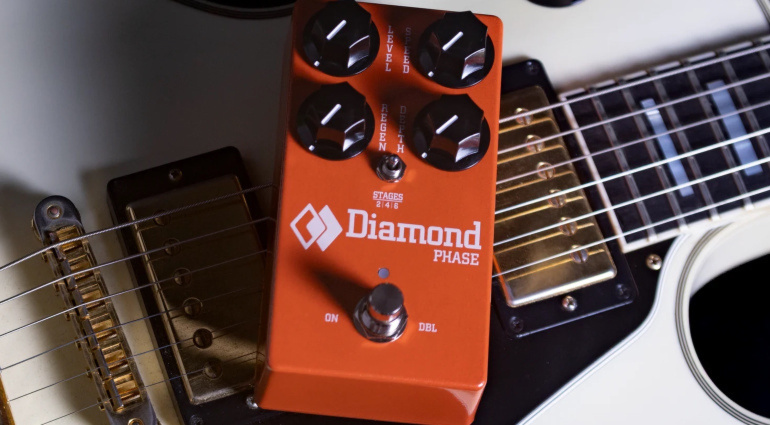
- Selectable 2-, 4-, or 6-stage phaser architecture for subtle, classic, or complex psychedelic sounds.
- Simple, manual control set with Level, Speed, Regen, and Depth knobs plus Momentary/Latching footswitch.
- Handcrafted in Canada with a price point of €279, positioning it as a premium, no-fuss analog effect.
Reading time: 4 min
Want more synth news before your next coffee break? Join the Noxal newsletter — no spam, just gear worth knowing about.
The Analog Core: JFETs & Musicality

Let’s cut to the chase: in a world awash with digital multi-effects and algorithm-based modulation, the promise of a “fully analog signal path” is more than just marketing copy for a certain breed of player. It’s a creed. Diamond Pedals understands this congregation, and the newly redesigned Diamond Phase is their latest sermon. The heart of this sermon remains unchanged from its predecessor: six carefully selected and matched JFET transistors. For the uninitiated, JFETs (Junction Field-Effect Transistors) are the secret sauce in many beloved vintage effects, prized for their warm, organic response and pleasing nonlinearities. They don’t just switch a signal; they shape it, imparting a depth and clarity that digital emulations often struggle to replicate authentically.
This isn’t about analog snobbery for its own sake—though we’re certainly not above that here at Noxal. It’s about a specific sonic outcome. A phaser works by splitting your signal, shifting the phase of one part, and blending it back with the original to create those characteristic sweeping notches. When this process is handled by these matched JFETs, the phase shift isn’t just a mathematical function; it feels “exceptionally smooth” and, crucially, “musical.” The result is a modulation that sits with your sound, adding warmth and movement without ever sounding harsh, sterile, or like an effect bolted on as an afterthought. It’s the difference between a perfectly engineered sine wave and the resonant tail of a struck bell.
Shrinking the Enclosure, Expanding the Options
The most immediately obvious change is the box itself. The new Diamond Phase has been put on a diet, emerging with a smaller, more pedalboard-efficient footprint. In an era where real estate is often more precious than gold, this is a welcome and pragmatic evolution. Adding to the practicality are the now top-mounted input/output jacks, a small but significant design choice that saves crucial millimeters when cramming pedals together. It’s a thoughtful update that respects the reality of the modern player’s setup.
But Diamond didn’t just shrink the box and call it a day. They’ve used the redesign as an opportunity to add functionality. The centerpiece of this expansion is a mini toggle switch that selects between 2-, 4-, or 6-stage phasing. This is a powerful addition. The number of stages in a phaser directly correlates to the intensity and complexity of the effect. More stages mean more notches in the frequency spectrum, creating a deeper, more pronounced “whoosh.” By making this selectable, Diamond has effectively packed three distinct phaser personalities into one compact unit. It transforms the pedal from a one-trick pony (albeit a very good trick) into a versatile modulation tool, all without adding a single confusing menu or digital display.
The Sound Spectrum: From Subtle to Psychedelic
So, what do these stages actually sound like? The 2-stage mode is your secret weapon. It’s the domain of subtle, almost chorused thickening and delicate movement. Think of it as adding a slight shimmer and dimensionality to a clean guitar line or a pad synth without screaming “HEY, I’M A PHASER.” It’s the setting for when you want the mood, not the effect. The 4-stage mode is the sweet spot of classic phasing. This is the territory of the iconic ’70s sound—that warm, recognizable sweep that defined countless funk rhythms and rock leads. It’s musical, assertive, and instantly familiar.
Then you engage the 6-stage mode, and the pedal puts on its tie-dye shirt. This is where you get increased harmonic complexity, a thicker, more pronounced swirl, and the potential for powerful, expressive, and outright psychedelic sounds. The “Regen” control (often labeled as “Feedback” or “Resonance” on other units) becomes particularly potent here, allowing you to push the peaks of the phase shift into self-oscillation for dramatic, jet-like sweeps. Paired with the standard Speed and Depth controls, the Diamond Phase covers an impressive range, from a gentle, studio-polish modulation to a full-blown trip back to 1969.
Who It’s For (And Who Might Look Elsewhere)
The Diamond Phase, with its €279 price tag and handcrafted-in-Canada pedigree, is unapologetically a premium offering. It’s for the player or producer who values analog purity, immediate tactile control, and studio-grade build quality above all else. It’s for the guitarist who wants their Small Stone sound but in a more robust, road-ready package, or the synth enthusiast looking for a high-quality, dedicated modulation effect to warm up digital oscillators. Its simplicity is its strength: no presets, no USB, no app. Just knobs, a switch, and great tone. As the source text aptly notes, you won’t need a manual.
Conversely, this pedal is not for the digital tinkerer who needs 127 recallable presets or wants to sync LFO shapes to MIDI clock with pinpoint precision. For that, you’d look at something like an Eventide H9 or a source audio modulator. The Diamond Phase is an instrument in its own right, not a software suite. It’s also not the absolute cheapest option on the market—Behringer’s recent foray into classic phase cloning proves that. But what you’re paying for here is the curated, musical result of selected components, thoughtful design, and artisanal construction. In a market flooded with options, the Diamond Phase makes a compelling case for doing one thing, with a few well-chosen variations, exceptionally well.
Frequently Asked Questions
Is the Diamond Phase true bypass?
The source material doesn’t specify, but given Diamond Pedals’ reputation for high-quality, musician-focused design, it is highly likely to feature a true bypass switching system. This ensures your dry signal remains completely unaffected when the pedal is off, a key consideration for analog purists.
Can it handle line-level signals from a synth or drum machine?
While primarily designed for guitar, many analog pedals with robust components (like these JFETs) can handle hotter line-level signals, though you may need to adjust the output level. There’s no official spec, but it’s always worth testing. For critical studio use with synths, a dedicated line-level effects unit or a re-amping solution might be safer, but the Diamond Phase could be a fantastic, characterful option for experimentation.
How does the “Momentary” footswitch function work?
The Momentary mode allows you to engage the phaser effect only while you hold down the footswitch. This is fantastic for adding dramatic, temporary sweeps—imagine holding it down during a synth filter rise or a guitar feedback sustain. Release the switch, and you’re instantly back to your dry signal. It’s a simple feature that offers a huge amount of expressive, performative potential.
Now, if you’ll excuse me, my coffee has gone cold contemplating the perfect phase setting for a sequenced bass line. Some rituals, like tweaking knobs and reheating coffee, are eternal.