
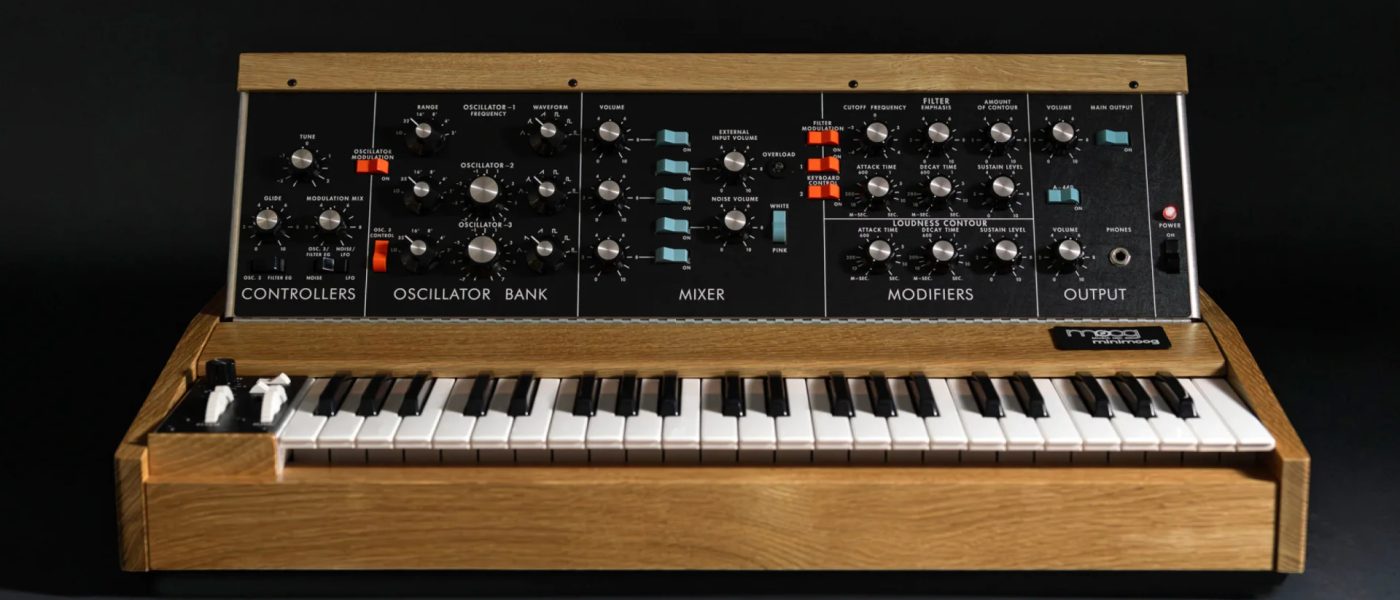
TL;DR: Moog has unveiled the Bob Moog Tribute Edition of the legendary Minimoog Model D synthesizer. This limited-run version features a custom oak enclosure, supports the Bob Moog Foundation, and incorporates all modern enhancements from the 2016 and 2022 reissues. It’s available now for $3,999.
- A limited-edition Minimoog Model D with a custom quartersawn oak wood cabinet and unique back-panel decal.
- Includes all modern updates: dedicated analog LFO, velocity/aftertouch CV outs, MIDI, feedback modification, and a spring-loaded pitch wheel.
- $500 from each unit sold is donated directly to the Bob Moog Foundation.
- Priced at $3,999 / €4,799, hand-built in the USA.
- Comes with an SR Series travel case as part of the package.
Reading time: 4 min
Want more synth news before your next coffee break? Join the Noxal newsletter — no spam, just gear worth knowing about.

The Synth That Won’t Quit

Let’s state the obvious, because in the world of synthesizers, the obvious is often sacred. First, the Minimoog Model D is the most legendary synthesizer ever made. It is the Platonic ideal of an analog synth, the sound that defined “synthesizer” for generations. Second, Bob Moog was the pioneer who made that instrument, and that sound, possible. The third certainty, which is a little more amusing, is that the Minimoog is also the synth that refuses to die a quiet death. It is the synth that has been officially revived, reissued, and re-celebrated more times than we’ve had hot coffees. And you know we’ve had a lot of coffee.
We at Noxal aren’t complaining. In a landscape cluttered with digital facsimiles and budget clones, the continued existence of a genuine, hand-built, Asheville-made Minimoog is a beacon. It’s a statement. Each reissue, from the 2016 revival to the 2022 updates, has been less of a cash grab and more of a gentle, persistent reminder: this is where it started. This is the benchmark. The new Bob Moog Tribute Edition continues this tradition, but wraps it in a layer of reverence and purpose that makes this iteration feel particularly significant.
What’s In The Tribute Box
So, what exactly are you getting for your $3,999? Beyond the immense gravitational pull of history, you’re getting the most refined version of the modern Minimoog reissue to date. The headline aesthetic change is the beautiful quartersawn oak enclosure. It’s a warm, organic contrast to the standard black walnut or later finishes, giving it a distinct, almost “heirloom” visual character. It also comes with a unique back-panel decal and, very practically, includes a fitted SR Series travel case. Because if you’re going to own this, you might as well take it out to be seen.
Under the hood, it’s the full-fat, 100% analog circuitry we demand: three iconic oscillators, that soul-stirring ladder filter, two envelopes. Crucially, it incorporates every functional enhancement Moog has added since bringing the Model D back. That means the dedicated analog LFO, the premium FATAR keybed with velocity and aftertouch outputs (via CV jacks), comprehensive MIDI integration, and the glorious mixer feedback modification that lets you dial in that signature overdriven scream. It also includes the 2022 tweak of a spring-loaded pitch wheel that snaps back to center. This isn’t a museum piece frozen in 1970; it’s the classic instrument thoughtfully updated for the modern studio and stage.
The Foundation Factor
This is where the “Tribute” part moves beyond a nameplate. Moog is donating $500 from the sale of each unit directly to the Bob Moog Foundation. This isn’t corporate philanthropy as a vague marketing line; it’s a direct, tangible link between purchasing this instrument and supporting Bob’s enduring legacy. The Foundation does critical work: it runs the Moogseum in Asheville, operates Dr. Bob’s Sound School to inspire future generations, and preserves the vast Bob Moog Foundation Archives.
We at Noxal find this immensely compelling. In an industry often focused on the next new thing, this creates a meaningful feedback loop. You buy an instrument born from Bob Moog’s genius, and a portion of that investment actively works to preserve and propagate that very genius for others. It transforms the purchase from a simple transaction into a form of patronage. It adds a layer of purpose that makes the premium price tag easier to swallow, knowing it’s supporting education and preservation, not just corporate overhead.
Who Is This For, Anyway?
Let’s be brutally honest: at nearly four thousand dollars, this is not an impulse buy for the casual hobbyist. The Behringer Poly D exists. A thousand brilliant software emulations exist. This Tribute Edition Minimoog is for a specific type of person. It’s for the collector who views synthesizers as cultural artifacts. It’s for the professional studio that needs the undisputed authority of *the* bass and lead sound on tap. It’s for the artist with the means who wants their primary instrument to also be a piece of functional art and a statement of support.
It’s also, perhaps, for the Moog purist who has been waiting for a reissue with a distinct character and a cause. This isn’t just another Model D; it’s a specific, limited-edition Model D with a story. In a market saturated with options, that narrative—combined with the foundational support—creates a unique value proposition. You’re not just buying a Minimoog; you’re buying *this* Minimoog, the one that helps keep Bob’s flame alive. For the right person, that distinction is worth every penny.
Frequently Asked Questions
Is the sound any different from the standard reissue Model D?
No, the analog signal path is identical to the current production Minimoog Model D reissue. The sound is the legendary, unchanged Minimoog voice. The differences are aesthetic (the oak case, decal), philanthropic (the donation), and inclusive (it comes with the travel case).
What modern features does it have over a vintage Model D?
It includes MIDI In/Out/Thru, a dedicated analog LFO with triangle/square waves, velocity and aftertouch sensing on the keybed with corresponding CV output jacks, a mixer feedback circuit for overdrive, and a spring-loaded pitch wheel. These were all additions made in the 2016 and 2022 revivals.
How limited is this “limited edition”?
Moog has not specified an exact number of units, which is typical for their “limited” runs. The limitation is tied to the production of the custom quartersawn oak enclosures. Once that wood is gone, the edition is closed. It won’t be a permanently in-production model like the standard version.
I’ll be celebrating this release the only way I know how: by firing up my own synth and spilling a little coffee on the manual, as a humble tribute to the chaos of creativity Bob helped unleash.