
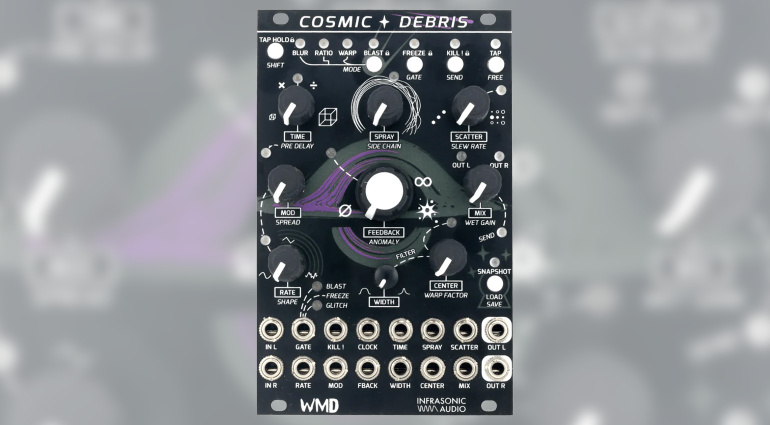
TL;DR: WMD has partnered with Infrasonic Audio to launch the Cosmic Debris, a Eurorack delay and reverb module built for interstellar sound design. It uses 16 interacting delay lines to create dense, reverb-like textures, with extensive CV control and unique performance features like a “Blast” button. Pre-orders are open now for $549.
- Built around 16 delay lines that can interact to create dense, reverb-like textures.
- Extensive CV control over most parameters, plus an integrated, shapeable LFO.
- Unique performance features include a “Blast” button for explosive bursts and a Send mode for insert-style processing.
- Includes a CV-controllable bandpass filter with adjustable bandwidth for sound shaping.
- Offers clock sync, tap tempo, and is available for pre-order at $549.
Reading time: 4 min
Want more synth news before your next coffee break? Join the Noxal newsletter — no spam, just gear worth knowing about.
What is Cosmic Debris?

In a move that feels both poignant and perfectly on-brand, WMD—a company we’ve watched with admiration as they navigated their planned closure—has teamed up with Nick Donaldson of Infrasonic Audio to launch the Cosmic Debris. This isn’t a farewell whimper; it’s a supernova. Announced in late summer 2025, the Cosmic Debris is a dedicated delay and reverb module for Eurorack that promises to “send your audio to another galaxy.” Given the pedigree of both parties involved, that’s less marketing hyperbole and more a credible technical specification.
At its heart, the module is a sound designer’s dream, built for creating spacious, evolving textures rather than just slapping a simple echo on your sequence. It arrives in a landscape crowded with digital delays, but it distinguishes itself immediately with a specific architectural ambition: to use delay as the primary engine for reverb-like washes and impossibly wide soundscapes. For anyone who has ever cranked the feedback on a BBD and wished for more control, more chaos, and more stars, this module seems to be speaking directly to you.
Pre-orders are live on the WMD site for $549. While a firm shipping date hasn’t been pinned down, the implication is that it’s imminent. Given WMD’s stated timeline, getting your hands on one of these might be one of the last chances to own a piece of new hardware from this beloved manufacturer, making this release feel particularly significant.
The Engine of Interstellar Drift
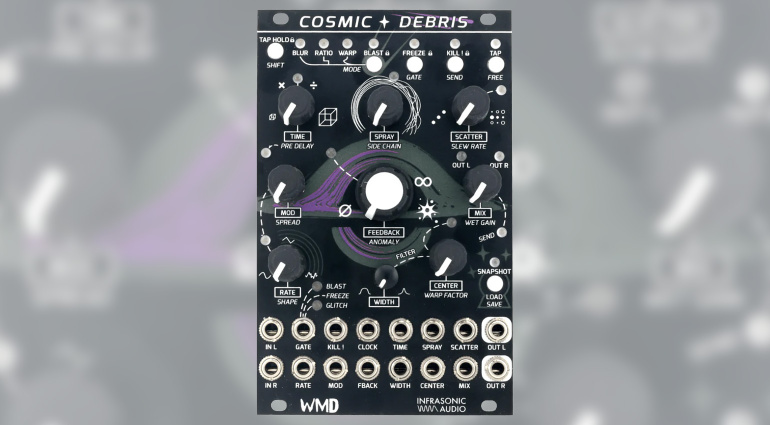
The magic—and the math—behind the Cosmic Debris is its army of 16 individual delay lines. This isn’t just about having a long delay time; it’s about how those lines are allowed to communicate. The module provides tools to manipulate their interactions, transforming straightforward echoes into dense, particulate clouds of sound. The “Spray” parameter, for instance, seems to be key here, explicitly tasked with morphing discrete delay taps into ambient reverbs. It’s a clever bit of nomenclature that perfectly describes the sonic result.
Further shaping comes from the “Scatter” control, which reshapes the feedback paths between the delay lines. Think of it less as a knob and more as a gravitational field adjuster, determining how the sonic particles attract, repel, and swirl around each other. This is where standard delay ends and textural synthesis begins. Complementing this core is a CV-controllable bandpass filter with adjustable bandwidth, giving you a crucial tool to sculpt the tonal character of your cosmic clouds, preventing them from turning into a muddy nebula.
Then there’s the integrated LFO. This isn’t a simple triangle wave slapped on the delay time. It offers continuously variable waveforms, allowing you to smoothly morph between shapes, and it’s dedicated to modulating the Time and Slew parameters. This single feature opens up a vast range of possibilities, from gentle, chorusing swims to violent, rhythmic stutters, all without patching a single external cable. It’s a thoughtful inclusion that makes the module feel complete in a single 20HP space.
CV Control and Creative Performances
WMD has always understood that a module’s soul is often found in its modulation inputs, and the Cosmic Debris appears to be generously endowed. Most parameters are CV-addressable, which means this space station can be fully integrated into your modular ecosystem. Want to tie the density of your reverb to an envelope? Modulate the filter width with a random source? Have the Spray parameter drift slowly with a slewed LFO? This module invites that level of patching, making it a dynamic sound design partner rather than a static effect.
But where it truly sings is in its performance-oriented features. The “Blast” button is a standout: a momentary trigger that sends a boosted signal into the delay input, creating what’s described as “explosive bursts of sound with natural tails.” In a live setting, this is the kind of immediate, dramatic tool that can turn a transition into an event. Equally smart is the “Send” mode, which re-tasks the Mix knob into a send/return control. This allows you to use the Cosmic Debris on an aux bus for parallel processing without needing an external mixer—a brilliantly practical feature for streamlined cases.
Rounding out the utility are the staples you’d hope for: external clock sync to lock your celestial drifts to a grid, and a Tap Tempo button for on-the-fly timing. These features ensure the Cosmic Debris can play nicely in both free-form ambient patches and tightly sequenced techno, proving its versatility. It’s a module designed not just for the studio contemplator, but for the performer who needs both depth and immediacy at their fingertips.
Context and Conclusions
The Cosmic Debris arrives at a fascinating moment. WMD’s announcement that they would cease operations by the end of the year was met with a collective sigh from the community. Yet, rather than fading away, they’ve been releasing a final salvo of compelling modules. This collaboration with Infrasonic Audio feels like a perfect fusion of WMD’s engineering prowess and Infrasonic’s deep expertise in spatial audio and processing. It’s a legacy project that aims to cement a reputation, not just cash in on it.
So, who is this for? The ambient explorer is the obvious candidate, but I’d argue it has a wider appeal. The producer looking for a unique, CV-able texture engine to run drums or vocals through will find a goldmine here. The live performer needing a big, playable effect with instant-impact features will appreciate the Blast button and Send mode. At $549, it sits in the upper mid-range for complex effects modules, but the feature set and unique sonic character appear to justify the ask.
In a market saturated with delays that often differ only in UI, the Cosmic Debris presents a distinct point of view. It’s not trying to emulate a tape echo or a vintage digital unit. It’s using modern DSP to create something that feels inherently modular and new: a gravitational field for sound. As a final act from WMD, it’s a powerful statement—a reminder that their focus was always on pushing the boundaries of what a module can be, right up to the end.
Frequently Asked Questions
Is the Cosmic Debris a reverb or a delay?
It’s fundamentally a multi-tap delay module, but its architecture and controls (like “Spray”) are specifically designed to create dense, reverb-like washes and textures. Think of it as a delay engine optimized for generating spacious soundscapes, blurring the line between the two effects.
What does the “Blast” button actually do?
The Blast button is a performance feature. When pressed, it momentarily sends a boosted signal into the delay input. This creates a sudden, loud burst that then decays through the module’s delay/reverb trails, perfect for adding dramatic, explosive accents to a live performance or recording.
Can I use the Cosmic Debris as a send effect in my rack?
Yes, absolutely. The module includes a dedicated “Send” mode. When activated, the main Mix knob functions as a send level control, allowing you to use the Cosmic Debris for parallel processing on a bus without requiring an external mixer module, making it very efficient for studio-style effects routing within your case.
I’ll be pre-ordering one with a dark roast in hand, fully prepared to lose entire afternoons to its gravitational pull. Some modules are tools; this one feels like a destination.