TL;DR: Endorphin.es has released a major firmware update, version 4.0, for its Ghost Pedal, a multi-effects unit co-designed with Andrew Huang. The update refines nearly every onboard effect, with a special focus on improving distortion for TB-303-style acid lines. For a limited time, the pedal is also available at a 30% discount.
- The firmware 4.0 update refines core effects like distortion, reverb, and filters without adding brand-new features.
- Distortion algorithms are specifically tuned for better performance with TB-303s and clones, offering a “squashed” response for consistent acid lines.
- Reverb algorithms (Hall, Shimmer, Reverse, Spring) have been improved for smoother, denser, and more artifact-free sound.
- A 30% discount is currently available on the Ghost Pedal, making it a more accessible entry point for this powerful multi-effects unit.
- The update also includes stability fixes, like preventing crashes from rapid MIDI program changes.
Reading time: 5 min
Want more synth news before your next coffee break? Join the Noxal newsletter — no spam, just gear worth knowing about.

The Ghost in the Machine Gets an Exorcism
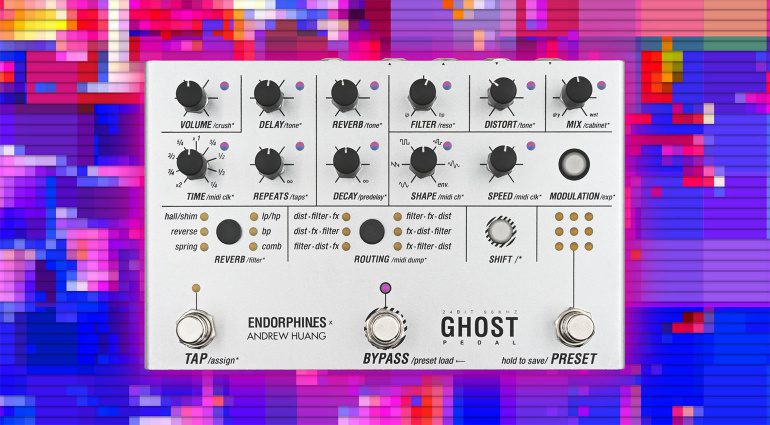
Here at Noxal, we have a soft spot for gear that gets better with age. It’s the hardware equivalent of a fine wine, or more accurately, a well-seasoned cast-iron skillet for cooking up sonic mayhem. Endorphin.es, in collaboration with the prolific Andrew Huang, has just served up a significant firmware update for their Ghost Pedal, moving it to version 4.0. This isn’t a flashy, feature-bloated release; it’s a thoughtful, ground-up refinement. Think of it less as a new model and more as the manufacturer going back over their homework with a red pen, fixing the rough edges and making the good parts even better.
The philosophy here is commendable. Instead of chasing novelty, the update focuses on improving nearly every existing effect algorithm. The distortion has been re-voiced, the reverbs have been smoothed out, and the filters have been tweaked for more musicality. It’s a clear signal that Endorphin.es is listening to its user base and is committed to supporting its products in the long term. In an era where some gear feels abandoned after purchase, this kind of post-launch love is something we can all raise a coffee mug to.
Perhaps the most pragmatic part of this announcement is the concurrent 30% discount. It transforms the Ghost Pedal from a compelling piece of boutique gear into a genuinely tempting proposition. A major firmware update paired with a price drop is a powerful one-two punch, suggesting Endorphin.es is keen to get this refined version of the Ghost into more studios and onto more pedalboards. It’s a smart move that acknowledges both existing users and potential new converts.
Acid-Wash Distortion and Ambient Polish
Let’s get into the sonic nitty-gritty. The headline grabber for the synth-centric crowd is the specific tweak to the distortion algorithm for TB-303 compatibility. Endorphin.es states the update provides a “squashed” response for “dense and consistent acid lines with better note-to-note stability.” In practice, this means your resonant filter sweeps and sequencer runs should hold together more cohesively under gain, reducing the potential for flabby or uneven distortion that can sometimes plague processing pure square waves. They’ve also refined the high-gain behavior to reduce hiss and added an asymmetrical ‘Fairfax’-style drive for a smoother, amp-like breakup. This isn’t just a distortion; it’s now a curated set of saturation tools with intentional character.
The other major area of improvement is the reverb section. The Hall algorithm is now denser and smoother for a true “Big Hall” feel, while the Shimmer effect has been refined with fewer artifacts when adjusting the pre-delay—a common pain point on many digital pedals. The Reverse and Spring algorithms have also received their share of polish. For ambient producers and sound designers, these are critical upgrades. A reverb is often the final spatial coat of paint on a sound, and artifacts or grainy tails can break the immersion. These refinements suggest a deeper optimization of the DSP code, yielding more professional, studio-ready results.
Beyond these highlights, the 4.0 update is packed with smaller, quality-of-life enhancements. Tap delays are more stable, filter resonance is described as “creamier,” and the comb filter has been improved. They’ve also squashed a bug that could crash the pedal when bombarded with rapid MIDI program changes. It’s this combination of major sonic improvements and minor stability fixes that makes this a truly comprehensive update. It’s the kind of work that makes you trust the instrument more, knowing it won’t glitch out in the middle of a jam or a take.
Beyond the Update: What Is the Ghost Pedal?
For the uninitiated, the Ghost Pedal is a desktop (or floor) format reinterpretation of the notoriously dense Ghost Eurorack module. Co-designed with Andrew Huang, its primary mission was to take that packed functionality and lay it out in a more logical, accessible pedal format. It succeeds brilliantly. You get a full chain processor featuring a JFET guitar input with cab sim, a resonant filter, multiple distortion types, a sophisticated multi-mode reverb (with freeze, delay/looper, and spring modes), and an internal LFO for modulation—all in a single unit.
Its routing flexibility is a key strength. You can rearrange the order of the filter, distortion, and reverb blocks via software, and nearly every parameter can be controlled via MIDI or an expression pedal. It can function as a end-of-chain sweetener for synths and drum machines, a creative multi-effect for guitar, or even as a DI box. This Swiss Army knife approach is what makes it so appealing to hybrid producers and performers who need a lot of tonal variety without a sprawling pedalboard.
It’s also worth noting its sibling, the Golden Master Pedal, which was launched alongside it. Based on the Eurorack module of the same name, the Golden Master is a dedicated multiband compressor, EQ, and stereo enhancer. While the Ghost is your creative mangler and space-maker, the Golden Master is your mix bus polish. Together, they form a powerful stereo processing duo for a desktop setup, but the Ghost is undoubtedly the more immediately “fun” and experimental of the two.
Who Should Summon This Ghost?
So, who is the ideal specter for this Ghost? First and foremost, the electronic musician or producer looking for a single, powerful effects hub. If your desk is crowded with synths and drum machines, the Ghost Pedal can serve as a phenomenal master output processor, adding everything from subtle drive and filtering to massive atmospheric reverbs. The update’s specific acid-line enhancements make it a no-brainer for acid house and techno producers who live and die by the 303 squelch.
It’s also a fantastic tool for the adventurous guitarist or bassist looking to move beyond traditional pedal fare. The combination of cab sim, complex modulation, and experimental reverb/delay modes opens up textural possibilities far beyond a typical stompbox. The current discount makes it a particularly compelling alternative to investing in several individual boutique pedals to achieve a similar range.
Finally, this update and sale are a perfect opportunity for existing users of the Ghost module who found the Eurorack version a bit too menu-divey. The pedal format offers the same sonic engine in a far more performative and immediate package. With the firmware now at a polished 4.0 state, the Ghost Pedal feels like it has fully matured into the instrument it was always meant to be. It’s no longer just an interesting collaboration; it’s a legitimately professional and deeply creative multi-effects unit that deserves a second look.
Frequently Asked Questions
Is the firmware 4.0 update free for existing Ghost Pedal owners?
Yes, absolutely. As with most firmware updates from reputable manufacturers, the version 4.0 update is a free download from the Endorphin.es website. You’ll need a USB cable to connect the pedal to your computer and follow their update instructions.
Does the Ghost Pedal require a separate power supply?
Yes. The Ghost Pedal uses a standard 9V DC center-negative power supply (not included), with a common 2.1mm barrel connector. It does not run on batteries. Given its digital processing power, using a reliable, isolated power supply is recommended to avoid noise.
Can I use the Ghost Pedal effectively with both synths and guitar?
Yes, that’s one of its core design strengths. It features a dedicated JFET input with cabinet simulation optimized for guitar, as well as line-level inputs perfect for synths, drum machines, and other studio gear. You can easily switch between these sources, making it a highly versatile centerpiece for a hybrid setup.
Now, if you’ll excuse me, I need to pour a fresh cup and see if my 303 clone finally stops sounding quite so politely distorted. The ghosts in my machine are waiting for their upgrade.