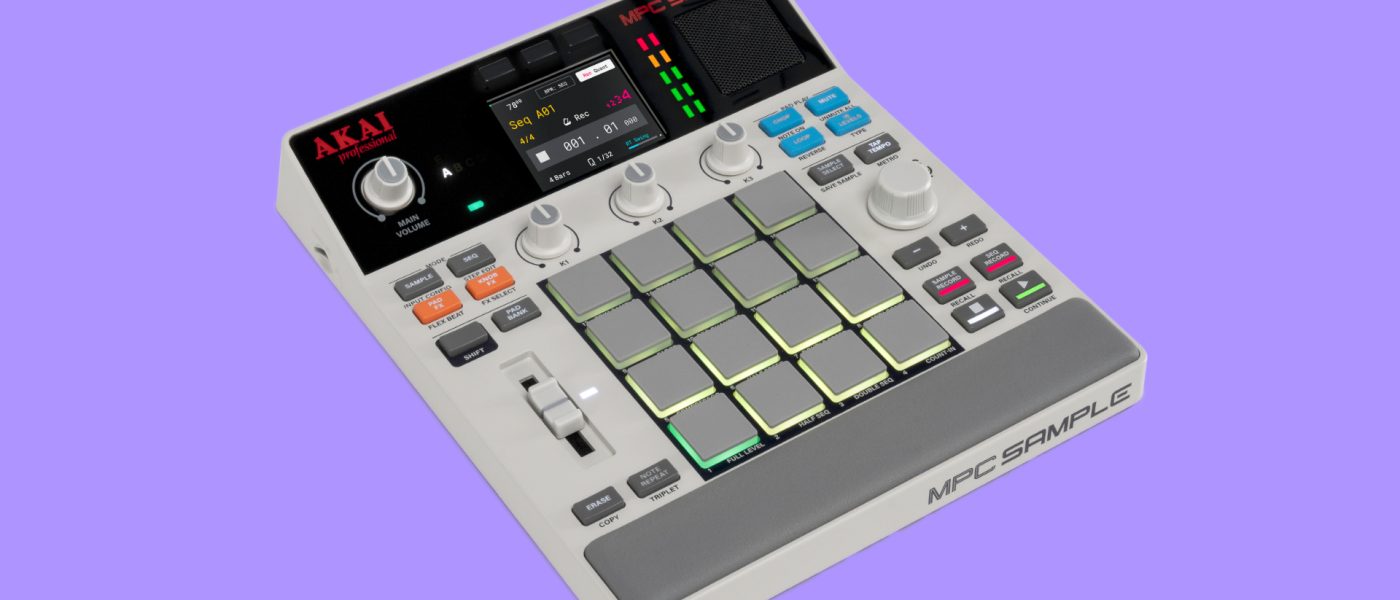
TL;DR: Akai’s new MPC Sample is a portable, battery-powered hardware sampler that channels the spirit of the classic MPC60 into a modern, streamlined box. Following a launch that saw initial stock evaporate, the device has already received a significant firmware update to version 1.3, adding sample normalization and customizable knob behavior.
- The MPC Sample is a dedicated, portable sampler with a 5-hour battery, built-in speaker, and mic, designed for on-the-go sampling and beat-making.
- Firmware 1.3 adds a new sample normalization feature (accessed via Shift in trim mode) and flexible knob/fader takeover modes for personalized workflow.
- It runs a focused sampling engine with 60 effects, 32-voice polyphony with disk streaming, but omits plugins, clip launching, and step sequencing found in bigger MPCs.
- Connectivity includes stereo 1/4″ I/O, USB-C audio, TRS MIDI, sync out, and a microSD slot, but notably lacks a sync input and dedicated power port (USB-C only).
- Projects are compatible with Akai’s MPC3 desktop software, allowing for a hybrid hardware/software workflow.
Reading time: 4 min
Want more synth news before your next coffee break? Join the Noxal newsletter — no spam, just gear worth knowing about.

The Portable MPC Dream

Let’s be honest: the allure of the classic MPC workflow is a siren song for many of us, but the idea of lugging an MPC60 to a park bench is a one-way ticket to physiotherapy. Akai, in a moment of clarity, seems to have heard the collective sigh. The MPC Sample isn’t just another iteration in the sprawling MPC ecosystem; it’s a deliberate, almost surgical extraction of the sampling soul from those legendary boxes. It strips away the DAW-in-a-box ambitions of its bigger siblings to focus on one thing: capturing and mangling audio, anywhere. The fact that its initial batch sold out in a day suggests Akai has either tapped into a genuine hunger or is masterfully practicing the art of artificial scarcity. Given the fervor around portable samplers, my money’s on the former.
The design philosophy is refreshingly retro-futurist. It takes the iconic two-section layout—screen and controls on top, the sacred 16-pad grid below—and shrinks it into a package that fits in a backpack. It’s an unabashed love letter to the MPC60, but one written on modern hardware. This isn’t a nostalgia trap, though. By omitting the kitchen sink (plugins, clip launching, VST hosting), Akai forces a focus that can be creatively liberating. It’s a sampler, not a workstation. In an era of feature creep, that’s a bold and welcome statement.
Specs in a Satchel
Peeling back the shell, the MPC Sample is built around a CPU with 2GB of RAM and 8GB of internal storage, expandable via microSD. That 8GB might sound modest until you realize the engine supports disk streaming, meaning you can trigger samples directly from the card without loading them into internal memory, effectively granting you 32 voices of polyphony from a vast, portable library. The heart of the experience is the 16 velocity-sensitive RGB pads with polyphonic aftertouch—the same excellent ones found on the new MPK Mini IV. Flanking them are three assignable knobs and a dedicated “Q-Link” knob for legacy-style parameter tweaks.
Connectivity is a mix of the generous and the curiously sparse. You get stereo 1/4″ inputs and outputs, a combo input for the built-in microphone, a headphone jack, and USB-C for both audio and data transfer (allowing you to sample directly from your phone or iPad). MIDI In and Out are present via TRS minijacks, and there’s a Sync Out. The notable absences? A Sync In port and, more critically, a dedicated DC power input. This device lives or dies by its internal, rechargeable 5-hour battery or a USB-C power bank. It’s a truly cord-free design, for better or worse. The built-in 3-watt speaker completes the “anywhere” ethos, though we suspect most will plug in headphones.
Firmware 1.3: The Quickening
Nothing says “modern hardware” like a firmware update before you’ve even finished your first coffee with the new gear. The rapid-fire release of versions 1.2.0, 1.2.1, and now 1.3 shows Akai is actively refining the experience. The headliner in 1.3 is the new sample normalization feature. Buried in the trim window (hold Shift, then look to button 2), it lets you boost a sample’s amplitude to 0dB between your chosen start and end points. It’s a simple, pro-level utility that should have been there at launch, but we’re glad it arrived quickly.
More interesting, perhaps, are the new knob takeover modes. You can now customize how the hardware knobs and fader interact with on-screen parameters. The default for knobs is now “scaled” mode, while the fader stays in “pickup.” This might seem esoteric, but for hands-on tweakers, it’s crucial for avoiding jarring parameter jumps. This level of customization, so soon after launch, hints at a device meant to be deeply personalized. Of course, the update also squashes some bugs, though Akai notes known audio glitches in the FlexBeat effect when changing tempo—a reminder that the journey with new hardware is always iterative.
Who Is This For?
The MPC Sample sits in a fascinating and increasingly crowded niche: the serious portable sampler. It’s not a toy like some pocket operators, nor is it a compromised groovebox. It’s for the producer who wants to sketch with sampled textures on a train, the beatmaker who finds inspiration in field recordings at a bus stop, or the MPC veteran who wants a dedicated sketchpad that feeds seamlessly into their larger MPC3 desktop setup. The lack of step sequencing and a more traditional “program the sequence” approach reinforces its classic MPC lineage.
However, it also has to contend with devices like the SP-404 MKII, which offers a different, effects-laden workflow and a lower price point. The MPC Sample’s bet is on the purity and speed of the MPC workflow itself. If the tactile feel of those pads, the swing of that sequencer, and the immediacy of “Chop,” “16 Levels,” and “Mute” are your native language, then this is your passport to a portable studio. For everyone else, it’s a compelling argument to learn that language. Just remember to pack a power bank.
Frequently Asked Questions
Can the MPC Sample run plugins or VSTs?
No. The MPC Sample uses a streamlined, dedicated sampling engine. It includes 60 built-in effects (reverb, granulator, beat repeat, etc.), but it cannot host third-party plugins or VST instruments. This is a deliberate design choice to focus on sampling and performance.
How do I power it if the battery dies and I’m not near a computer?
The MPC Sample can be powered via its USB-C port using any standard USB power adapter or a portable power bank. There is no dedicated DC power jack, so your charging options are limited to USB-C sources. Keep a good power bank in your bag for extended sessions.
Is the sequencing only real-time, or is there step sequencing?
The sequencing is primarily real-time recording into the MPC sequencer (with 960 PPQN resolution and swing). Akai has confirmed there is no step-sequencing mode on the MPC Sample. You program your patterns by playing them in or using the grid in conjunction with record functions.
Now, if you’ll excuse me, I need to see if my coffee mug fits in the MPC Sample’s carry case. Priorities.