
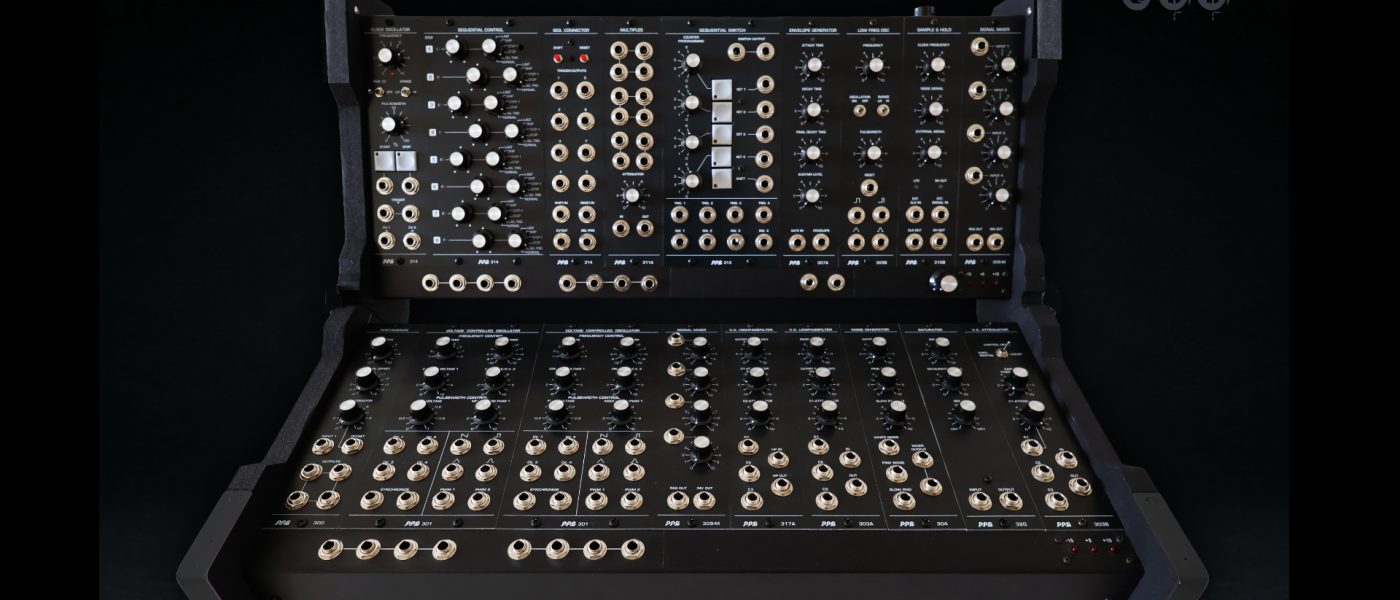
TL;DR: The Liquid Sky Artistcollective, with developer Cornel Hecht, is resurrecting the ultra-rare PPG 300 System, Wolfgang Palm’s 1976 analog modular. This hand-built, officially licensed replica will be a limited, high-end release, with a prototype on display at SynthFest France 2026. Expect a price tag that reflects its boutique, historical nature.
- The PPG 300 System is a 1976 analog modular synth from PPG founder Wolfgang Palm, predating the famous Wave series and built as his personal Moog Modular replacement.
- It is being revived as a hand-built, officially licensed replica by the Liquid Sky Artistcollective and developer Cornel Hecht, following their 2025 reissue of the PPG 1002 Mk2.
- Each component is selected and tested by ear, with VCOs individually matched, emphasizing the character of analog circuitry over sterile precision.
- The system will come pre-configured in a new case with an integrated power supply and will be made-to-order, with shipping expected later this year.
- Pricing is to be announced but is anticipated to be in the “price of a car” range, similar to the €9,999 PPG 1002 Mk2, positioning it as a luxury historical artifact.
Reading time: 4 min
Want more synth news before your next coffee break? Join the Noxal newsletter — no spam, just gear worth knowing about.

The Ghost in the Machine
We at Noxal have a soft spot for the ghosts of synthesizers past, especially when they’re brought back with more than just a fresh coat of paint and a nostalgic marketing campaign. The news that the Liquid Sky Artistcollective is resurrecting the PPG 300 System is one of those stories that makes me put down my coffee (a grave act) and pay attention. Wolfgang Palm’s name is, of course, synonymous with the legendary blue-hybrid PPG Wave, the digital wavetable pioneer that shaped an entire era of electronic music. But before the Wave, there was the 300 System—an analog modular synth from 1976 that Palm built for himself, essentially as a bespoke replacement for his original Moog Modular.
This piece of history is so obscure that it makes a rare Buchla 200 series module look like a common Korg Volca. The original 300 System modules never achieved the commercial or cultural orbit of Moog’s offerings, which is precisely why they’re mythical unicorns on the second-hand market. They represent a fascinating “what if” branch in synth history: what if the mind that later gave us pristine digital wavetables first expressed itself through the warm, unpredictable medium of discrete analog circuitry? This revival, spearheaded by Dr. Walker and developer Cornel Hecht under the official PPG license, isn’t just a reissue; it’s an archaeological dig with a soldering iron.
Hand-Built History
The methodology behind this rebirth is as important as the instrument itself. The Liquid Sky team isn’t aiming for mass production. They are building these systems entirely by hand, one unit at a time, in the spirit of the original. In an age where we often debate the “soul” of analog gear versus the precision of digital emulation, their approach is tellingly purist. They state that each component is selected not just by its technical specification, but by ear. Every Voltage-Controlled Oscillator (VCO) is individually tested and matched, a process that acknowledges and celebrates the subtle variations and quirks that give vintage analog circuits their unique character.
This philosophy stands in stark contrast to the modern pursuit of perfect consistency. It’s a reminder that the original modular era was one of hand-soldered individuality, where no two systems sounded exactly alike. By embracing this, the replica promises to be more than a museum piece; it aims to capture the living, breathing—and sometimes temperamental—essence of a 1970s studio workhorse. Following their 2025 release of the hand-built PPG 1002 Mk2 replica, this project confirms the collective’s commitment to this painstaking, artisanal approach to synth resurrection.
Specs, Context, and Caveats
So, what are you actually getting? The specific module list for the initial configuration hasn’t been fully detailed in the announcement, but we know it will come pre-installed in a newly manufactured case with an integrated power supply. The case will also feature several additional I/O ports, the function of which remains a tantalizing mystery for now. The full reveal is slated for SynthFest France 2026, where a prototype will be on display. You’ll also be able to hear it at the “303 Years of Liquid Sky” event in Cologne on May 30, 2026.
Now, let’s talk about the elephant in the room: the price. The announcement explicitly warns that it will likely be “in the very high range. Probably the price of a car.” As a reference point, their PPG 1002 Mk2 replica is listed at Thomann for a cool €9,999. We should expect the 300 System, with its multiple modules and case, to command a similar or greater premium. This places it firmly in the realm of luxury collectibles and serious investment pieces, alongside other modern revivals like the Moog System 35 or 55. It exists in a market where you can buy an astonishing array of powerful synths at almost any budget, making this a very specific, and very expensive, proposition.
For Whom The Modular Tolls
Who is this for? The announcement itself is refreshingly candid: this replica “will only interest those who absolutely want a PPG modular synth.” This isn’t a general-purpose workstation or a beginner’s first dive into Eurorack. This is for the historian-collector, the sonic archaeologist with deep pockets, and the studio owner for whom the PPG name carries a specific, almost sacred, weight. It’s for the individual who looks at a perfect software emulation or a more affordable modern analog modular and still feels the pull of the authentic, physical artifact.
We at Noxal think there’s immense value in projects like this, even if 99.9% of us will never own one. They preserve a tangible link to our technological and musical heritage. In a world of disposable tech, the act of meticulously rebuilding a piece of history, component by component, is a powerful statement. It says that some instruments are worth preserving not just in code or memory, but in wire, solder, and wood. If you have the means and the motive, why not? For the rest of us, we can appreciate the craft, listen to the demos, and be glad that such ghosts are still allowed to walk among us, however briefly.
Frequently Asked Questions
Is this an exact replica of the original PPG 300 System?
Yes, it is being built as an officially licensed, hand-built replica using the original designs. The developers emphasize component selection “by ear” and individual VCO matching to capture the character of the original 1976 analog modules.
How much will the PPG 300 System replica cost?
An official price has not been announced (TBA). However, the developers have indicated it will be in a “very high range,” comparable to “the price of a car.” As a benchmark, the related PPG 1002 Mk2 replica sells for €9,999.
Where and when can I buy one?
The system will be made-to-order, with shipping expected to begin later this year. A prototype will be on display at SynthFest France 2026, and it will be featured at the “303 Years of Liquid Sky” event in Cologne on May 30, 2026. Orders will likely be handled directly through the Liquid Sky Artistcollective once full details are released.
I’ll be admiring this from a safe, financially responsible distance, likely while nursing a slightly bitter espresso that suddenly feels like a very reasonable purchase.