TL;DR: Randomwaves has launched a Kickstarter for the Drumboy Pro, a significant hardware and software overhaul of their open-source groovebox. It replaces the touch-only interface of the original with tactile buttons, a larger screen, assignable knobs, and a more powerful sample and sequencing engine. Early bird pricing starts at $239, with estimated shipping in August 2026.
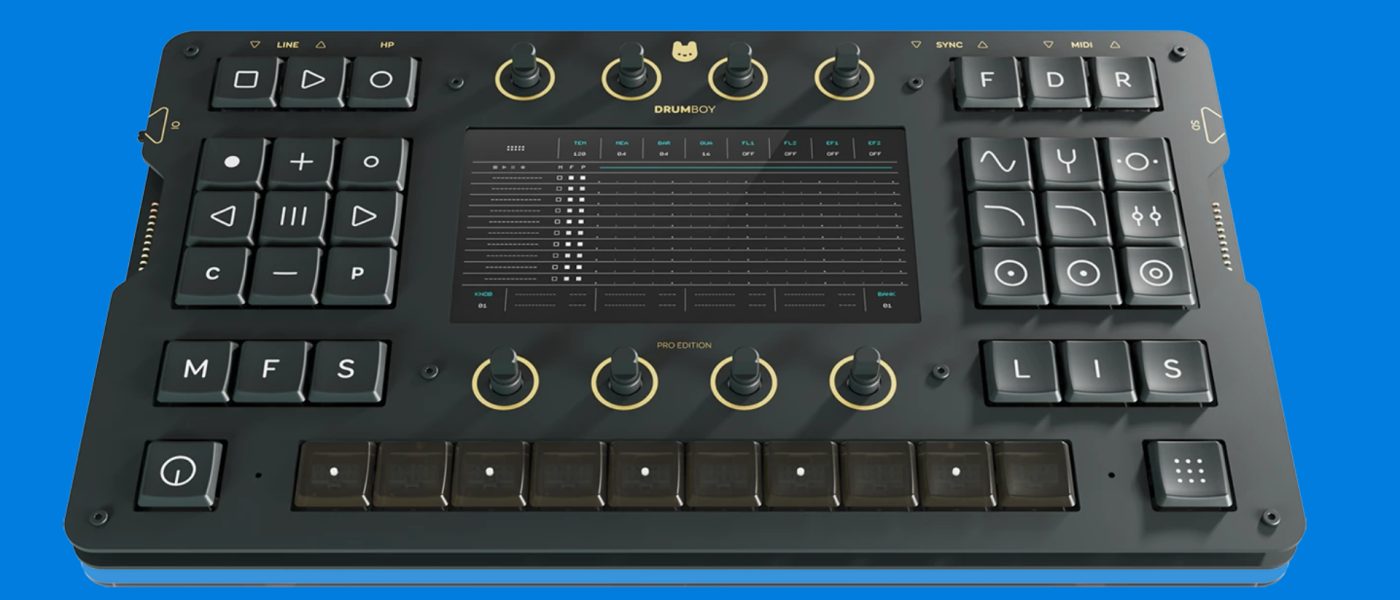
- The Drumboy Pro is a complete hardware redesign, swapping the original’s touch interface for silent tactile buttons, eight assignable knobs, and a larger 5.3-inch display.
- Its open-source, sample-based engine now offers deep, real-time control over 10 layers, including sample start/end, bit rate, probability, and flexible routing through dual filters and effects.
- A new sequencer with a dynamic fill generator and 10 multi-wave LFOs aims to provide extensive, menu-dive-free programming for mobile production, powered by a battery offering up to five hours.
- The Kickstarter campaign offers an early bird price of $239 (down from a $399 MSRP) starting March 15, 2026, with a fully refundable $1 deposit option to secure a private purchase link.
- This release directly addresses the primary criticism of the original Drumboy Mini, positioning the Pro as a more serious, hands-on instrument for creators and open-source tinkerers.
Reading time: 5 min
Want more synth news before your next coffee break? Join the Noxal newsletter — no spam, just gear worth knowing about.

From Touch to Tactile: The Hardware Reboot
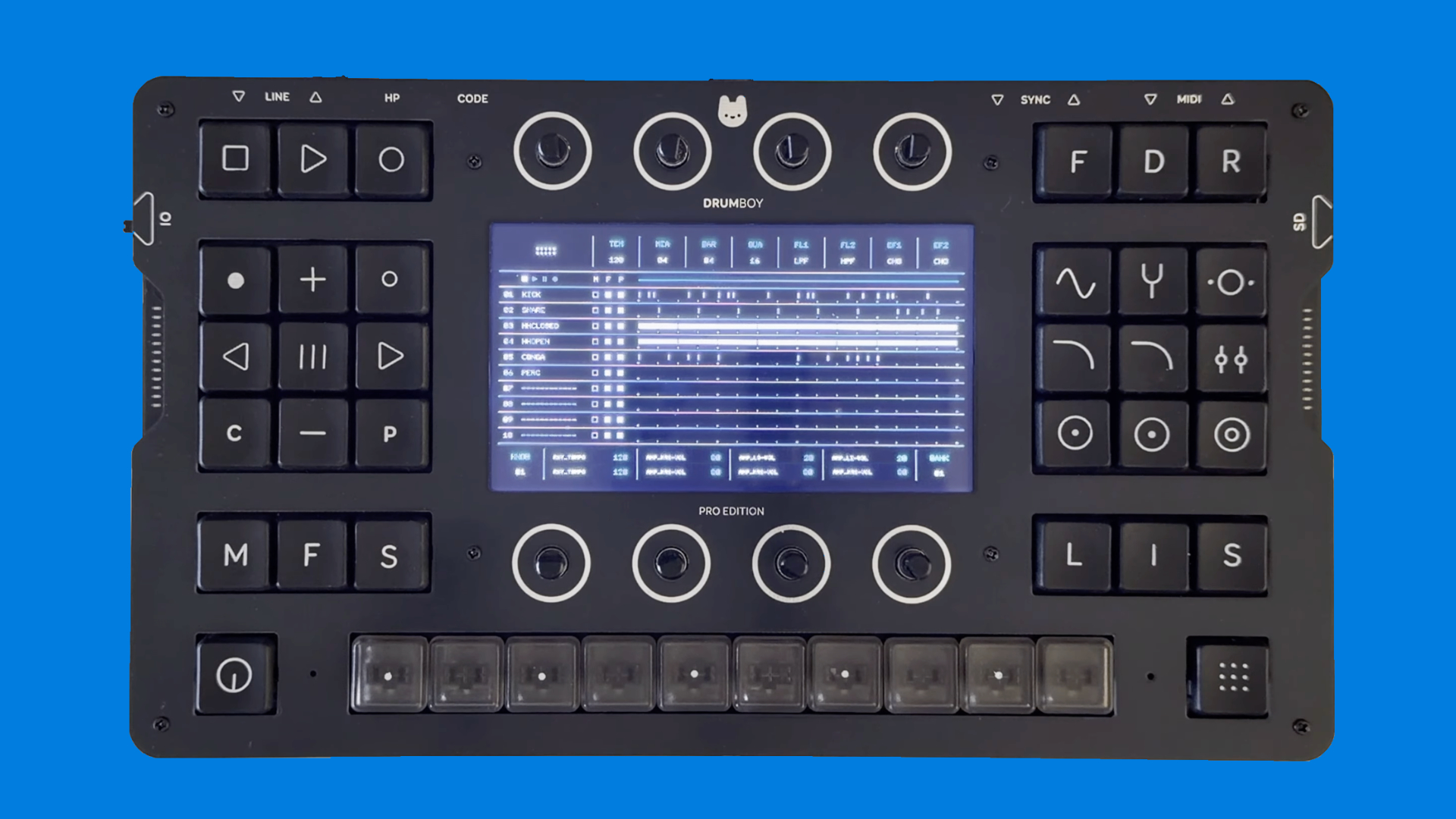
Let’s be blunt: the original Drumboy Mini’s touch-only interface was, in our not-so-humble opinion, a fascinating concept that likely felt about as intuitive as programming a drum pattern on a supermarket self-checkout screen. Randomwaves seems to have heard the collective sigh from the hardware community, because the Drumboy Pro isn’t just an iteration—it’s a full-scale intervention. The most critical change is the wholesale abandonment of that touch interface. In its place, we now have a grid of silent tactile buttons. This single decision transforms the device from a curious tech demo into a potentially serious instrument. Buttons provide physical feedback; you know when you’ve hit them. It’s a fundamental principle of instrument design that should never have been optional.
The upgrades continue with a larger, 5.3-inch display, promising better responsiveness for navigating what is undoubtedly a deep software engine. Flanking this screen are eight rotary knobs, a veritable bounty of hands-on control compared to the Mini’s austerity. These aren’t just for show; they’re assignable to up to 10 banks of eight parameters each, putting direct control over 80 different settings at your fingertips. This is the kind of hardware philosophy we can get behind—surface-level simplicity backed by extensive, immediate control for those who want to dive deeper without getting lost in menus.
Rounding out the physical package is the inclusion of a charge pad, promising up to five hours of untethered operation. This cements the Drumboy Pro’s identity as a truly portable groove workstation. You’re not just buying a desktop brain; you’re buying a sketchpad for rhythms, something to take to the park, the train, or just a different corner of your studio. The hardware story here is one of listening and learning, and on paper, it’s a compelling redemption arc.
Engine Unlocked: Sample Sculpting & Routing
Beneath the new knobs and buttons lies a software engine that has received an equally substantial power-up. At its core, the Drumboy Pro remains a 10-layer, sample-based groovebox. However, where many such devices offer a layer of gloss over pre-baked samples, Randomwaves has “unlocked total control over the engine.” This is marketing speak that, for once, seems to hold water. You get real-time access to fundamental sample manipulation: level, pitch, playback direction, and critically, sample start and end points. Add to that bit-rate reduction and per-step probability, and you have a toolkit for transforming a single hit into a evolving, glitchy texture.
The signal routing, which was presumably more rigid in the Mini, is now “fully flexible.” This means you can freely route any of the 10 layers through one of two independent filter channels. Each filter offers four modes: low-pass, high-pass, band-pass, and band-stop. Following this, the signal hits a dual-channel FX engine, with each channel offering a choice of eight algorithms: delay, chorus, flanger, phaser, compressor, expander, overdrive/distortion, and bitcrusher. A dedicated, fully tweakable reverb engine sits alongside for adding space. This modular, patchable approach within a fixed architecture is incredibly powerful, inviting sound design that goes far beyond simple kit playback.
Modulation is handled by 10 assignable multi-wave LFOs. With one LFO per layer as a starting point, the potential for motion and life within a pattern is significant. You’re not just sequencing static hits; you’re orchestrating moving soundscapes where filter cutoffs sweep, pitches wobble, and effects parameters pulse in time. This depth transforms the Drumboy Pro from a mere drum machine into a compact, self-contained sound design workstation.
Sequencing and the Open Road
A powerful sound engine is nothing without an equally capable sequencer to drive it. The Drumboy Pro’s sequencer has been overhauled to be “more powerful and easier to use.” The promise, boldly stated, is that all this programming can be done without menu-diving—a claim we’ll be eager to test. Core functions like adding, deleting, and shifting notes are now more straightforward. The inclusion of per-step probability and time shifts (micro-timing) is essential for creating grooves that feel human, or intriguingly robotic.
The headline sequencer feature is the new dynamic fill generator. It promises “instant, inspiring pattern fills,” which, if implemented well, could be a fantastic creative spark. A keen-eyed reader on the original announcement pointed out that demos seemed to show strictly binary subdivisions (8ths, 16ths, 32nds) and wondered about triplet support or even accelerating/decelerating ratchets. This is where the Drumboy Pro’s secret weapon comes into play: it is fully open-source. The feature set you see at launch is merely the foundation. If the community embraces it, we could see third-party firmware adding these very features, or Randomwaves themselves could implement them in future updates. The sequencer isn’t a closed book; it’s an open invitation to hack and expand.
This open-source nature is the thread that ties the entire project together. It’s a gamble that builds a different kind of relationship with the user. You’re not just a customer; you’re a potential collaborator, or at least a beneficiary of a collaborative ecosystem. It means the Drumboy Pro you buy in August 2026 could be a significantly more powerful instrument by 2027, shaped by the needs of the people actually using it.
Crowdfunding, Context, and Who It’s For
The Drumboy Pro is launching on Kickstarter on March 15, 2026. The early bird price is aggressively set at $239, a significant discount from the projected $399 MSRP. Randomwaves is also offering a now-common but sensible option: a fully refundable $1 deposit to secure a private purchase link at launch. As we must always state: crowdfunding is not a pre-order. It carries inherent risks regarding timelines, final product quality, and delivery. That said, Randomwaves has a track record, having successfully delivered the Drumboy Mini and Synthgirl via Kickstarter before. This isn’t their first rodeo.
So, who is this for? Firstly, it’s for anyone who was intrigued by the Drumboy Mini’s concept but repelled by its interface. This is the version you waited for. It’s for the tinkerer and the open-source enthusiast who loves the idea of a device that can grow and evolve. It’s for the producer who needs a portable, battery-powered idea factory for rhythms and textured patterns, separate from their sprawling desktop setup. It sits in a interesting space—more hands-on and sound-design focused than a Roland T-8, more compact and open-ended than an Elektron Model:Samples.
In a market where “groovebox” can mean anything from a toy to a temperamental studio centerpiece, the Drumboy Pro makes a compelling case for itself. It addresses its predecessor’s fatal flaw head-on, packs a serious sonic toolkit into a portable frame, and bets its future on the power of community. We’re not in the business of endorsing crowdfunding campaigns, but we are in the business of getting excited about interesting hardware. The Drumboy Pro, on paper, has earned a raised eyebrow and a freshly poured cup of coffee as we watch its campaign unfold.
Frequently Asked Questions
Is the Drumboy Pro’s open-source nature a security risk?
In the context of a dedicated music hardware device, the “risk” is minimal. You’re not running a web server on it. The open-source aspect primarily means the firmware’s source code is available for viewing, modification, and community contribution. This allows for custom features and fixes but doesn’t inherently make the device less stable than closed-source gear. Think of it as community-augmented development.
Can I load my own samples onto the Drumboy Pro?
While the original announcement text focuses on the sample engine’s manipulation capabilities, it doesn’t explicitly detail sample import/export procedures or storage limits. Given its open-source nature and lineage, user sample loading is a highly probable feature, but this is a key specification to confirm directly on the Kickstarter page before backing.
How does the “dynamic fill generator” actually work?
The provided details are sparse, describing it as a tool for “instant, inspiring pattern fills.” Typically, such generators analyze a existing pattern or kit and automatically create variations based on rhythm density, velocity, or effect triggers. The hope, as mentioned by an observer, is that it can move beyond simple 32nd-note bursts to include triplets and more musically intelligent variations—a perfect candidate for future open-source development.
Now, if you’ll excuse me, I need to finish this coffee and ponder whether my studio truly needs another groovebox, or if I just have a problem saying no to knobs.