
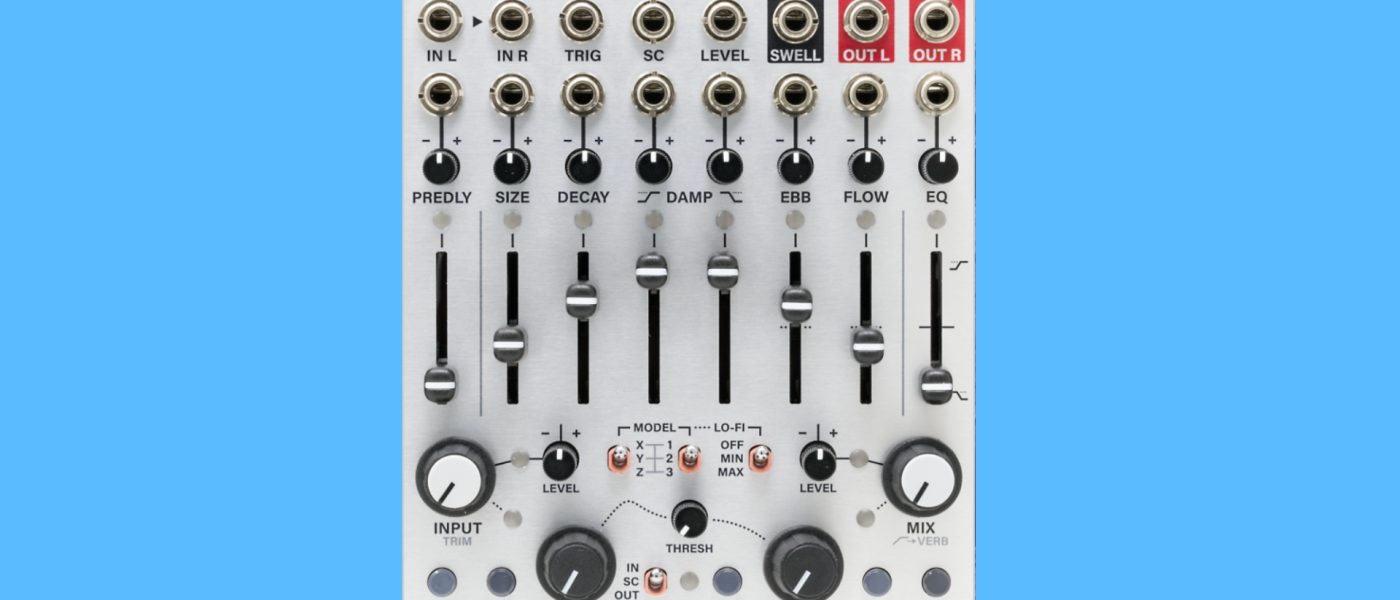
TL;DR: Intellijel has officially released Swells, a powerful stereo reverb module for Eurorack that was teased at last year’s Superbooth. It features nine distinct reverb models, extensive fader-based control, and deep sound-mangling options like Lo-Fi modes, freeze, reverse, and a built-in swell generator. Available now for $499/€499.
- Nine distinct reverb models, from realistic spaces to otherworldly textures.
- Performance-centric fader control over core parameters like decay, size, and damping.
- Built-in sound-mangling features: Lo-Fi degradation, Freeze, Reverse, and Burst effects.
- Integrated Swell generator (envelope follower) normalled to all parameters for automatic modulation.
- Comprehensive CV control, trigger sync, and send/return functionality for studio integration.
Reading time: 4 min
Want more synth news before your next coffee break? Join the Noxal newsletter — no spam, just gear worth knowing about.

What Is Intellijel Swells?

At Noxal, we watch the Eurorack landscape with a caffeinated intensity, and the arrival of a new flagship reverb from a company like Intellijel is an event. Swells is that event. Officially launched after a teaser at Superbooth 2024, it is a dedicated stereo reverb module that positions itself not as a mere utility, but as a central, creative sound-design instrument. Following the design language of their excellent Sealegs delay, Swells is built around a bank of faders, promising both precise control and performative flair.
Under the hood, it’s a serious piece of DSP. Audio runs in at 96kHz/24-bit, with internal processing at 32-bit float, ensuring a pristine signal path for those crystal-clear, infinite-tail reverbs we all crave for pads and atmospheres. But this isn’t just a clean machine; it’s one built for character and transformation. The core offering is nine distinct reverb algorithms. Intellijel promises a range from convincing room and hall simulations to lush studio plates and, most enticingly, “otherworldly and far-out textures.” This suggests Swells is designed to cover the entire spectrum from mix-polishing tool to experimental texture generator.
The Fader Philosophy and Sound Sculpting
The most immediate and compelling feature of Swells is its control surface. A grid of faders gives you direct, uncompromising access to the fundamental parameters of whichever reverb model you’ve selected. We’re talking pre-delay, size, decay, damping, and two intriguingly named controls: EBB and Flow. These last two appear to be Intellijel’s secret sauce for fine-tuning the movement and character of the reverb tail, moving beyond static parameters into the realm of animated, living sound.
This fader-based approach is a statement of intent. It invites performance. You can’t subtly nudge a fader; you slide it. This transforms sound shaping from a tweaking exercise into a gestural act. Want to suddenly expand a room from a closet to a cathedral? Slam the Size fader. Need to dampen a bright tail into a murky cloud? Pull down the Damping. It’s immediate, visual, and tactile—a philosophy that aligns perfectly with the hands-on nature of modular synthesis. It also creates a wonderful kinship with siblings like Sealegs and Multi-Grain, suggesting a cohesive FX suite where sound transformation is always at your fingertips.
Mangle Modes and Modulation
Where Swells truly earns its place in a creative rack is in its dedicated “mangling” section. A simple Lo-Fi switch offers two flavors of degradation, deliberately dirtying up the pristine 96kHz signal path for warm, fuzzy, and broken textures—perfect for lo-fi beats or gritty ambient. Then come the play buttons: Freeze, Reverse, and Burst. Freeze captures a slice of audio for infinite sustain (drone makers, take note). Reverse flips the reverb buffer for classic, ethereal backward effects, with sync options for rhythmic use. Burst is a wildcard, generating sudden noise or feedback eruptions.
Perhaps the most intelligent feature is the built-in Swell generator. This is a multi-mode envelope follower (with Rise, Fall, and Threshold controls) that can track the input, output, or a dedicated sidechain signal. By default, its output is normalled to modulate all the reverb parameters. This is genius. It means the reverb can dynamically respond to your playing—swelling with a chord, ducking under a bassline—without patching a single cable. Of course, for those who love to patch, every major parameter has a dedicated CV input with an attenuverter, and a trigger input allows for rhythmic syncing of the mangle functions.
Context and Conclusion
In a market crowded with digital reverb modules, Swells carves out a distinct niche. It’s not trying to be the smallest or the cheapest. At $499/€499 and 26 HP, it’s an investment. It’s competing in the space occupied by modules like the Make Noise Mimeophon or the Noise Engineering Desmodus Versio, but its fader-centric, all-in-one design philosophy sets it apart. It’s for the performer who wants immediate, dramatic control, and the sound designer who wants one module that can do “clean,” “dirty,” “weird,” and “beautiful” without needing a secondary mangler.
Intellijel seems to be building a formidable FX ecosystem. As noted in the source, pairing Swells with Multi-Granular processing and Sealegs delays would create a powerhouse stereo FX processor row. With its send/return mode, it also gracefully steps into a traditional studio role. Swells feels like a mature, fully-realized instrument. It respects the need for high-fidelity audio while enthusiastically providing the tools to utterly destroy it—a balance we at Noxal can always appreciate.
Frequently Asked Questions
Is the Intellijel Swells a stereo-in, stereo-out module?
Yes, Swells is a fully stereo module. It processes and outputs in stereo, making it ideal for the final stage of a stereo signal path or for use as a send effect on a mixer.
What does the “Swell generator” actually do?
The Swell generator is an envelope follower that creates a modulation signal based on the amplitude of an audio source (input, output, or sidechain). By default, this signal automatically modulates the reverb’s parameters, creating dynamic, playing-responsive effects like auto-swells or ducking without any extra patching.
Can I use Swells as a send effect from my mixer?
Absolutely. Swells features dedicated send and return modes, allowing you to integrate it into a traditional effects send/return loop on a mixer or within your modular system, making it a versatile tool for both performance and studio processing.
Now, if you’ll excuse me, I need to re-patch my entire case to make 26 HP of space, a task that will require at least two more coffees and a minor existential crisis.