TL;DR: The wavetable world is buzzing with the reveal of a brand new, fully compatible PPG Wave 2.3 clone. In other news, a browser-based editor for the classic Nord Modular has emerged, and Landscape has introduced a passive, voltage-powered rhythm machine called Moon.
- A new, rackmount PPG Wave 2.3 clone has been unveiled, with circuit boards that are 100% interchangeable with original 1980s units.
- A new web-based editor now exists for the classic Clavia Nord Modular, allowing patch editing and management directly in a browser.
- Landscape’s new ‘Moon’ is a passive, 4-channel analog rhythm instrument powered solely by incoming gate and CV signals.
- The new PPG Wave 2.3 is a passion project, not yet available for sale, but a newsletter sign-up is live for the deeply curious (and likely deep-pocketed).
- These releases highlight a current trend: resurrecting iconic digital architectures and exploring minimalist, voltage-driven analog sound design.
Reading time: 6 min
Want more synth news before your next coffee break? Join the Noxal newsletter — no spam, just gear worth knowing about.

The PPG Phoenix Rises Again
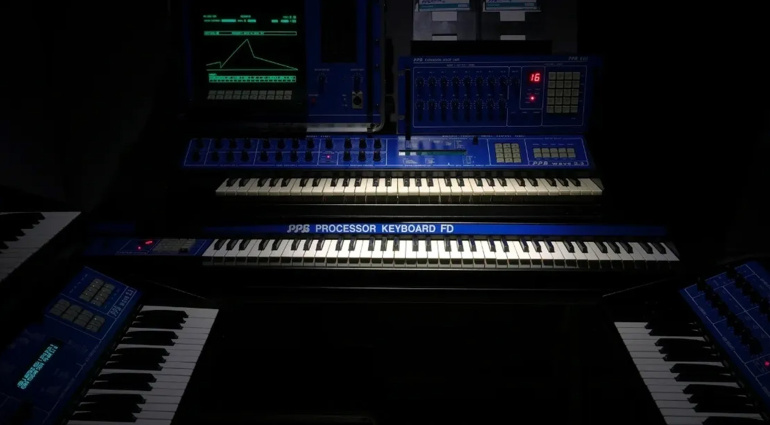
If you had told me last week that Wolfgang Palm would be unboxing a brand new PPG Wave 2.3 in 2024, I would have politely suggested you check the calibration on your oscillators. Yet, here we are. In a move that feels less like a product launch and more like a historical artifact being beamed forward in time, the inventor himself recently revealed a stunning 4U rackmount version of the legendary wavetable synthesizer. This isn’t a reimagining or a spiritual successor with modern conveniences; according to Palm, this new unit is a “1:1 clone,” with boards that are “100% interchangeable with the vintage units.” Let that sink in. The prospect of obtaining a factory-fresh PPG, with its iconic—and notoriously finicky—digital oscillators and analog filters, is enough to make any synth historian weak at the knees.
The significance of this cannot be overstated. For decades, the PPG Wave 2.3 has existed in a realm of myth, coveted for its glassy, evolving pads and searing leads that defined a generation of progressive and electronic music. Owning one meant dealing with 40-year-old electronics, scarce parts, and the constant anxiety of a costly failure. This clone, crafted by Daniel Saxlid, changes the calculus entirely. It promises not just to satisfy collector lust but to actively preserve the lineage. Existing units can now be repaired with new-old stock, and a new generation of sound designers can interface with this architecture without the fear of breaking a museum piece. The faithful recreation, down to the 5-pin DIN cassette interface, is a statement of pure, uncompromising reverence.
Of course, the elephant in the room is cost. Palm’s revelation is both uplifting and, as the source text rightly notes, disheartening. A project of this niche fidelity, involving the remanufacture of proprietary chips and complex digital-analog hybrids, will not be cheap. This isn’t a mass-market Volca. It’s a bespoke piece of audio archaeology. The website is live with a newsletter sign-up, which I’ve already done, less out of a genuine belief I’ll afford one and more out of a sense of duty to witness what happens next. The embedded audio demos are a tantalizing glimpse into a sound that has never truly been replicated, only approximated.
Nord Modular Gets a Web-Based Lifeline
Shifting from monumental hardware to ingenious software, another blast from the past has received a crucial update. The Clavia Nord Modular, that groundbreaking virtual modular environment from the late ’90s, has long been hamstrung by its abandoned editor software. Trying to run the original editor on a modern OS is an exercise in frustration, a digital ghost that refuses to be fully exorcised. Enter Peter van der Noord (a name so perfect it has to be real) with a browser-based Nord Modular Editor. This is the kind of news that makes me want to immediately dig my old G1 out of storage, blow the dust off, and see if it still boots.
The original Nord Modular was revolutionary because it offered the boundless patching possibilities of a modular system within a relatively affordable and portable hardware shell. The catch was that you designed your patches in software on a computer. When that software became obsolete, a core part of the instrument’s functionality was locked away. This new web editor, though in early development, aims to pick that lock. The ability to edit patches, manage the 99 memory slots, and route virtual cables again—all within a browser tab—is nothing short of a resurrection. It acknowledges that the hardware, the DSP brain of the operation, is still perfectly capable; it was just waiting for a new interface to talk to.
For those of us who lived through that era, this is more than a utility; it’s a time machine. The Nord Modular G1 and G2 represented a specific moment where computer-based editing felt like the future, not a compromise. This browser editor doesn’t just restore functionality; it validates the entire concept. I haven’t had a chance to test it myself—my Nord Modular is currently serving as a very expensive bookend—but the very existence of this project is a testament to the enduring love for Clavia’s deep dive into digital modular. It’s a community-driven fix for a corporate orphan, and that’s always a beautiful thing to see.
Moon: A Passive Rhythmic Satellite
In stark contrast to the digital precision of the PPG and Nord, Landscape’s new Moon brings us back to the raw, unpredictable world of pure analog circuitry. Following their collaboration with Eli Pechman on the Noon, Moon is described as a “passive analog 4 channel rhythmic instrument.” The key word here is passive. This device has no power supply of its own. It draws all the energy it needs to create sound directly from the gate and CV signals you feed into it. This isn’t just a power-saving gimmick; it fundamentally shapes the character of the device. The incoming voltages don’t just trigger sounds—they literally power the oscillating circuits that generate them.
The result, as you can hear in the demos, is a wonderfully unstable and organic palette of percussive and textural sounds. Because the internal circuits are being directly excited by your sequencer’s output, their behavior is inherently variable and sensitive. Slight fluctuations in gate length or voltage can produce dramatically different results. The four channels can be blended and combined, encouraging a exploratory, almost sculptural approach to rhythm. You’re not programming a drum machine; you’re guiding a chaotic electronic system with voltage and seeing what emerges. It’s the antithesis of sample-perfect techno, and that’s precisely its appeal.
Priced at $420, Moon sits in that intriguing space between a boutique Eurorack module and a standalone experimental instrument. It demands an external sequencer or voltage source, positioning itself as a satellite to your main setup. For artists working with modular systems, tape loops, or circuit bending, Moon offers a direct path to gritty, voltage-starved percussion. It’s a reminder that some of the most interesting sonic territories lie in constraints—in this case, the constraint of having no internal power, forcing the instrument to live and breathe entirely at the mercy of the signals you provide.
Context and Conclusions
So, what do these three disparate pieces of news tell us about the state of hardware synthesis in 2024? We see a fascinating trichotomy: the faithful resurrection of a digital icon (PPG), the software emancipation of a digital pioneer (Nord Modular), and the exploration of minimalist, analog passivity (Moon). This isn’t a market converging on a single idea; it’s expanding in multiple, passionate directions simultaneously. There’s a clear reverence for history, but not mere nostalgia. The PPG clone and Nord editor seek to activate history, to put legendary tools back into working hands. Moon, conversely, looks forward by looking back to fundamental electronic principles.
This ecosystem thrives precisely because it caters to different mindsets. The PPG Wave 2.3 clone is for the archivist, the perfectionist, the producer who needs that specific, unreplicable spectral sheen. The Nord Modular editor is for the tinkerer, the programmer, the artist who finds joy in system building and complex signal flow. The Moon is for the experimentalist, the noise artist, the musician who finds beauty in instability and the direct manipulation of electricity. What unites them is a shared belief in hardware as a tangible, inspiring partner in the creative process.
For us at Noxal, this week is a potent reminder of why we love this world. It’s not about chasing the “best” or the “most powerful.” It’s about the stories, the engineering, and the unique pathways to sound that each box represents. Whether it’s the precise digital wavetable scan of a PPG, the virtual patch cable of a Nord, or the voltage-hungry oscillation of a Moon, each offers a distinct conversation with the musician. And frankly, we can’t wait to hear what people say with them. Now, if you’ll excuse me, I need to check my email again to see if there’s a price list from that PPG newsletter. A synth enthusiast can dream, preferably with a strong espresso in hand.
Frequently Asked Questions
Is the new PPG Wave 2.3 available to buy right now?
No, it is not currently available for sale. The unit revealed by Wolfgang Palm is a prototype. The builder, Daniel Saxlid, has indicated that units for sale are “a little way off.” Interested parties can sign up for a newsletter on the project’s website to receive future updates on availability and pricing.
Does the browser-based Nord Modular Editor work with both the G1 and G2?
The article and the developer’s focus appear to be on the original Nord Modular (G1) series, which was most severely impacted by the obsolete editor software. It’s always best to check the specific project page for compatibility details, as the G2 system had a different architecture and its own, more modern editor (which also has compatibility issues). The new web editor’s primary goal is resurrecting the original G1 platform.
What do I need to use the Landscape Moon?
Moon is a passive instrument, meaning it requires an external source of control voltages (CV) and gate signals to operate. You will need a sequencer, a modular synth system, or another voltage-generating device to send signals into Moon’s four input channels. It does not make sound on its own and has no internal power supply or battery.
I’m off to gently whisper “wavetable” to my coffee maker in the hope it produces something half as inspiring as a PPG. No luck yet, but the ritual is part of the process.