
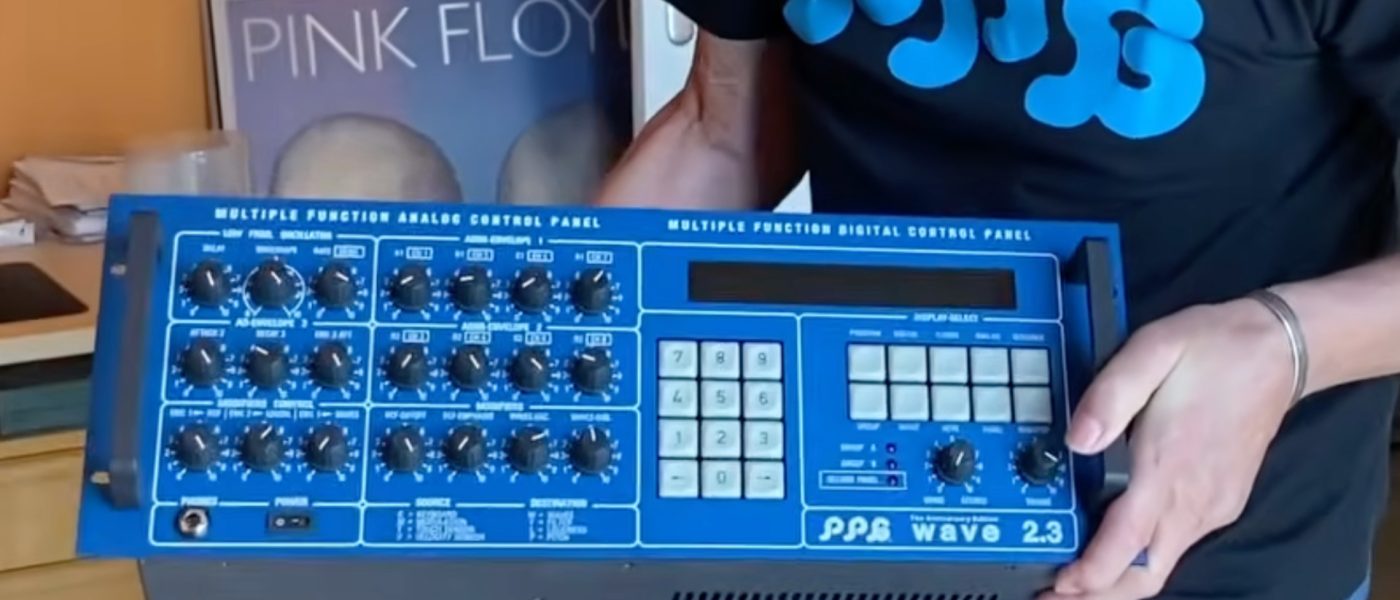
TL;DR: Developer Daniel Saxlid is teasing a new, officially licensed clone of the legendary PPG Wave 2.3 rackmount wavetable synthesizer. The project appears to be a separate, high-fidelity recreation distinct from other recent PPG revivals, with a video showing the unit being gifted to PPG inventor Wolfgang Palm himself. Details on availability and price are still to come.
- A new, officially licensed PPG Wave 2.3 rack clone is in development by Daniel Saxlid.
- This project is separate from the Liquid Sky/PPG 1002 Mk2 reboot, suggesting a different licensing agreement.
- The teaser promises “full integration with PPG legacy systems” and “vastly improved reliability.”
- The back panel reveals extensive connectivity: individual outs, MIDI, CV, and legacy sync/parallel bus ports.
- It’s being billed as an “exclusive encore,” hinting at a potentially limited production run.
Reading time: 4 min
Want more synth news before your next coffee break? Join the Noxal newsletter — no spam, just gear worth knowing about.

The Ghost in the Rack

Here at Noxal, we’ve watched the PPG renaissance with the keen, slightly jaded eye of synth historians who’ve seen more than a few legends get a questionable reboot. The original PPG Wave 2.3, born in 1984, wasn’t just a synth; it was a statement. A hybrid digital-analog wavetable monster that defined the crisp, glassy, and unforgettably cold sound of 80s electronic pop. It was complex, notoriously finicky, and utterly irreplaceable—until everyone started trying to replace it. First came the ambitious Groove Synthesis 3rd Wave, then Behringer’s budget-friendly Wave, and most recently, Liquid Sky’s licensed recreations of the PPG 1002 analog synth and W2.2.x4 oscillator. Just when we thought the PPG well was running dry, a new specter appears: a teaser for a clone of the PPG Wave 2.3 rack unit itself.
The tease comes from developer Daniel Saxlid, via a new PPG-branded website with the suitably dramatic caption: “1984 a legend was born, 2026: an exclusive encore.” The promise is one of “glorious irreplaceable PPG sound” with “no shortcuts no compromise.” It’s the kind of marketing that makes my credit card twitch nervously in my wallet. But the real clincher, the moment that separates this from mere vaporware, is a separate video featuring Wolfgang Palm, the godfather of wavetable synthesis himself. In it, Palm unpacks a birthday gift from Saxlid: what appears to be a pristine PPG Wave 2.3 rack, complete with a personalized serial number. The implication is clear: if it’s good enough for Wolfgang, we should probably pay attention.
Not Your Average Revival
Immediately, the question arises: is this another product from the Liquid Sky collective, who just showed their PPG-licensed gear at Superbooth? The answer, confirmed directly to the source, is a firm no. This is a separate project. The most plausible scenario is that Daniel Saxlid has secured his own licensing agreement, likely through Native Instruments, who currently hold the PPG trademark. This creates a fascinating market dynamic: we now have multiple, competing “official” PPG products from different developers. It’s less a unified revival and more of a splintered legacy, each faction promising the truest path to sonic nirvana.
This separation is crucial. It suggests Saxlid’s project is a focused, standalone effort to recreate a specific, beloved instrument—the 2.3 rack—rather than a broader reimagining of the PPG ecosystem. The emphasis on “full integration with PPG legacy systems” and “vastly improved reliability” speaks directly to the pain points of original owners and devout enthusiasts. It’s not trying to be a modernized, feature-packed workstation; it’s trying to be a PPG Wave 2.3 that doesn’t break down and can talk to your other vintage PPG gear. In an era of endless soft-synth emulations, this kind of hardware purism is either admirably dedicated or completely bonkers. At Noxal, we lean toward the former, especially before our second espresso.
Ports of Call and Legacy Links
A brief glimpse of the unit’s back panel in the teaser video is more revealing than any spec sheet. This isn’t a minimalist modern box. It’s a portal to 1984, bristling with connectors that tell a story. We see the expected main and individual outputs, a full MIDI trio (In, Out, Thru), and CV inputs hinting at modular compatibility. Then come the anachronisms: a cassette interface jack (for loading wavetables the old-fashioned way), separate sync in/out ports, and, most tellingly, multipin connectors for the Parallel Communication Bus.
That Parallel Bus is the key to the “legacy integration” promise. It’s what allowed the original PPG systems to link expanders, keyboards, and computers. Its inclusion suggests this clone isn’t just cosmetically accurate; it’s architecturally faithful, designed to slot into an existing, aging PPG setup as a reliable new heart or a powerful expansion. This level of detail is what separates a passionate clone from a cash-grab replica. It acknowledges that the value of these instruments is often tied to their ecosystem. For the collector or studio with a shelf of vintage PPG modules, this could be a game-changer, a way to keep a classic system alive without relying on 40-year-old capacitors and dubious repair techs.
Who Is This Encore For?
So, who is the target audience for this “exclusive encore”? It’s certainly not the beginner or the casual sound designer. The first group is the preservationists and the purists: the engineers, producers, and artists who own and still use original PPG gear. For them, a reliable, new-old-stock brain unit that integrates seamlessly is worth its weight in gold. The second group is the high-end enthusiast with deep pockets and a historical bent—the person who missed the original but wants the authentic experience, warts and all, not a modern interpretation.
The mention of an “exclusive encore” strongly hints at a limited run. Given the niche appeal, complex construction, and likely high cost of components (and licensing), a small-batch, high-price-tag release seems inevitable. It won’t compete with Behringer on price or with the 3rd Wave on modern features. Its entire raison d’être is authenticity. In a market flooded with options that say “inspired by,” this clone is aiming to say “is.” Whether it succeeds will come down to the final sound, build quality, and that elusive, magical “feel.” If Daniel Saxlid can truly deliver a 2.3 that feels and sounds right, with the stability the originals lacked, he won’t just be selling synths; he’ll be selling peace of mind to a very specific, very anxious group of people. And that, as we know, is a powerful market indeed.
Frequently Asked Questions
Is this the same as the Liquid Sky PPG 1002 Mk2?
No. The developers behind the Liquid Sky PPG products have confirmed they are not involved with this PPG Wave 2.3 rack clone project. This appears to be a separate, independently licensed endeavor by developer Daniel Saxlid.
Will it work with my original PPG gear?
The teaser explicitly promises “full integration with PPG legacy systems,” and the back panel shows a Parallel Communication Bus port. This strongly suggests it is designed to connect with and control original PPG expanders and peripherals, a major selling point for existing owners.
When will it be available and how much will it cost?
As of now, both availability and price are “To Be Announced.” The project is still in the teaser phase. Given the “exclusive encore” wording and the complex nature of the build, expect a limited production run and a price tag reflecting its niche, high-fidelity status.
Now, if you’ll excuse me, I need to check my studio’s humidity levels and pray to the capacitor gods. My original 2.2 is giving me a look.