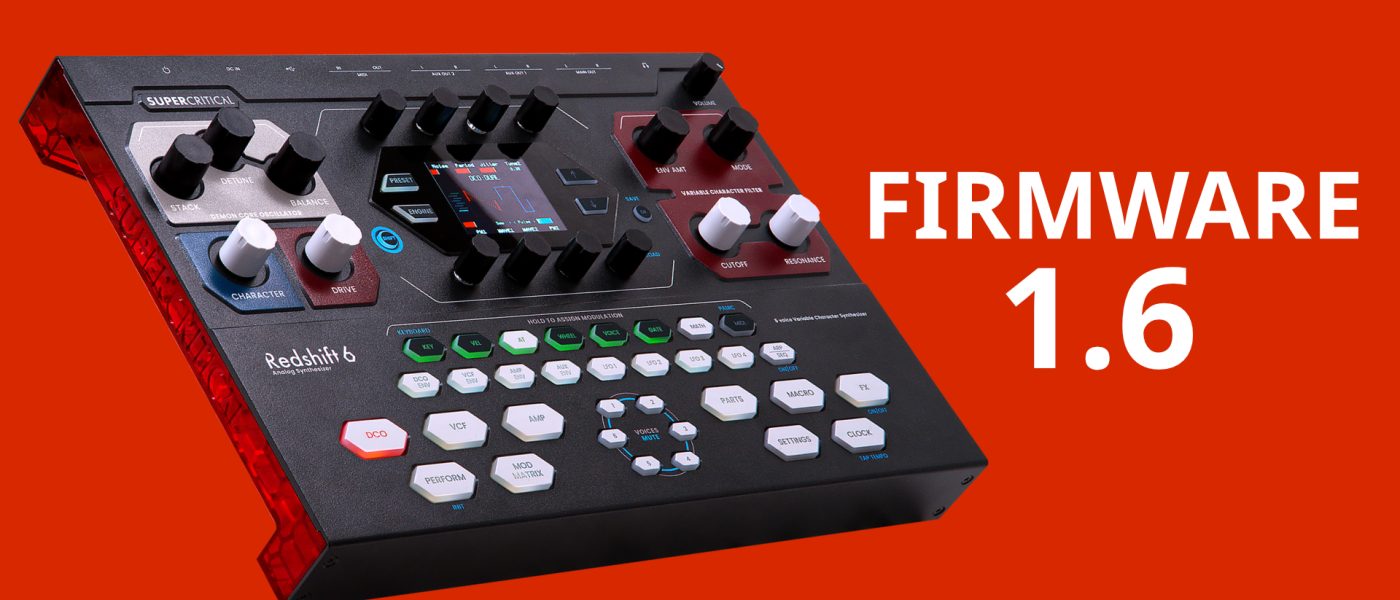
TL;DR: Supercritical Synthesizers has released firmware 1.6 for its Redshift 6 desktop analog polysynth, adding a per-part polyphonic sequencer and assignable macro controls. This free update continues the Finnish company’s aggressive post-launch support, transforming the synth from a capable analog engine into a deeply featured and performative powerhouse.
- Firmware 1.6 adds a new polyphonic sequencer engine (SEQ: POLY) for each of the synth’s six multi-timbral parts, allowing up to six independent 32-step sequences to run in parallel.
- Eight assignable macro controls are introduced, each capable of modulating multiple parameters across different parts simultaneously, ideal for live performance.
- The update also makes the Drive FX available as a modulation destination in the mod matrix and includes eight new factory presets.
- This is the latest in a series of major, free firmware updates that have already added multi-timbrality, MPE, a per-part arpeggiator, and a multi-FX engine.
- A public roadmap promises even more for 2026, including new oscillator and filter modes, hinting that the Redshift 6 is far from a finished product.
Reading time: 5 min
Want more synth news before your next coffee break? Join the Noxal newsletter — no spam, just gear worth knowing about.
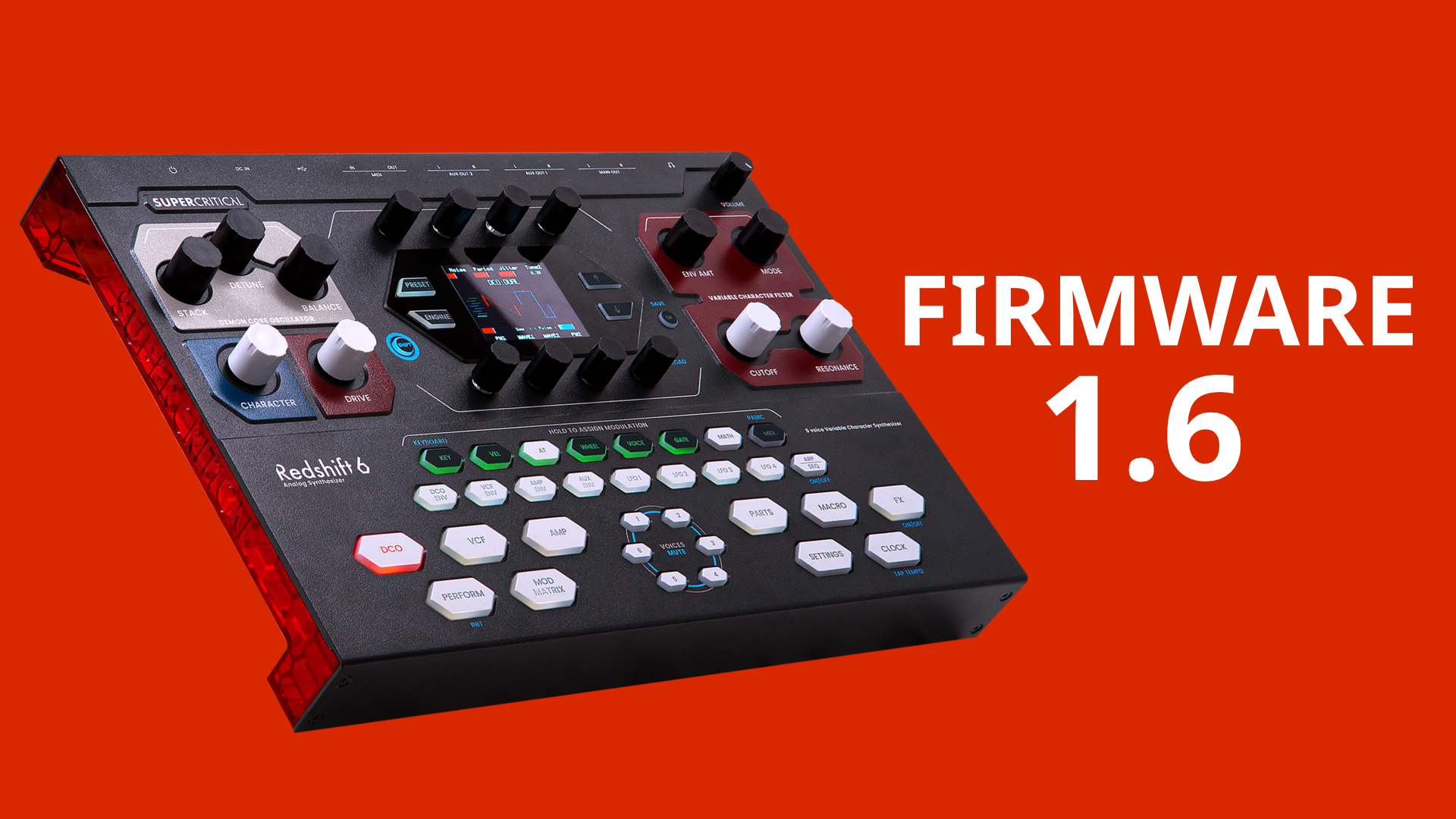
The Redshift 6: A Refresher

For those who haven’t been tracking this Finnish dark horse, the Supercritical Redshift 6 is a six-voice, fully analog desktop polysynth that launched about a year ago. Its initial proposition was compelling: a compact, knob-per-function interface built around a dual-oscillator-per-voice analog core, with digital modulation and effects handling the “thinking” parts. The price, hovering around $1300, placed it as a serious contender in the crowded “affordable analog poly” space, competing with the likes of the ASM Hydrasynth Desktop and various Behringer offerings, but with a distinctly Scandinavian, no-nonsense aesthetic.
What set it apart from day one, however, wasn’t just its sound—which is rich, brash, and wonderfully analog—but its architecture. It was built from the ground up to be a multi-timbral synth, capable of splitting its six voices across up to six independent parts. This wasn’t a tacked-on afterthought; it was a core design philosophy. In a market where even high-end polysynths often relegate multi-timbral operation to a secondary mode, the Redshift 6 made it a front-and-center feature. The potential was enormous, but at launch, the tools to fully exploit that potential were still being forged.
Firmware 1.6: Sequencing the Multiverse
Enter firmware 1.6, the latest and perhaps most significant step in unlocking that potential. The headline feature is the new SEQ: POLY engine. Previously, each of the six parts had its own arpeggiator (a feature added in the excellent 1.4 update). Now, each part gets a fully-fledged 32-step polyphonic sequencer. Let that sink in. You can have six completely independent melodic, bass, or percussive sequences running in parallel, all from a single desktop unit. This transforms the Redshift 6 from a powerful sound source into a self-contained, multi-layered composition and performance tool.
The implications are vast. Imagine setting up a driving bass sequence on part one, a chord progression on part two, a lead melody on part three, and using the remaining parts for evolving pads or percussive hits—all internally sequenced, with independent sound design per part. It’s the kind of feature set we associate with high-end workstations or modular setups, not a sub-$1500 analog desktop module. This isn’t just an update; it’s a fundamental shift in the instrument’s identity, catering directly to producers and performers who think in layers and patterns.
Macros and the Roadmap
The second major pillar of the 1.6 update is the addition of eight assignable macro controls. In a synth with this many layers, the ability to make broad, performative changes without menu-diving is crucial. Each macro can be mapped to multiple parameters, and critically, those parameters can live in different parts. You could, for example, have one knob that simultaneously opens the filter on a pad, increases the decay on a bass sequence, and modulates the rate of a delay effect. It’s a live performer’s dream, allowing for complex, evolving transitions at the twist of a single encoder.
Furthermore, Supercritical has been admirably transparent about its future plans via a public roadmap. Firmware 1.6 delivers on promised features like the sequencer and macros, but the roadmap teases what’s next: new DCO modes (including partials and drum waveforms), new VCF engines (formant, pole mixing), and more advanced arpeggiator engines. This commitment to long-term development is arguably as valuable a feature as any knob or jack on the unit itself. It signals that buying a Redshift 6 isn’t a transaction, but an entry into a developing ecosystem.
Context: The Art of the Update
To fully appreciate 1.6, you have to view it as the latest chapter in an ongoing saga of enhancement. Firmware 1.4 was a monster, adding full MPE compatibility and that per-part arpeggiator. Firmware 1.5, the “Christmas update,” gifted users a superb multi-FX engine with reverb, delay, and chorus algorithms. Before that, updates solidified MIDI sync, USB functionality, and multi-part editing. The Redshift 6 we have today is a profoundly different—and better—instrument than the one that shipped a year ago.
This approach stands in stark contrast to the industry norm, where firmware updates are often limited to bug fixes or minor quality-of-life improvements. Supercritical is engaging in a form of “post-purchase R&D,” actively expanding the capabilities and value of their product. It builds immense goodwill and turns customers into advocates. In an era where hardware can feel disposable or static, the Redshift 6’s evolution feels refreshingly alive and responsive to user needs.
Who Is This For Now?
With firmware 1.6, the target audience for the Redshift 6 has crystallized. It is now unequivocally for the producer-performer. The musician who wants a single, central brain for a hardware setup. The sound designer who needs complex, layered textures that can be manipulated in real-time. The live act that values a compact, powerful unit capable of generating an entire track’s worth of sequenced parts without a laptop in sight.
It’s also a compelling argument against the notion that analog architecture is inherently limited or “finished.” The Redshift 6 proves that by pairing a robust analog voice architecture with a smart, updateable digital brain, you can have the best of both worlds: the warmth and immediacy of analog oscillators and filters, with the sequencing, modulation, and effects flexibility of the digital domain. If you dismissed the Redshift 6 at launch as just another analog poly, it’s time to look again. The goalposts have moved, and Supercritical is kicking the ball.
Frequently Asked Questions
Is the Redshift 6 update free?
Yes. Like all previous major firmware updates (1.4, 1.5), version 1.6 is a free download for all existing Redshift 6 owners. Supercritical has maintained a policy of free feature updates since launch.
Can I use the new sequencer and arpeggiator at the same time?
No, the SEQ: POLY engine and the arpeggiator are separate engines per part. You select one or the other for a given part, not both simultaneously. However, you can have some parts running sequences and others running arpeggios.
What’s the best way to think about the macro controls?
Think of them as customizable “performance knobs.” You assign them to the parameters you most want to manipulate live—filter cutoff, effect mix, LFO rate, etc. Their power comes from being able to control multiple parameters across different synth parts at once, letting you create dramatic, cohesive changes in your multi-timbral patches with a single gesture.
I’m going to need a stronger espresso to properly test six independent sequencers. My studio routine wasn’t built for this level of multi-dimensional responsibility.