
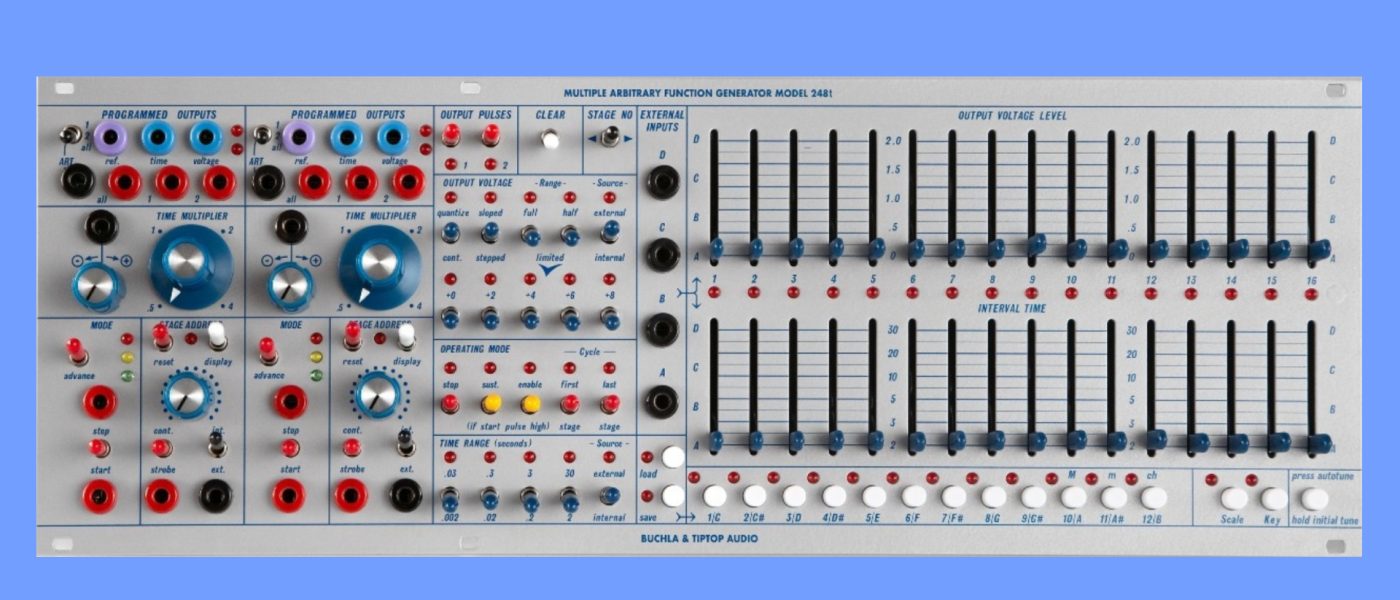
TL;DR: Tiptop Audio has unleashed the Buchla 248t MARF, a faithful yet enhanced Eurorack recreation of the legendary 1970s Multiple Arbitrary Function Generator. This 16-stage programmable CV monster is far more than a sequencer, offering deep, non-linear control over voltage movements for spectacular sound design. It’s available now for $999, demanding both rack space and serious study time.
- A modern Eurorack recreation of the iconic Buchla 248 MARF, developed over two years in partnership with Buchla.
- 16 programmable stages with two independent output sections, capable of acting as a sequencer, complex envelope, portamento processor, and more.
- Features include stage grouping, stop/sustain commands, external addressing, time scaling, and Tiptop’s proprietary ART protocol output.
- Includes modern upgrades like non-volatile memory for preset recall and a dense array of CV, pulse, and reference outputs.
- Priced at $999/989€, it’s a flagship, deep-dive module for those seeking the ultimate in flexible CV generation and manipulation.
Reading time: 4 min
Want more synth news before your next coffee break? Join the Noxal newsletter — no spam, just gear worth knowing about.
The MARF Awakens

We at Noxal have watched Tiptop Audio’s official Buchla 200 series partnership with a mix of awe and trepidation. First came the faithful recreations, then the epic 296t spectral processor claimed the “largest module” crown. It seems that title was merely on loan. Tiptop has now deployed the true flagship: the Buchla 248t MARF, a modern Eurorack incarnation of the legendary Multiple Arbitrary Function Generator. This isn’t just another module drop; it’s the arrival of a foundational piece of synthesis history, one that spent two years in development to ensure it wasn’t just a clone, but a viable, robust citizen of the modern modular grid.
The original MARF, born in Don Buchla’s 1970s laboratories, has long been spoken of in reverent tones as one of the most powerful and flexible control voltage sources ever conceived. It was the kind of module that defined a system’s personality. Bringing such a complex, idiosyncratic design to Eurorack is a statement of intent from Tiptop. It signals that this partnership is about translation, not dilution. They’re not just making Buchla-shaped Eurorack modules; they’re porting the deep, often esoteric, philosophy of voltage control.
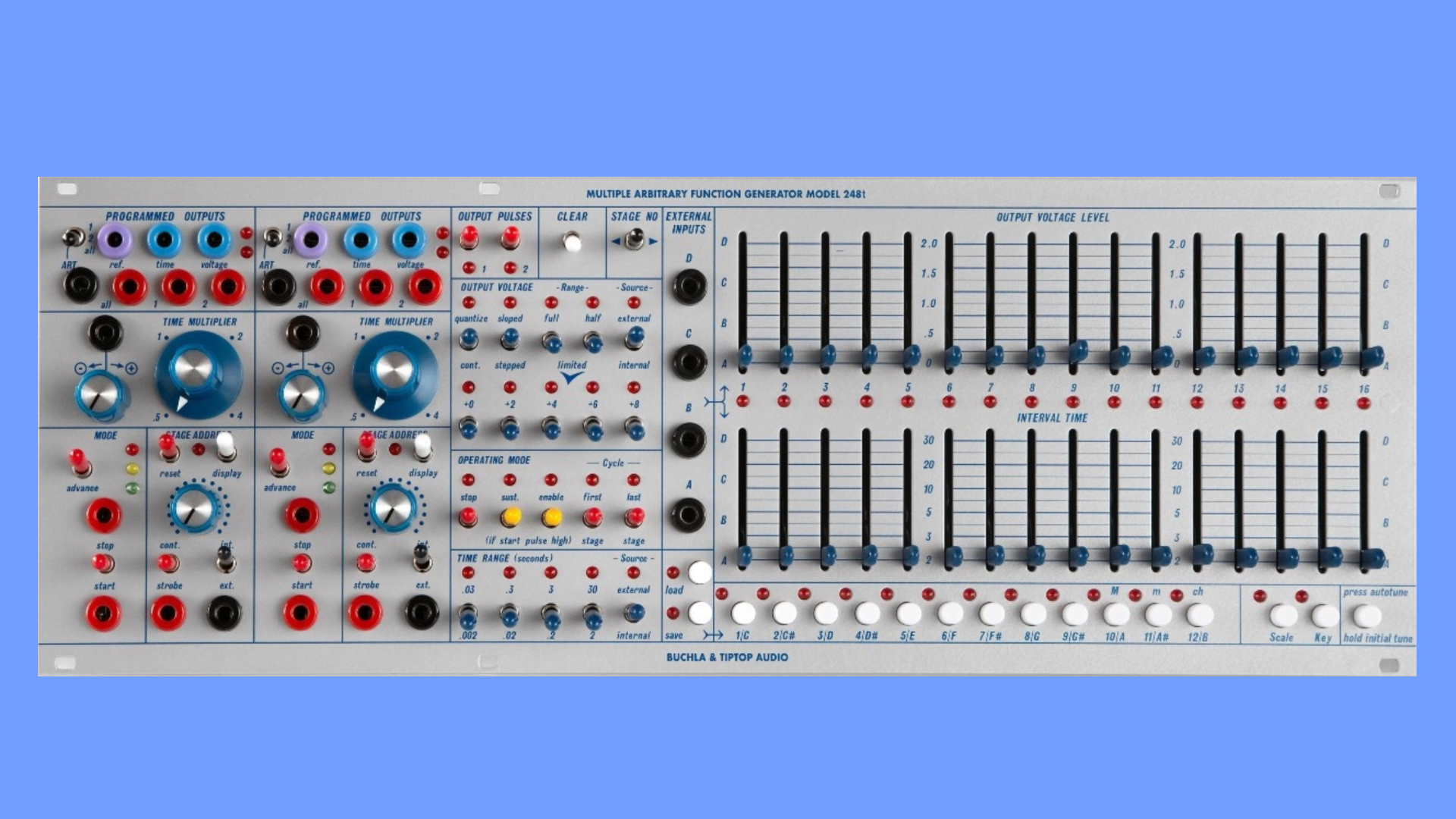
I look at the 248t’s panel—dense with sliders, switches, and jacks—and feel a familiar pang. It’s the same feeling I get when a new, impossibly complex coffee gadget arrives: excitement for the potential, immediately followed by the sobering knowledge that the manual and I are about to become very close. This module demands a relationship.
More Than a Sequencer, a CV Universe

At first glance, yes, it looks like a 16-step sequencer. That’s the trap. To call the MARF a sequencer is like calling a particle accelerator a fancy tube. It can step through voltages, but its soul is in the spaces between. The core magic is its ability to create “wonderfully odd, non-typical, non-symmetrical, and non-linear voltage movements.” Each of its 16 stages is a playground. You can set a voltage value, but you also define how it gets to the next one—gliding, stepping, or quantizing in divisions of 12. You can map stages to specific voltage ranges, creating custom scales or bizarre, compressed sweeps.
This is where the “Arbitrary Function” part earns its name. By grouping stages and assigning commands like Stop, Sustain, First, or Last, you morph its function entirely. Need a bizarre 5-stage ADSR envelope with a sustain plateau that wobbles? The MARF is your module. Want a 7-step sequence for pitch where steps 3 and 4 trigger a separate envelope on another output? Configure it. It can be a portamento processor, a complex LFO, or a voltage memory unit. The two independently addressable output sections mean you can run two completely different, yet interrelated, voltage narratives simultaneously from the same 16-stage timeline.
The ability to address stages internally or via external CV is the final piece of the puzzle, opening the door to chaotic, generative, and deeply interconnected patch architectures. It turns voltage control from a linear command into a multidimensional conversation. I imagine patching it into itself, creating feedback loops of stage addressing, and immediately decide I should finish my coffee first before attempting such madness.
Specs and Modern Touches
So, what are you actually getting for your HP and dollars? The 248t MARF is a powerhouse of connectivity and modern convenience. The outputs are a festival of control: the main Stored Voltage outs, a stage-triggered ramp Reference output, two assignable pulse outputs, and pulse inputs for start/stop commands. The time multiplier control (with CV input) lets you scale the timing of the entire sequence or grouped stages globally, a master clock divider/multiplier for your voltage shapes.
Tiptop hasn’t just copied the original; they’ve thoughtfully integrated it into their ecosystem. The inclusion of their ART protocol with a dedicated output is a significant upgrade, allowing for tight, timing-accurate communication with other ART-equipped modules like the 259t complex oscillator. Then there’s the crucial quality-of-life feature: non-volatile memory. You can craft your magnum opus of voltage choreography, save it as a preset, and have it waiting for you after a power cycle. This alone makes the module infinitely more practical in a modern studio context than its vintage forebear.
The panel, while intimidating, is logically laid out. The central array of switches and buttons for programming mode, quantization, and range mapping is the cockpit. The 16 sliders are your data entry points and visual reference. It’s a design that encourages exploration but requires you to learn its language. This isn’t a “twist a knob and get a pleasing LFO” module. It’s a “define the mathematical personality of your modulation” module.
For Whom The MARF Tolls
Let’s be clear: the Buchla 248t MARF is not for everyone. At $999/989€, it’s a significant investment, both financially and in terms of the mental real estate required to master it. This is a module for the synthesist who looks at a traditional ADSR and thinks, “But what if the decay had three inflection points and could be triggered from the middle?” It’s for the patcher who feels constrained by regular sequencers and wants to design the contour of every parameter movement with deliberate, arbitrary precision.
We at Noxal see it as the ultimate modulator for those building a “West Coast” or complex, voltage-centric system in Eurorack. It’s the control center that can unify and animate a case full of complex oscillators, wavefolders, and function generators. It’s also a dream for experimental composers and sound designers seeking to create evolving, unpredictable, yet perfectly structured voltage landscapes. If your ideal studio session involves drawing voltage curves as much as playing notes, the MARF is your holy grail.
For the rest of us, it’s a fascinating, slightly terrifying monument to what’s possible in voltage control. It commands respect. I suspect many will buy it for the legend, and a dedicated few will truly unlock its world. It’s the kind of module that doesn’t just make sounds; it changes how you think about synthesis. And for that alone, its arrival in Eurorack is a momentous event.
Frequently Asked Questions
Is the Buchla 248t MARF just a very expensive sequencer?
No, that’s a common misconception due to its layout. While it can function as a powerful 16-step sequencer, its primary purpose is as a Multiple Arbitrary Function Generator. This means it’s a programmable voltage source that can create complex, non-linear voltage shapes, act as a multi-stage envelope, generate portamento curves, and much more. The sequencing of stages is just one of its many operational modes.
What is the ART protocol output for?
The ART (Analog Rendered Technology) output is Tiptop Audio’s proprietary timing and synchronization protocol. It allows the 248t MARF to communicate precisely with other ART-equipped modules in the Tiptop Buchla series, like the 259t complex oscillator, ensuring tight integration for features like hard sync and complex modulation that requires sample-accurate timing.
Can I save my complex MARF configurations?
Yes! This is a key modern improvement over the original. The Tiptop Audio 248t MARF features non-volatile memory, meaning you can save your painstakingly programmed stage values, groupings, and modes as presets. These presets will be retained even when you power off your modular system, making it a practical tool for structured work or live performance.
Now, if you’ll excuse me, I need to stare at a simple LFO for a few minutes to calm my brain down. The coffee pot is officially on standby for the deep dive this module demands.