TL;DR: Kaona has released firmware 2.0 for its Sisyphus granular filter module, a significant free update that expands its sonic palette. The update introduces 14 new granular patterns and supercharges the existing variability control, while also adding a new ‘Follow’ algorithm for smoother, more organic filter movement. It’s a substantial evolution for a module that was already rethinking what a filter could be.
- Firmware 2.0 is a free update adding 14 brand-new, fully adjustable granular patterns to the Sisyphus engine.
- The key ‘Variability’ knob has been expanded from a simple intensity control to one that modulates depth, complexity, tuning, and spectral behavior of each pattern.
- A new ‘Follow’ algorithm promises smoother filter transitions, fewer glitches, and more organic stereo movement in cutoff and resonance.
- The update emphasizes richer interaction between the granular and filter elements, which are uniquely intertwined in Sisyphus’s architecture.
- This continues Kaona’s distinct path from modules like the Klavis Grainity, focusing on stereo processing and pattern-based grain organization.
Reading time: 4 min
Want more synth news before your next coffee break? Join the Noxal newsletter — no spam, just gear worth knowing about.
What Is Sisyphus, Anyway?

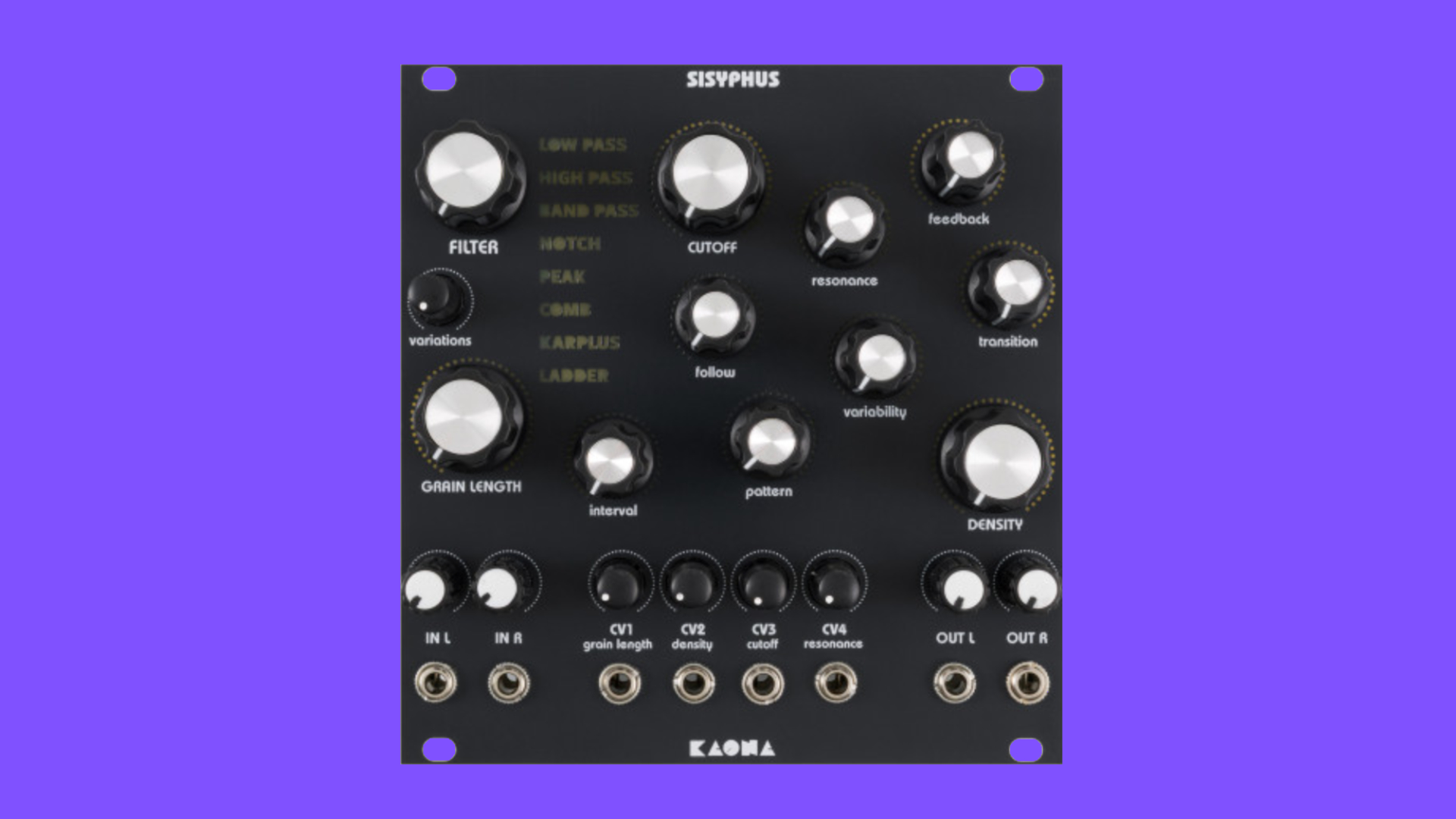
Before we get lost in the firmware update, let’s re-establish what we’re talking about. The Kaona Sisyphus, launched last year, is a 24HP Eurorack module that poses a fascinating question: what if a filter and a granular synthesizer had a deeply intertwined, inseparable child? It’s not a filter placed before or after a granular processor—a common patch we might all try. Instead, Kaona architected it so that the filtering is baked directly into the grain-generation process itself. Each tiny audio segment (a grain) is analyzed, filtered according to your settings, and then spat out, carrying those filtering characteristics with it as it joins the chaotic, configurable swarm.
This sets it apart from another notable entry in this niche, the Klavis Grainity. Where Grainity is mono, Sisyphus is stereo. More fundamentally, Sisyphus organizes its chaos into what Kaona calls “patterns.” A central knob scrolls through predefined scenarios for how grains are organized, behaved, and related to each other. It’s granular synthesis with a sense of pre-composed, yet fully malleable, disorder. The original module came with a palette of eight original, in-house developed filters (from 12dB/oct modes to comb and Moog-style ladder), all waiting to be injected into this granular bloodstream.
Firmware 2.0: The New Grains of Sand

So, what does version 2.0 bring to this already complex sandbox? In short: more sand, and better tools to shape it. The headline is 14 new granular patterns. In the world of Sisyphus, a pattern isn’t just a rhythm; it’s a personality profile for your grains. These new additions promise their own sonic behaviors, manipulable through now-familiar parameters like pitch shift, detuning, chord generation, grain reversal, stereo movement, and density. Want unstable repetitions? There’s probably a pattern for that now. This directly expands the module’s core vocabulary, offering fresh starting points for texture, rhythm, and mangling.
Perhaps more interesting than the new patterns is the evolution of the “Variability” knob. In the original firmware, this was essentially an intensity control for a pattern’s specific effects. Firmware 2.0 turns it into a multidimensional morphing tool. Now, turning this knob can influence a cascade of attributes: the depth and complexity of the pattern, the tuning, how grains are distributed, their direction, and even their spectral behavior. It transforms a one-dimensional “more” control into a “different” control, allowing you to explore nuanced variations of a single pattern without touching another setting. This is a thoughtful, musician-centric upgrade that acknowledges the depth of the system.
Under the Hood: A Different Kind of Filter

The update isn’t just about the grains; it’s also about the glue that holds them together—the filter. Kaona has introduced a new algorithm called “Follow.” The promises here are enticing for anyone who’s wrestled with digital filters that can sound abrupt or glitchy (sometimes desirably so, sometimes not). “Follow” aims for smoother transitions in cutoff and resonance, wider stereo imaging possibilities, and more “organic” movement. In a module where the filter state is per-grain, smoother transitions could translate to more cohesive, less atomized textures, even at high granular densities.
Gilles from Kaona states the engine has been broadly expanded to allow “more detailed work on the sound itself,” promising richer interactions between the granulation and filtering, livelier modulation, and more distinctive behaviors. This reads like foundational work—optimizations and refinements under the hood that make the existing and new features sing together more effectively. For a digital module of this complexity, the quality of these algorithms is everything. It’s heartening to see the developer not just adding features, but revisiting and improving the core sonic character a year in.
Who Is This For (And Why It Matters)
The Sisyphus, especially post-2.0, is not a beginner’s module. It’s for the sound designer, the texture hunter, the musician who looks at a filter and thinks, “This could be so much more.” Its $659/€492 price tag positions it as a premium, specialized processor. You’re buying into a specific, opinionated vision of sound manipulation—one that rewards deep exploration and pattern-based thinking over immediate, predictable results. The four CV inputs (assignable via SD card, a nice touch) and stereo capability make it a potent centerpiece for a complex modulation and processing chain.
Why does this matter to the broader synth community? Because we need modules that ask “what if?” The Sisyphus challenges the very definition of a filter. In a market saturated with recreations and variations on 40-year-old concepts, a module that genuinely attempts a new synthesis of ideas (granular + filtering) is a breath of fresh air. That Kaona supports it with a substantial, free firmware update like this shows a commitment to the instrument’s longevity. It validates the early adopters and makes the proposition for new buyers significantly stronger. The synth world evolves not just with new chips, but with new ideas, and Sisyphus firmware 2.0 is a solid push on that boulder up the hill.
Frequently Asked Questions
Is the Kaona Sisyphus firmware 2.0 update free?
Yes. Kaona has confirmed that firmware version 2.0 is a free update for all existing Sisyphus owners. You’ll need to download the update file from Kaona and follow their update procedure, which typically involves an SD card.
How is the Sisyphus different from the Klavis Grainity?
While both combine granular processing with filtering, they take different architectural paths. The Klavis Grainity is a mono-input module where the filter and granular engine are distinct sections that can be routed in series. The Kaona Sisyphus is stereo and integrates the filter directly into the grain generation process. Furthermore, Sisyphus uses a system of predefined, selectable “patterns” to organize grain behavior, which is a unique approach to controlling granular chaos.
What do I need to use the Sisyphus in my Eurorack system?
You’ll need a free 24HP space in your case and a power cable that provides +12V, -12V, and +5V (the +5V is often required for digital modules, so check your case’s power supply). The module has stereo inputs and outputs, so you’ll benefit from using it with stereo signal paths, though it can process mono sources as well. An SD card is useful for loading custom CV assignment maps and the firmware updates.
Now, if you’ll excuse me, I need to finish this coffee and contemplate the existential plight of a digital grain, forever filtered and reformed. A bit like my attempts at a productive morning, really.