TL;DR: Cre8audio and Pittsburgh Modular are about to complete their affordable desktop/Eurorack ecosystem with the imminent release of the Programm, a performance sequencer. It packs two melodic tracks, two CV modulation tracks, and eight drum triggers into a hands-on box, with generative features like probability-based ratcheting. Expect it in one to two weeks at a price point likely under €300.
- The Programm is a desktop/Eurorack performance sequencer, the logical final piece for the East Beast/West Pest/Boom Chick/Assembler lineup.
- It features two 1v/oct + gate + CV tracks, two dedicated CV modulation tracks, and eight drum trigger outputs.
- Generative features are a highlight, with per-step or global probability controls for functions like ratcheting and pattern shifting.
- The 32-pad grid suggests 32-step patterns, with page functions likely extending that to 64 or more steps.
- Official release and pricing are expected within weeks, with an estimated street price between €200 and €300.
Reading time: 4 min
Want more synth news before your next coffee break? Join the Noxal newsletter — no spam, just gear worth knowing about.

The Missing Link

Here at Noxal, we’ve watched with genuine interest as Cre8audio and Pittsburgh Modular have methodically built a coherent, affordable ecosystem of desktop-or-Eurorack boxes. It started with the distinct sonic personalities of the East Beast and West Pest semi-modular synths. Then came the Boom Chick drum machine, offering a taste of Pittsburgh’s analog percussion circuits. The Assembler mixer tied the audio together. But the brain was missing. A setup like this, designed for hands-on, immediate play, was screaming for a dedicated, equally playable sequencer. The Cre8audio Programm, announced via a surprisingly open SonicTalk appearance by Pittsburgh’s Richard Nicol, is that brain. It’s the final piece that makes the entire lineup feel like a complete, intentional instrument suite rather than a scattered collection.
The timing of this reveal, just weeks before Superbooth, is a clever bit of stage-setting. It breaks from Cre8audio’s usual tight-lipped NDA culture, suggesting they’re confident this is a product that can build its own buzz through sheer feature appeal. The promise of a release in “one or two weeks” turns speculation into imminent anticipation. For anyone who invested in an East Beast or a Boom Chick, this isn’t just another sequencer; it’s the sequencer designed to talk natively to their gear, both in format and likely in workflow philosophy.
Faceplate Forensics
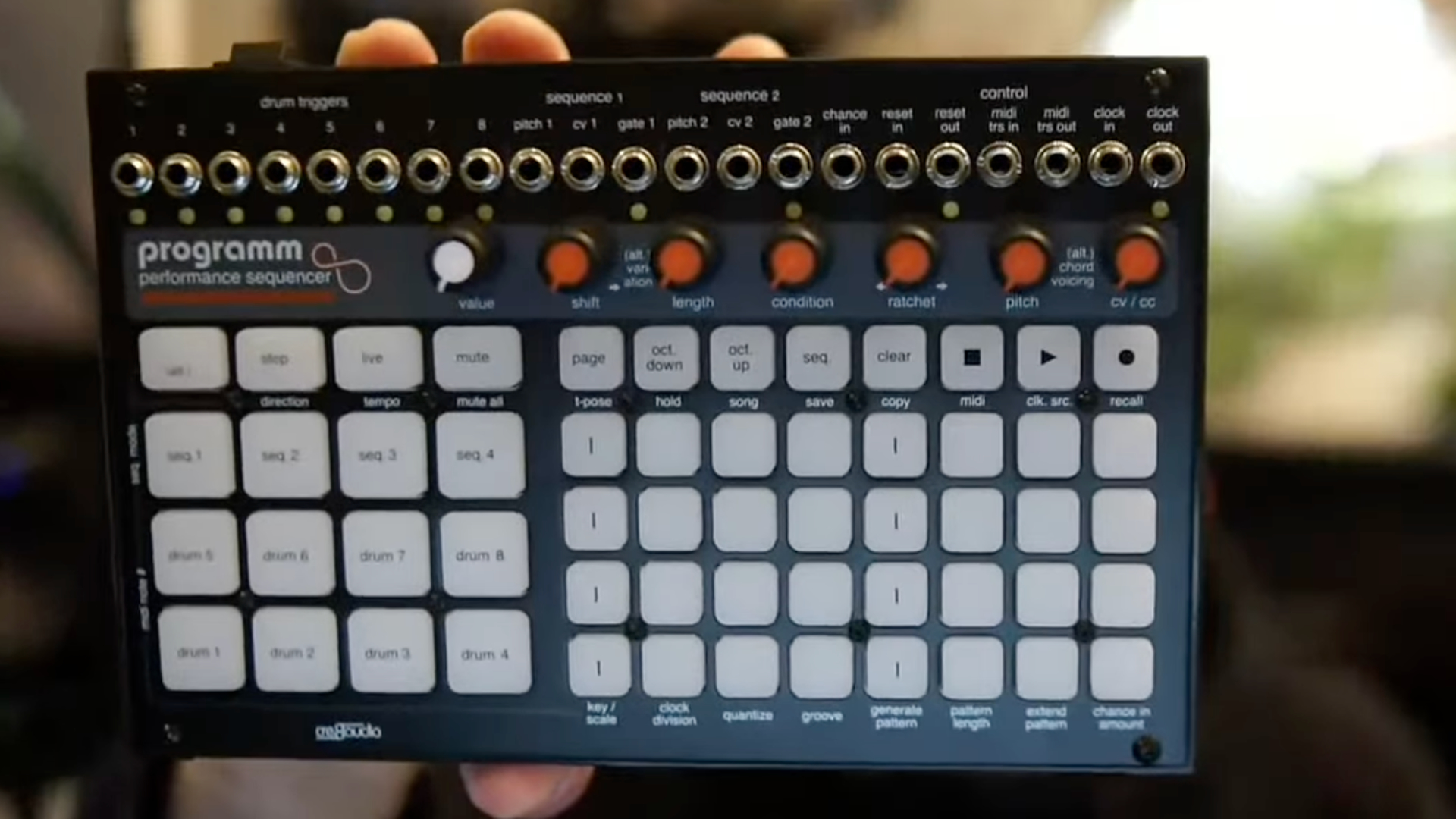
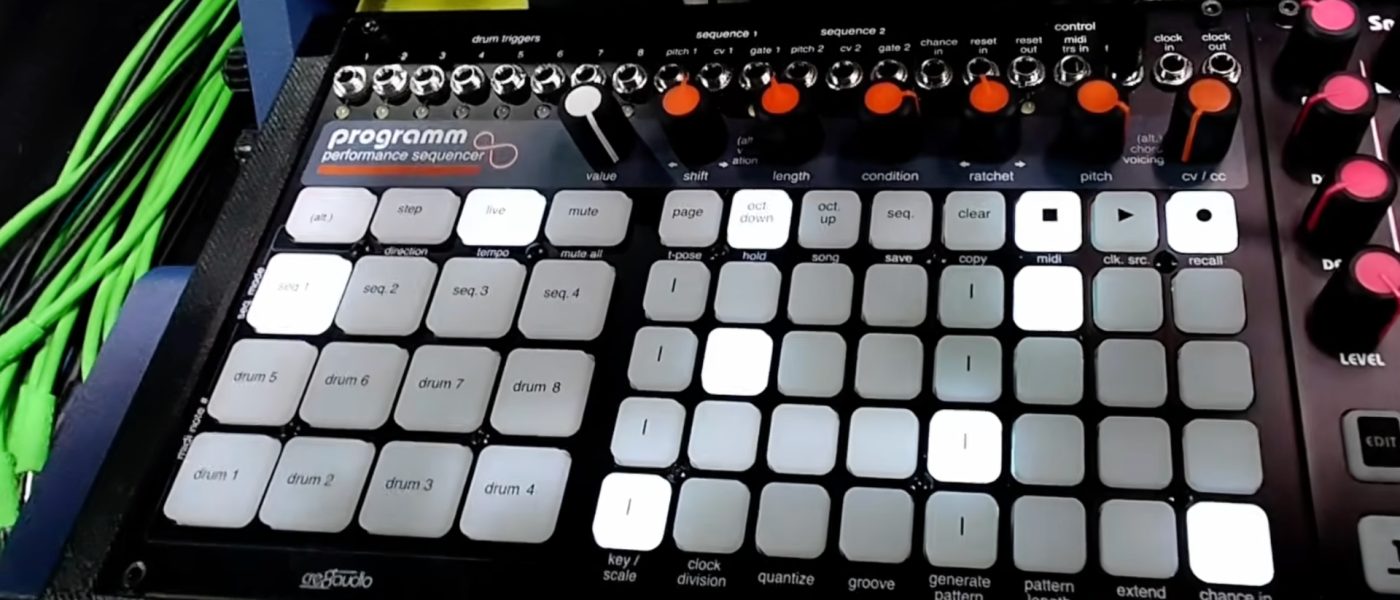
Without an official spec sheet, we’re left to do what we do best: scrutinize the blurry photos and video frames. The layout tells a compelling story. The left-side track selection buttons hint at a multi-channel workflow, controlling the two melodic tracks (each with 1v/oct, gate, and a dedicated CV out), the two CV-only modulation tracks, and the eight drum triggers. That’s a substantial amount of sequencing in a box this size—enough to drive the entire Cre8audio ecosystem and then some.
The central 32-pad grid is the heart of it. While 32 steps is a solid foundation, buttons for “Page” and “Octave Up/Down” strongly suggest the ability to chain pages for longer patterns or access different parameter layers. The bottom row of knobs is where the performance magic likely happens, with direct controls for pattern length, shift, condition (probability), and that all-important ratcheting parameter. The inclusion of “Key/Scale” and “Quantize” knobs is a welcome sight, promising quick, on-the-fly musicality without menu diving. It’s a faceplate that speaks of immediacy, designed for tweaking in the flow of a jam rather than programming in a static pre-production phase.
The Generative Twist
This is where the Programm moves from being a competent sequencer to a genuinely interesting one. Richard Nicol highlighted that advanced features like ratcheting won’t just be static settings. They can have “independent probability functions.” This is a significant detail. It means you can set a ratchet pattern, but then let the sequencer decide, based on a chance percentage you set, whether to apply it on any given step or cycle. Apply this concept to the “Pattern Shift,” “Condition,” and other parameters, and you have a machine that can create evolving, ever-surprising variations from a simple seed pattern.
This generative layer, controllable per-step or globally per channel, is what could set the Programm apart in a crowded field of entry-level sequencers. It’s not just about recording and playing back notes; it’s about creating a living, breathing control center that introduces controlled randomness. It takes the experimental, patchable spirit of the East Beast and West Pest and applies it to sequence generation itself. For the price point, offering this level of algorithmic composition is a compelling proposition.
Who It’s For (And What’s Next)
The Programm is a textbook example of a “lineup completer.” Its primary audience is the existing community of Cre8audio box owners. If you have a Beast, a Pest, and a Boom Chick on your desk, the Programm is a near-irresistible upgrade, promising a unified workflow. Secondly, it’s a fantastic entry point for anyone wanting a capable, self-contained hardware sequencer that can drive both Eurorack and desktop gear via CV/gate and MIDI (the TRS MIDI jacks are a nice touch). Its estimated €200-€300 price, consistent with the rest of the series, places it firmly in the “impulse buy” territory for many.
What does this mean for Cre8audio and Pittsburgh Modular? With the core ecosystem now seemingly complete—synth, drum, mix, sequence—the question becomes: what’s next? Do they iterate on these designs with firmware updates, as seen with the East Beast 1.5? Or do they expand outward, perhaps into effects or more esoteric modulation? The Programm’s release closes one chapter and neatly sets the stage for the next phase of this remarkably productive collaboration. For now, though, they’ve addressed the most obvious gap in their catalog with what looks like a thoughtfully designed and powerful tool.
Frequently Asked Questions
How many melodic sequences can it run at once?
The Programm features two independent melodic tracks. Each track provides a 1v/oct output for pitch, a gate output, and a dedicated CV output for modulation (like filter cutoff or wave shaping), allowing for two fully articulated synth lines with continuous control.
Can it be used as a standalone desktop unit?
Yes, absolutely. Like the East Beast, West Pest, Boom Chick, and Assembler, the Programm is designed as a desktop device with a built-in power supply. It can also be mounted into a Eurorack case using optional ears, providing incredible flexibility for different setups.
What does “probability-based ratcheting” mean?
Instead of a ratchet (multiple triggers per step) always firing on a step you set, you can assign a probability percentage to it. For example, you could set a 50% chance for a ratchet to occur. This means the sequencer will randomly, based on that chance, decide whether to execute the ratchet pattern each time that step plays, creating more organic and less predictable rhythms.
Now, if you’ll excuse me, I need to clear a perfect 19-inch space on my desk and brew a fresh pot. Something tells me I’ll be doing a lot of pattern programming very soon.