Explore the ongoing debate of analog vs. digital music production. This article delves into the strengths and weaknesses of both approaches, guiding producers toward a hybrid model that maximizes creativity and efficiency in the studio.
- Analog offers warmth and tactile inspiration, while digital provides precision and flexibility.
- Both worlds present challenges that producers must consider in their workflows.
- A hybrid approach blends the best of both analog and digital for optimal creativity.
Estimated reading time: 8 minutes
Join our newsletter: Join our newsletter
Table of Contents
- The Allure of Analog: Warmth, Character, and Tactility
- The Power of Digital: Precision, Flexibility, and Efficiency
- The “Cons” Unpacked: The Realities of Both Worlds
- Blending the Best: A Modern Producer’s Hybrid Approach for Efficient Studio Sessions
- Encouraging Exploration: Your Sound, Your Choice
- Conclusion: The Symphony of Synergy
- FAQ
The Allure of Analog: Warmth, Character, and Tactility
Let’s start with the one that often conjures images of vintage studios, thick cables, and glowing tubes: analog. For many, including myself, there’s an undeniable magic to analog synthesizers and analog hardware. It’s more than just nostalgia; it’s a tangible experience.
The Pros of Analog:
- Unmistakable Sound Quality: Analog circuits introduce subtle imperfections, harmonic richness, and warmth that is often described as organic or lively.
- Tactile Workflow and Inspiration: Physical knobs and faders create an engaging experience that can lead to ‘happy accidents’ and spontaneous creativity.
- Unique Component Interactions: Variations in analog components contribute to a unique sonic fingerprint, with imperfections celebrated as character.
- Investment and Resale Value: High-quality analog gear often holds its value and can even appreciate over time.
My Personal Take: I’ve always believed that the true power of analog lies in its ability to inspire. When I sit down with my semi-modular rig, patching cables and turning physical knobs, it’s an interaction that digital sometimes struggles to replicate.
The Power of Digital: Precision, Flexibility, and Efficiency
Now, let’s turn the spotlight to digital. Far from being “cold” or “soulless,” digital tools have revolutionized music production, democratizing access and unleashing creativity.
The Pros of Digital:
- Unrivaled Precision and Control: Digital audio provides perfect recall and sound reproduction, vital for detail-oriented mixing and mastering.
- Infinite Flexibility and Sound Design: Digital offers a vast array of sounds and manipulation techniques that would be challenging or costly with analog.
- Cost-Effectiveness and Portability: A single laptop can replace an entire studio of hardware, making music production more accessible.
- Seamless Integration and Workflow Efficiency: Digital workflows promote fast editing, easy arrangements, and collaboration capabilities.
- Innovation and Accessibility: The digital sphere is continually developing, fostering a vibrant community of innovators.
My Personal Take: The intricate soundscapes in modern film scores show the power of digital. It’s not simply about replicating analog; it’s about venturing into new sonic territories only accessible through the logic of code.
The “Cons” Unpacked: The Realities of Both Worlds
To truly optimize your studio, acknowledging the drawbacks alongside strengths is essential. Both analog and digital come with their own set of challenges.
Analog Cons:
- Cost and Maintenance: High-quality analog gear is often expensive and requires specialized repairs.
- Space and Portability: Analog hardware can be bulky; a studio full of gear necessitates considerable space.
- Limited Recall: Recreating exact settings can be a complex process without clear documentation.
- Noise and Latency: Older analog gear can introduce unwanted noise, which can be problematic in a pristine mix.
Digital Cons:
- “Clinical” Sound (Perception): Some feel digital lacks the organic imperfections of analog.
- Option Paralysis: The overabundance of tools can stifle creativity, leading to endless tweaking.
- Latency and System Overhead: Complex digital setups can cause latency issues, affecting workflow.
- Software Dependency and Obsolescence: Compatibility issues can require constant vigilance to maintain software stability.
- Less Tactile Workflow: The digital interface can lack the engaging quality of physical controls.
Noxal’s Perspective: Understanding these trade-offs isn’t about discouraging either path; it’s about making informed decisions, recognizing that every tool has its purpose and limitations.
Blending the Best: A Modern Producer’s Hybrid Approach for Efficient Studio Sessions
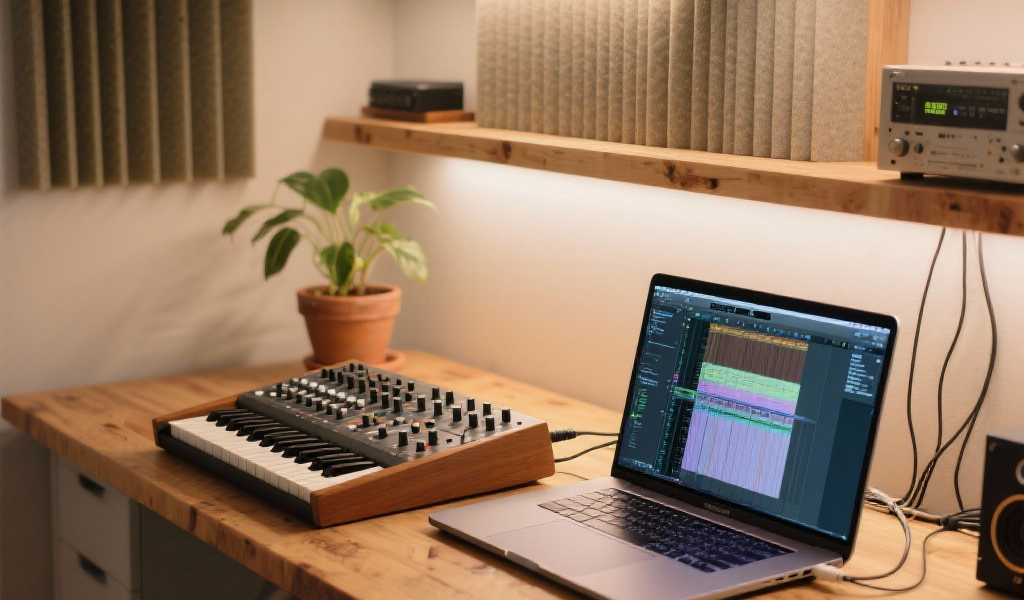
The most effective approach for contemporary music production isn’t choosing one side over the other, but creating a symbiotic relationship between analog and digital.
Maya’s Hybrid Studio Setup:
- Analog Core: A Sequential Prophet Rev2 for lush pads and a Moog Mother-32 for expressive basslines.
- Digital Powerhouse: Ableton Live, plugins like FabFilter Pro-Q 3, Valhalla DSP VintageVerb, and synths like u-he Diva and Xfer Serum.
Maya’s Workflow: A Step-by-Step for Maximum Efficiency:
- Idea Generation & Analog Foundation: Jamming on her Prophet Rev2 for an evolving pad, capturing its warmth into Ableton Live.
- Rhythm & Arrangement: Programming a beat in Ableton and arranging the track structure flexibly.
- Layering & Hybrid Sound Design: Incorporating u-he Diva for sub-bass with layered analog sounds from her Moog Mother-32.
- Processing & Automation: Applying FabFilter Pro-Q 3 and UAD Neve 1073 for mixing precision, while using Valhalla VintageVerb for effects.
- Mixing & Final Polish: Utilizing the control of her DAW for professional level mixing and mastering.
This workflow illustrates how Maya maximizes inspiration from analog while leveraging digital’s precision.
Encouraging Exploration: Your Sound, Your Choice
There’s no single “right” answer in the analog vs. digital debate. The best approach is personal, depending on your goals, budget, and style.
I advise new producers to experiment. Start with high-quality software synths that emulate analog sounds, or consider an affordable semi-modular synth to understand its character. Attending workshops or local synth meetups can provide hands-on experience and valuable insights.
The goal isn’t to amass gear, but to create music that resonates with you and your audience.
Conclusion: The Symphony of Synergy
The pros and cons of analog vs digital in music production reveal a spectrum of possibilities. Analog offers tactile connection and warmth, while digital provides precision and workflow efficiency.
True magic happens when these worlds collide, facilitating the creation of sounds that are both organic and pristine. So, what’s your take? Are you an analog purist, a digital native, or a proud architect of a hybrid studio? Share your thoughts in the comments!
FAQ
Q: Which is better for music production, analog or digital?
A: It depends on your style and workflow; both have unique strengths you can leverage.
Q: How can I integrate both analog and digital in my studio?
A: Use analog gear for foundational sounds while relying on digital tools for precision and flexibility.
Q: What should I start with as a beginner?
A: Start with high-quality software tools; consider hardware once you’re comfortable with the basics.
And remember, if synthesizers had emotions, they’d be weeping over your out-of-key notes! But hey, that’s just part of the synth jam session, right?