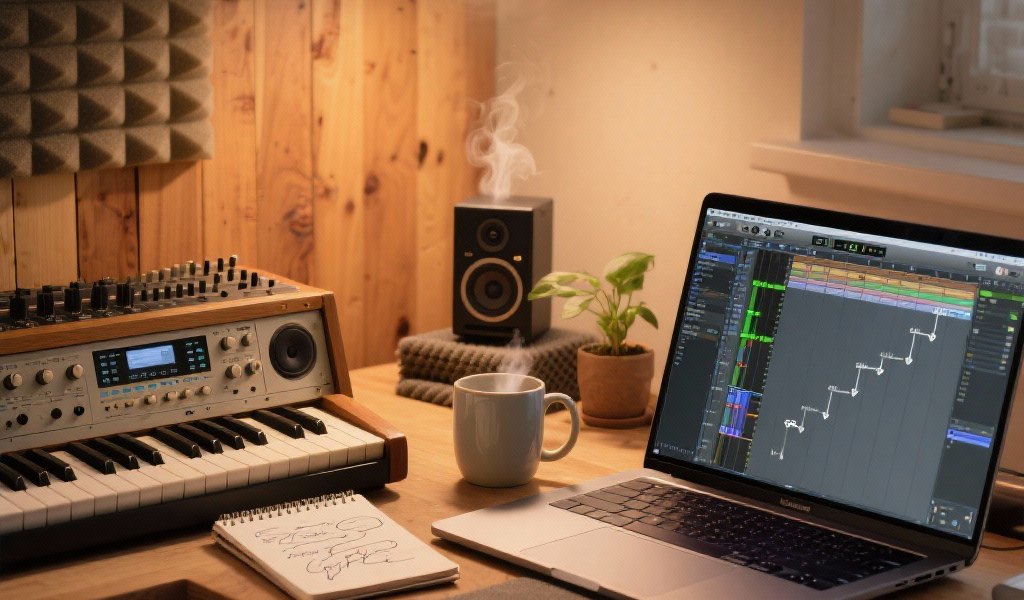
In the ongoing debate between analog and digital in music production, both worlds offer unique strengths and weaknesses. Understanding these aspects will help you expand your creative potential and make more informed decisions when producing music.
- Analog offers warmth and tactile inspiration, while digital provides precision and infinite flexibility.
- Both approaches can be integrated into a hybrid production setup for optimal results.
- Understanding the strengths and challenges of each can enhance your sound palette.
- Ultimately, creativity matters more than the type of gear you use.
Estimated Reading Time: 8 minutes
Join our newsletter to explore new insights into music production and to stay updated with Noxal’s latest content!
Table of Contents
- The Allure of Analog: Warmth, Character, and Tangible Connection
- The Digital Frontier: Precision, Power, and Infinite Possibilities
- Bridging the Gap: Where Analog Meets Digital in the Studio
- Expanding Your Sound Palette: A Step-by-Step Mixing Example
- The Ultimate Truth: Creating Matters More Than the Gear
- Conclusion: A Complementary Symphony
- FAQ Section
The Allure of Analog: Warmth, Character, and Tangible Connection
For many, the word “analog” conjures images of classic synthesizers, vintage recording consoles, and the legendary studios where iconic records were born. There’s a certain mystique, a undeniable charm that comes with these machines.
- Unique Sound Character & Warmth: Analog circuits introduce subtle harmonic distortions and non-linearities that provide a warmth and fullness that digital often struggles to replicate. Think rich basses from a Moog Minimoog or the shimmering pads from a Roland Juno-60.
- Tactile Workflow & Inspiration: The joy of physically interacting with gear fosters creativity and often leads to spontaneous discoveries.
- Investment & Collectibility: Vintage analog synthesizers can hold their value and serve as tangible pieces of music history.
- Cultural & Historical Significance: Using analog gear connects you to the legacy of music-making that defined genres.
- Cost: High-quality analog gear can be very expensive, creating a significant barrier to entry.
- Maintenance & Reliability: Older hardware may require costly maintenance and is prone to wear and tear.
- Portability & Space: A full analog setup is often bulky and challenging to transport.
- Limited Flexibility & Recall: Changing patches on analog gear is not as instantaneous as digital systems.
- Noise Floor: Analog circuits often introduce an inherent noise that can complicate pristine mixes.
The Digital Frontier: Precision, Power, and Infinite Possibilities
Digital music production has revolutionized how music is created and mixed, offering endless possibilities through digital audio workstations and versatile software plugins.
- Affordability & Accessibility: A digital studio can be established at a fraction of the cost of analog setups.
- Unparalleled Flexibility & Recall: Unlimited patch memory and instant recall allow for seamless project management.
- Pristine Sound & Advanced Sound Design: Digital systems offer clarity and capabilities for complex sound design that analog cannot match.
- Portability & Space Efficiency: The entire setup can fit in a laptop bag, allowing for production anywhere.
- Innovation & Constant Evolution: New software developments continually expand creative possibilities.
- Perceived Lack of “Warmth”: Some argue that digital sounds can be perceived as cold compared to analog.
- Workflow & “Option Paralysis”: The multitude of options can overwhelm and stifle creativity.
- Screen Fatigue & Lack of Tactility: Working solely on a screen may feel monotonous.
- CPU Demands: High-quality digital instruments can tax system resources significantly.
- Obsolescence & Compatibility: Software can become outdated, creating compatibility issues.
Bridging the Gap: Where Analog Meets Digital in the Studio
The most powerful approach often lies in combining both analog and digital elements in a hybrid studio setup. This allows producers to take advantage of the strengths offered by both types of equipment.
Imagine using a digital drum machine for precise rhythms while complementing it with a thick, analog bassline. Hybrid setups can create unique sonic signatures that blend distinct characteristics from both worlds.
Expanding Your Sound Palette: A Step-by-Step Mixing Example
Let’s put this into practice with a concrete example, focusing on a track that requires both clarity and warmth.
- Digital Drums: Tight and impactful programmed in a digital drum VST.
- Digital Bassline: Complex synth bass from a wavetable VST with emphasis on low-end precision.
- Analog Lead Synth: A recorded performance from a classic analog polysynth for an organic sound.
- Establishing the Digital Foundation:
- Drums: Use digital EQs to carve out frequencies and apply compression for punch.
- Bassline: Use high-pass filtering and multi-band compression for an even low end.
- Introducing Analog Character:
- Lead Synth: Clean unwanted noise digitally, but add warmth with analog processing.
- Blending and Enhancing:
- Accentuate Digital Drums: Route through analog-modeled saturation for warmth.
- Refine Digital Bass: Add analog-modeled compression for thickness.
- Overall Bus Processing: Use both digital limiting and analog compression for the final touch.
The Ultimate Truth: Creating Matters More Than the Gear
At Noxal, our fundamental belief is that creating matters more than the gear. While we may be gear enthusiasts, we recognize that the tools are merely a means to express and innovate.
The pioneers of music often created groundbreaking tracks with limited equipment. Ultimately, your imagination and dedication will define your output, not the gear you use.
Conclusion: A Complementary Symphony
In the debate of analog vs. digital, no single victor exists. Each has its unique offerings, and understanding them can enhance your creative process. Embrace a hybrid approach, experiment with the tools at your disposal, and forge your own sound.
FAQ Section
What is better for beginners: analog or digital?
Digital setups are generally more affordable and accessible for beginners.
Can I achieve an analog sound using digital tools?
Yes! Many digital plugins emulate analog characteristics to produce warmth.
How do I decide between analog and digital for my music production?
Consider your budget, workflow preferences, and the sound you want to achieve.
And remember, no matter what synth you’re using, always keep your cables away from the coffee! That’s a recipe for noise—unless you’re going for that “experimental glitch” sound.