At Noxal, we’re passionate about synthesizers and the evolution of electronic music tools. Discover how advancements in technology have reshaped music production, offering new sonic landscapes and empowering creators worldwide. Join us as we explore this rich narrative and delve into the tools that continue to define the music we love.
- Understanding the history of electronic music tools can enhance creativity.
- From early analog synths to modern DAWs, each era brought significant innovation.
- MIDI and digital technology revolutionized communication between instruments.
- The hybrid approach combines the benefits of hardware and software for an advanced creative process.
Estimated reading time: 10 minutes
Join our newsletter to stay updated on the evolution of electronic music tools and more exciting content from Noxal!
Table of Contents
- The Genesis: When Electricity Became Music
- The Digital Dawn: MIDI, Memory, and Monoliths
- The Software Revolution: Desktops and Democratization
- The Hybrid Horizon: A Renaissance of Hardware and Hands-On Control
- Tracing the Sonic Path: How Tools Shaped Our Techniques
- Looking Ahead: The Future is Hybrid and Limitless
- FAQ
The Genesis: When Electricity Became Music
Before MIDI, before software, and even before the notion of a “preset,” there were dedicated engineers and avant-garde composers experimenting with electricity itself as a musical medium. The early 20th century saw inventions like the Theremin and the Ondes Martenot, which, while beautiful and expressive, were often unwieldy and lacked the polyphonic and sequencing capabilities we now take for granted.
The true explosion began in the mid-20th century with the arrival of the first commercially viable synthesizers. Innovators like Robert Moog and Don Buchla, independently and almost simultaneously, laid the groundwork for what would become the cornerstone of electronic music. Their early modular systems, like the Moog Modular and Buchla Music Easel, were not just instruments; they were entire sound laboratories. Patch cables, oscillators, filters, and envelopes were all separate components that artists like Wendy Carlos (with her seminal “Switched-On Bach”) painstakingly interconnected to craft entirely new sounds.
The Digital Dawn: MIDI, Memory, and Monoliths
The late 1970s and early 1980s heralded a new era: digital synthesis and the standardization of communication. While analog synths continued to evolve, digital technology offered new sonic textures, greater stability, and crucially, memory. The ability to save and recall sounds transformed live performance and studio workflow.
Then came MIDI (Musical Instrument Digital Interface) in 1983. This wasn’t a sound tool itself, but a universal language that allowed different pieces of electronic musical equipment to communicate with each other. It was a game-changer, enabling complex setups where a single keyboard could control multiple sound modules, sequencers, and drum machines.
The Software Revolution: Desktops and Democratization
The late 1990s and early 2000s ushered in the era of the Digital Audio Workstation (DAW) and software synthesizers (VSTs). Suddenly, a powerful computer could host an entire studio – multiple virtual instruments, effects, and mixing capabilities – all for a fraction of the cost of their hardware counterparts. This was the true democratization of music production.
DAWs like Ableton Live, Logic Pro, Cubase, and FL Studio became the nerve centers of countless productions. They integrated sequencing, recording, mixing, and mastering into a seamless environment, revolutionizing workflow and enabling incredibly intricate arrangements.
The Hybrid Horizon: A Renaissance of Hardware and Hands-On Control
While software offered unparalleled flexibility, a counter-movement began to emerge. Many producers found themselves yearning for the tactile experience of hardware – the physical knobs, sliders, and patch cables that offered a more immediate, hands-on connection to sound. This led to a hardware renaissance, with modular synthesis experiencing a massive resurgence.
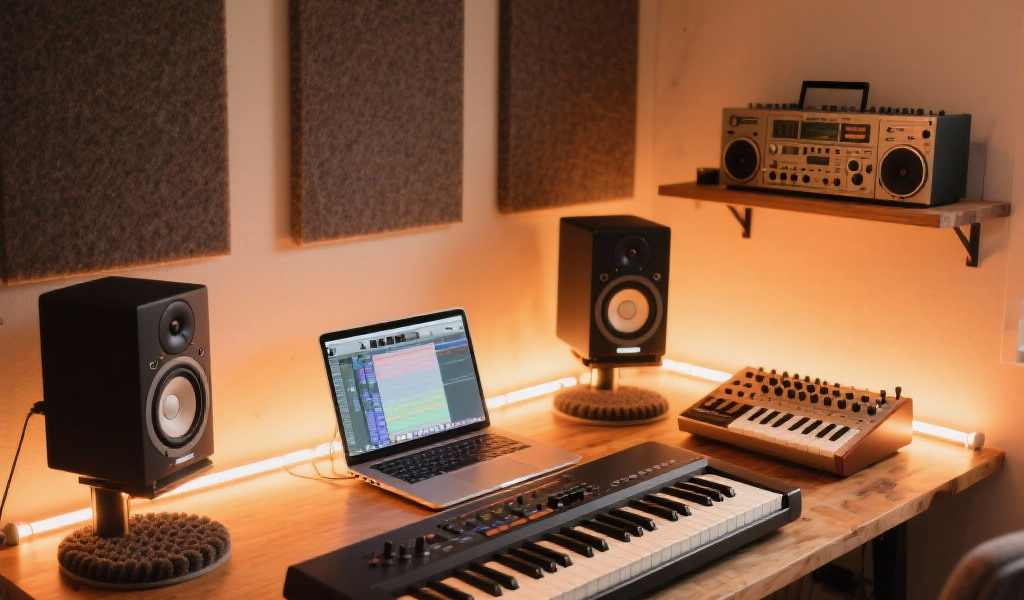
Today, the most common and arguably most powerful setup is a hybrid one. Producers leverage the power and convenience of DAWs for arrangement, mixing, and digital effects, while integrating hardware synths, drum machines, and effects pedals for their unique sonic character and inspirational workflow.
Tracing the Sonic Path: How Tools Shaped Our Techniques
The evolution of electronic music tools hasn’t just given us new sounds; it’s given us entirely new ways of thinking about sound and composition. Here’s a quick-tip list of how these tools have shaped key production techniques:
1. Master the Analog Core – The Power of ADSR & Filters
Key Technical Detail: The ADSR (Attack, Decay, Sustain, Release) envelope and resonant filters are the foundational building blocks of subtractive synthesis.
Evolution Link: These elements, initially physical components, were the first ways musicians learned to sculpt sound dynamically.
Practical Takeaway: Spend time with a simple subtractive synth (hardware or software) and experiment solely with the ADSR and filter.
2. Embrace the Digital Edge – FM Synthesis and Beyond
Key Technical Detail: FM synthesis generates complex waveforms by using one oscillator to alter the frequency of another.
Practical Takeaway: Dive into FM synths and explore how different algorithms generate unique timbres.
3. The Art of Repurposing – Sampling and Granular Synthesis
Key Technical Detail: Sampling involves recording audio and manipulating it – chopping, looping, pitch-shifting.
Practical Takeaway: Don’t be afraid to sample anything! Load sounds into a sampler and experiment creatively.
4. Modulation Nation – Pushing Beyond the Obvious
Key Technical Detail: Modulation refers to using one parameter to control another, offering vast modulation possibilities.
Practical Takeaway: Don’t just set parameters statically; assign modulation to create dynamic, evolving sounds.
Looking Ahead: The Future is Hybrid and Limitless
What does the future hold? Likely a continued blend of the best aspects of hardware and software. We’ll see increasingly powerful standalone devices, deeper integration between physical and virtual studios, and new paradigms in synthesis.
But no matter how advanced the tools become, the core principles of sound design and human expression will always remain at the heart of electronic music production.
FAQ
Q: How can I learn more about synthesis?
A: Exploring vintage synthesizers, reading books, and joining forums can provide valuable insights.
Q: What software should I consider as a beginner?
A: Software like Ableton Live Lite, GarageBand, or FL Studio is accessible and user-friendly for beginners.
So, as you dust off those old synths or fire up a new VST, remember: in the world of electronic music, there are no mistakes, only deliciously unexpected detours that lead to creative breakthroughs. Happy producing, and may your waveform always be in the syncopated groove!