TL;DR: Novation has officially announced the Launchkey Mk4 White editions for the 49-key and Mini 37 models at Superbooth 25, bringing a crisp white-and-grey aesthetic to their popular MIDI controller lineup. The standard Launchkey Mk4 series itself dropped in August 2024 with redesigned hardware, polyphonic aftertouch pads, multi-DAW support, and a generative arpeggiator — a significant overhaul that goes well beyond a simple paint job.
- The Launchkey 49 Mk4 White (€259) and Launchkey Mini 37 White (€219) are confirmed; no word yet on white versions of the 61-key or other sizes.
- The Mk4 generation introduced semi-weighted, piano-style keys on the 49 and 61 models, plus FSR pads with polyphonic aftertouch across the entire lineup.
- For the first time, Launchkey controllers now include custom scripts for Logic Pro, Cubase, Reason, and FL Studio, not just Ableton Live.
- A new step editor for the generative arpeggiator and 22 additional scale modes (30 total) make this a serious tool for melodic exploration.
- All Mk4 models feature high-resolution OLED displays — even the Mini variants, which previously had none.
Reading time: 5 min
Want more synth news before your next coffee break? Join the Noxal newsletter — no spam, just gear worth knowing about.

White on White: A New Coat for the Launchkey
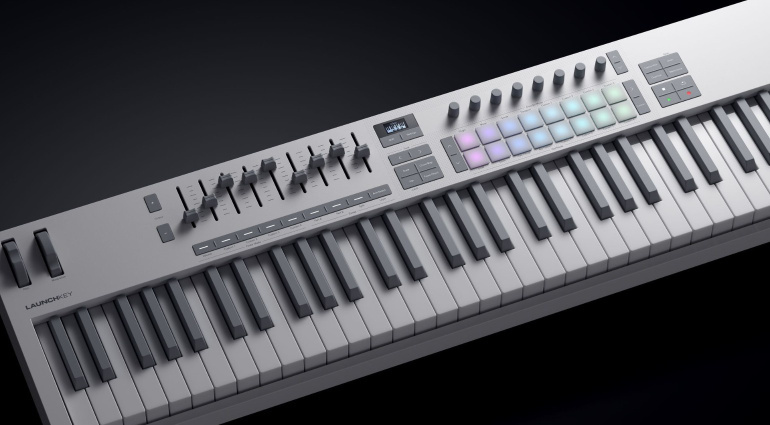
At Superbooth 25, Novation did what Novation does best: they took a perfectly capable piece of hardware and asked, “What if it was white?” The answer is the Launchkey Mk4 White — a limited-edition colourway for the 49-key and Mini 37 variants. We at Noxal are not entirely sure the world needed another white controller, but then again, we said the same about the third espresso of the morning, and here we are.
The white-and-grey finish is undeniably clean. It’s the kind of look that says, “I have my studio lighting figured out,” even if you’re hunched over a desk in your bedroom at 2 AM. The Launchkey 49 Mk4 White will set you back €259, while the Mini 37 White rings in at €219 — both available via Thomann as of the announcement. Whether Novation plans to extend this treatment to the 61-key or 37-key full-size models remains a mystery, and we’re not holding our breath. But if you’ve been eyeing a Launchkey and your aesthetic leans more “minimalist Scandinavian” than “gamer RGB,” this might be your moment.
Inside the Mk4 Generation: More Than a Facelift
Let’s not kid ourselves — the white paint is the headline, but the real story here is the Launchkey Mk4 platform itself, which debuted in August 2024. We at Noxal have spent enough time with previous generations to appreciate when a company actually listens. Novation’s fourth-generation overhaul is not a “slap a new logo on it” affair. It’s a ground-up rethinking of what a MIDI controller should be in 2025.
The hardware has been completely redesigned. The 49 and 61-key models now feature semi-weighted, piano-style keys with a new mechanism that Novation claims offers smoother, more sensitive response. I’ve played enough plasticky controllers to be skeptical of such claims, but early hands-on reports suggest the keybed genuinely feels better — less spongy, more articulate. The pads and encoders have been moved to the right side on the larger units, with faders on the left. This seems like a small thing, but it suggests Novation observed that most users reach for pads with their dominant hand. Good observational design, that.
Speaking of pads: FSR (Force Sensitive Resistor) technology now underpins all pads across the lineup, and they support polyphonic aftertouch. For anyone who’s ever wanted to press a pad harder to modulate a filter while leaving others untouched, this is a big deal. The pads are also velocity-sensitive in a way that feels more like a real instrument than a trigger button.
Key Specs and the Things That Matter
Let’s talk specs, but we promise to keep it interesting. All Mk4 models — including the Mini variants — now boast high-resolution OLED displays. Yes, the Minis get a screen for the first time. This is not just a “nice to have”; it means you can actually see what scale you’re in, what chord mode is active, or what your arpeggiator is doing without squinting at a three-character LED.
The arpeggiator itself has been upgraded to a generative model with a step editor. You can now edit arpeggio patterns directly on the pads, which turns the Launchkey into a surprisingly capable sequencing tool. Combined with 30 scale modes (up from 8) and three new chord modes — Chord Map, User Chord, and Fixed Chord — plus a Chord Detector that identifies chords as you play, this controller is clearly aimed at both producers and performers who want to get out of the mouse-and-keyboard loop.
Perhaps the most significant shift is multi-DAW support. The Launchkey has long been the unofficial sidekick of Ableton Live, but Mk4 includes custom scripts for Logic Pro, Cubase, Reason, and FL Studio out of the box. Pro Tools, Reaper, and Studio One are supported via HUI protocol, with more scripts promised. This opens the door for users who aren’t married to Ableton — and frankly, it’s about time.
The software bundle is generous: Ableton Live 12 Lite, GForce Oberheim SEM and OB-EZ, AXXESS, plus Klevgrand effects and an Orchestral Tools orchestra bundle. That alone justifies a chunk of the price tag for anyone starting out.
Market Context and Who Should Care
The MIDI controller market is crowded, and we at Noxal have seen more than our share of plastic that promises the world but delivers only frustration. The Launchkey Mk4 sits in a sweet spot: it’s affordable enough for beginners (€219 for the Mini 37 White) yet feature-rich enough for seasoned producers who need something portable or a secondary controller.
Compared to competitors like the Arturia KeyLab Essential or the Native Instruments Komplete Kontrol series, the Launchkey Mk4 offers better integration with Ableton (obviously) and now broader DAW support. The FSR pads with polyphonic aftertouch are a genuine differentiator — most controllers at this price point still use rubber pads that feel like marshmallows after six months. The addition of layers and zones on the 49 and 61-key models also makes these viable for live performance, where splitting the keyboard for bass and lead duties is standard practice.
Who is this for? If you’re an Ableton user who wants deep integration without spending €600 on a Push, the Launchkey Mk4 is a no-brainer. If you use Logic or Cubase and have been eyeing Novation’s ecosystem, the Mk4 finally extends a hand. And if you just want a white keyboard that looks good on Instagram, well, the Mk4 White has you covered there too.
Frequently Asked Questions
Do the white editions have different internal hardware than the standard Launchkey Mk4?
No. The white editions are purely a cosmetic variant. All internal components, keybed mechanisms, pads, and connectivity remain identical to the standard Launchkey Mk4 models. You are paying a slight premium for the colourway, not for upgraded specs.
Can I use the Launchkey Mk4 with DAWs other than Ableton Live?
Yes, and this is a major upgrade from previous generations. The Mk4 includes custom scripts for Logic Pro, Cubase, Reason, and FL Studio out of the box. It also supports Pro Tools, Reaper, and Studio One via the HUI protocol. Novation has promised additional scripts in future updates.
Is the Launchkey Mk4 compatible with iOS or iPadOS?
Yes. The Launchkey Mk4 is class-compliant, meaning it works with iPad and iPhone via a USB-C connection (or USB-A with an adapter). However, the deep DAW integration features — such as the step sequencer and chord modes — may not be fully functional in all iOS DAWs. We recommend checking Novation’s compatibility chart for your specific app.
I’m going to go make a pour-over and stare at the white Launchkey on my desk, wondering if I really need another controller. The answer, as always, is yes — but I’ll pretend to deliberate for at least a few minutes first.