TL;DR: After four years of silence and a name change from “Model D Soul” to “D Mini,” Behringer has finally shown its tiny Minimoog-style analog synth at NAMM 2026. It packs three oscillators, a sequencer, and that iconic ladder filter into a Volca-sized chassis for just €99 — and it’s available to order now.
- The Behringer D Mini is a compact, three-oscillator analog monosynth inspired by the Minimoog Model D, now shipping for €99.
- It features a built-in sequencer, a voice mode knob (poly, unison, octave, fifths, ring, ring poly), and an octave footage dial from 32′ to 1′.
- Originally announced in 2022 as the “Model D Soul,” it reappeared at NAMM 2026 with a new name and differently colored keys.
- All three oscillators share a single waveform control, and there’s no dedicated detune knob — a compromise for the price and size.
- The D Mini is part of Behringer’s growing “Mini” line, joining the JT Mini and others, aimed at budget-conscious synth enthusiasts and portable jamming.
Reading time: 3 min
Want more synth news before your next coffee break? Join the Noxal newsletter — no spam, just gear worth knowing about.

What Is the D Mini?
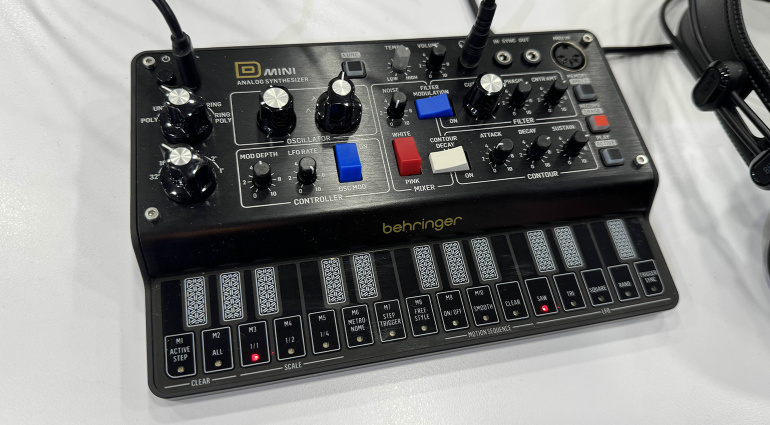
Behringer’s D Mini is exactly what it sounds like: a miniature version of their Model D, which itself is a clone of the legendary Minimoog Model D. But while the Model D is a full-sized desktop unit, the D Mini shrinks everything down to a footprint that’s barely larger than a Volca. It’s been a long time coming — we first heard about it back in 2022 under the name “Model D Soul,” and then… crickets. Until now.
At NAMM 2026, Behringer finally showed the D Mini in the flesh, and it’s now available to order at retailers like Thomann for €99. That’s a price point that makes you do a double-take, especially when you remember that a real Minimoog costs more than most used cars. The D Mini keeps the core analog soul — three oscillators, the iconic 24 dB/octave low-pass filter, and a built-in sequencer — but squeezes it into a box you could fit in a coat pocket.
What Makes It Interesting?
Let’s be honest: Behringer’s clone strategy isn’t new. They’ve been churning out affordable takes on classic synths for years, from the Model D to the MonoPoly and beyond. But the D Mini feels different. It’s not just a cheaper version of something expensive — it’s a fundamentally different form factor that changes how you interact with the instrument.
The D Mini is designed for portability and immediacy. It has a built-in sequencer, a voice mode knob that lets you switch between poly, unison, octave, fifths, ring, and ring poly modes, and an octave footage dial that goes from a deep 32′ all the way up to a dog-bothering 1′. That means you can get everything from sub-bass growls to piercing leads without touching a menu. It’s the kind of synth you keep on your desk for quick ideas, or throw in a backpack for a jam session.
Also worth noting: the D Mini uses differently colored keys compared to the original Model D Soul concept, aligning it visually with the rest of Behringer’s “Mini” line. It’s a small detail, but it signals that this isn’t just a one-off — it’s part of a family of tiny, affordable synths that includes the JT Mini and likely more to come.
Key Specs and Compromises
The D Mini’s specs are mostly what you’d expect from a Minimoog-style synth: three analog oscillators, a ladder filter, a sequencer, and a straightforward control layout. But there are some notable compromises that come with the price and size.
First, all three oscillators share a single waveform control. You can’t set each oscillator to a different waveform — they’re all locked to the same shape. That’s a significant limitation if you’re used to the full Model D’s flexibility. Second, there’s no dedicated detune knob. Detuning oscillators is a classic way to get that fat, chorused sound, and its absence here is a real head-scratcher. You can probably fake it with the voice modes, but it’s not the same.
On the plus side, the voice mode knob offers some clever workarounds. Setting it to “fifths” or “ring” can create interesting harmonic textures, and the “poly” mode lets you play chords across the three octaves. It’s not true polyphony — there’s still only one filter and envelope — but it’s a fun way to expand the sonic palette. The octave footage dial is also a nice touch, letting you jump between register quickly without needing an external controller.
Market Context and Who It’s For
The D Mini enters a crowded field of budget monosynths. Korg’s Volca series has dominated this space for years, and Behringer’s own Model D (the full-sized one) has been a staple since 2018. So why does the D Mini exist? Because it fills a specific niche: it’s a Minimoog-style synth that’s small enough to forget about until you need it.
One reader on the source article put it well: “How often do you get a Minimoog or clone out to use in a tune? It’s not every tune, is it? This little one can probably sit in the drawer or on the desk until needed.” That’s the D Mini’s raison d’être. It’s not meant to replace your main synth — it’s meant to be there when inspiration strikes, without taking up space or costing a fortune.
Who should buy it? Beginners who want an affordable entry into analog synthesis. Busy producers who need a quick sketchpad for basslines and leads. And anyone who’s ever thought “I’d love a Minimoog, but I don’t have €3,000 or the space for it.” The D Mini isn’t perfect — the shared waveform control and lack of detune are real limitations — but at €99, it’s hard to argue with the value proposition.
Frequently Asked Questions
Can the Behringer D Mini play chords?
Not in the traditional sense. The D Mini is a monosynth with a single filter and envelope, but it has a voice mode knob that offers settings like “poly,” “unison,” “octave,” “fifths,” “ring,” and “ring poly.” In poly mode, you can play multiple notes across the three octaves, but they share the same filter and envelope settings. It’s more of a paraphonic mode than true polyphony.
Does the D Mini have a detune function?
No, there’s no dedicated detune knob on the D Mini. All three oscillators share a single waveform control, and you can’t detune them independently. Some users might be able to achieve a similar effect using the voice modes, but it’s not a direct substitute. This is one of the main compromises compared to the full-sized Model D.
Is the D Mini the same as the Model D Soul?
Yes, it appears to be essentially the same synth, just with a new name and differently colored keys. The Model D Soul was announced in 2022 but never released. The D Mini showed up at NAMM 2026 with the same specs and form factor, so it’s likely a rebranding to align with Behringer’s “Mini” line (which includes the JT Mini).
I’m already eyeing a spot for it on my desk — right between the coffee mug and the pile of half-finished tracks. At €99, it might just be the most affordable gateway to Moog-style bass I’ve ever seen. Now if only it came with a built-in espresso machine.