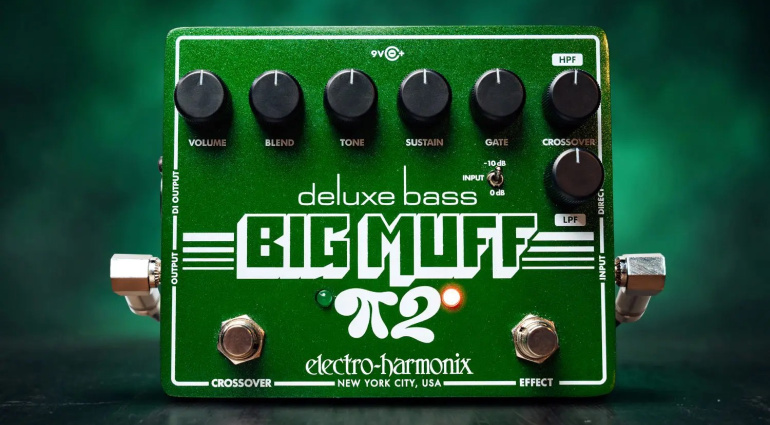
TL;DR: Electro-Harmonix has unleashed the Deluxe Bass Big Muff Pi 2, a bass-focused fuzz pedal built on the long-lost dual-op-amp Big Muff 2 circuit rediscovered from a shed. It adds a Blend control, footswitchable crossover section, noise gate, XLR DI output, and momentary switching, all for €179. Bass players who want more than a one-trick fuzz now have a serious sculpting tool.
- Built on the revived Big Muff 2 circuit (dual-op-amp design from the 1970s by Bob Myer and Mike Matthews), now in a deluxe bass format.
- New Blend control lets you mix clean signal with fuzz to preserve low-end attack and definition — crucial for bass.
- Footswitchable Crossover section with independent HPF and LPF cutoff controls lets you toggle between tight modern distortion and massive, room-shaking fuzz.
- Includes built-in noise gate, -10dB input pad for active basses, XLR DI output, and buffered direct out for studio/live flexibility.
- Latching and momentary switching modes allow standard on/off or quick stabs of fuzz — ideal for dramatic drops in a set.
Reading time: 4 min
Want more synth news before your next coffee break? Join the Noxal newsletter — no spam, just gear worth knowing about.

The Legendary Circuit Rises Again
We at Noxal have a soft spot for a good resurrection story. When Josh Scott and Daniel Danger pulled a long-lost dual-op-amp Big Muff 2 circuit from a shed last year, it felt like discovering a forgotten master tape under a pile of coffee filters. The standard edition and bass version have already hit the streets, and now EHX has aimed its sights squarely at the low-end faithful.
The Deluxe Bass Big Muff Pi 2 is not just another reissue. It’s a bass-specific evolution of a circuit that was originally created in the 1970s by Bob Myer and Mike Matthews. The core is that dual-op-amp topology — a sound that’s been called “more aggressive and articulate” than the classic four-transistor Muff. For bass players who’ve always felt the standard Big Muff swallowed their low-end like a hungry carpet, this revision promises something more surgical.
I’ll admit: when I first heard about the Big Muff 2 revival, I poured myself an extra espresso and braced for nostalgia-bait. But EHX has been smart. They haven’t just dusted off old schematics; they’ve added features that actually matter for modern players. The Deluxe Bass version is the most thoughtful iteration yet.
What Makes This Bass Fuzz Different
The controls are where this pedal earns its “Deluxe” badge. You get the classic Volume, Tone, and Sustain knobs — sure, that’s the DNA. But then EHX throws in a Blend control, which is the secret weapon for bassists who want fuzz without losing their note attack. You can mix in just enough clean signal to keep your low-end punchy while the fuzz does its thing.
This is not a subtle point. If you’ve ever played a bass through a traditional Big Muff, you know the struggle: you turn it on, and suddenly your low-end becomes a mushy, indistinct roar. The Blend control lets you dial back the fuzz’s dominance, keeping your root notes defined. It’s like having a fuzz that actually respects your bass’s integrity — and that’s rare.
There’s also a -10dB Input Pad for active basses, which is a welcome addition. Active pickups can overload a fuzz pedal’s input stage, turning your carefully sculpted tone into digital clipping hell. This pad gives you headroom to breathe. And for the noise-phobic among us, a built-in noise gate keeps the hiss in check when you’re not playing. It’s the little things, really.
Crossover Sculpting, Noise Gate, and DI Magic
The headline feature is the footswitchable Crossover section. This splits your bass signal into two paths — a High-Pass Filter and a Low-Pass Filter — each with its own cutoff control. Stomp the switch, and you can toggle between a tight, modern distortion (think tech-death precision) and a massive, wall-of-fuzz tone that will shake the stage floor.
This is not just a gimmick. In practice, it means you can have a verse tone that’s lean and aggressive, then stomp into a chorus that’s pure low-end chaos. The HPF and LPF controls are independent, so you can dial in exactly how much of each frequency band gets fuzzed. For bass players who rely on dynamics and clarity, this is a game-changer.
Then there’s the connectivity. The XLR DI Output is a godsend for live players who want to send a clean, balanced signal to the front of house while running their amp. The Buffered Direct Out lets you split your signal for dual-amp setups — send one clean, one fuzzed — without tone suck. And the latching/momentary switching means you can either latch the effect on/off normally or hold your foot down for a quick burst of fuzz, like a punctuation mark in your riff. It’s the kind of thoughtful design that makes me want to buy the pedal just to have it on my board for the momentary switch alone.
Market Context and Who Should Care
At €179, the Deluxe Bass Big Muff Pi 2 sits in the sweet spot of the bass fuzz market. It’s not cheap enough to be an impulse buy, but it’s far less than boutique alternatives like the Darkglass Hyper Luminal or the JHS Colour Box. For bass players who’ve been using a standard Big Muff and wishing for more control, this is a direct upgrade. For studio engineers who need a flexible fuzz that can go from clean-ish to catastrophic, this is a no-brainer.
We at Noxal have seen the Big Muff 2 circuit spawn a small ecosystem — the standard edition, the Tone Wicker version, the JHS limited run — and this Deluxe Bass model feels like the most complete package. It’s not just a fuzz pedal; it’s a signal-routing and tone-sculpting tool that happens to fuzz. If you’re a bassist who plays stoner rock, doom, post-punk, or even modern metal, you should pay attention.
Is it perfect? I haven’t heard it in person yet, so I’m reserving final judgment. But on paper, it’s the most thoughtful bass fuzz EHX has released in years. And if the sound matches the spec sheet, it will be a staple on boards from here to Oslo.
Frequently Asked Questions
Does the Deluxe Bass Big Muff Pi 2 work with passive basses?
Yes, absolutely. The -10dB Input Pad is specifically for active basses to avoid clipping, but passive basses will work fine without engaging the pad. The Blend control is especially useful for passive basses to retain low-end punch.
Can I use the XLR DI output for recording directly into an interface?
Yes, the XLR DI Output is balanced and designed to send a signal to mixing desks or audio interfaces. It’s a clean output, so you can record the fuzz effect directly or use it as a split for re-amping later.
How does the Crossover section work in practice?
The Crossover section splits your signal into high-pass and low-pass paths, each with its own cutoff control. You can stomp the footswitch to toggle between the two settings. For example, set the HPF for a tight, cutting distortion and the LPF for a massive, sub-heavy fuzz, then switch between them during a song.
Now if you’ll excuse me, I need to find a shed of my own — apparently, that’s where all the good circuits are hiding. I’ll bring coffee.